Bitcoin vs Stablecoins: Giacomo Zucco on Bitcoin’s Dollar Problem and RGB
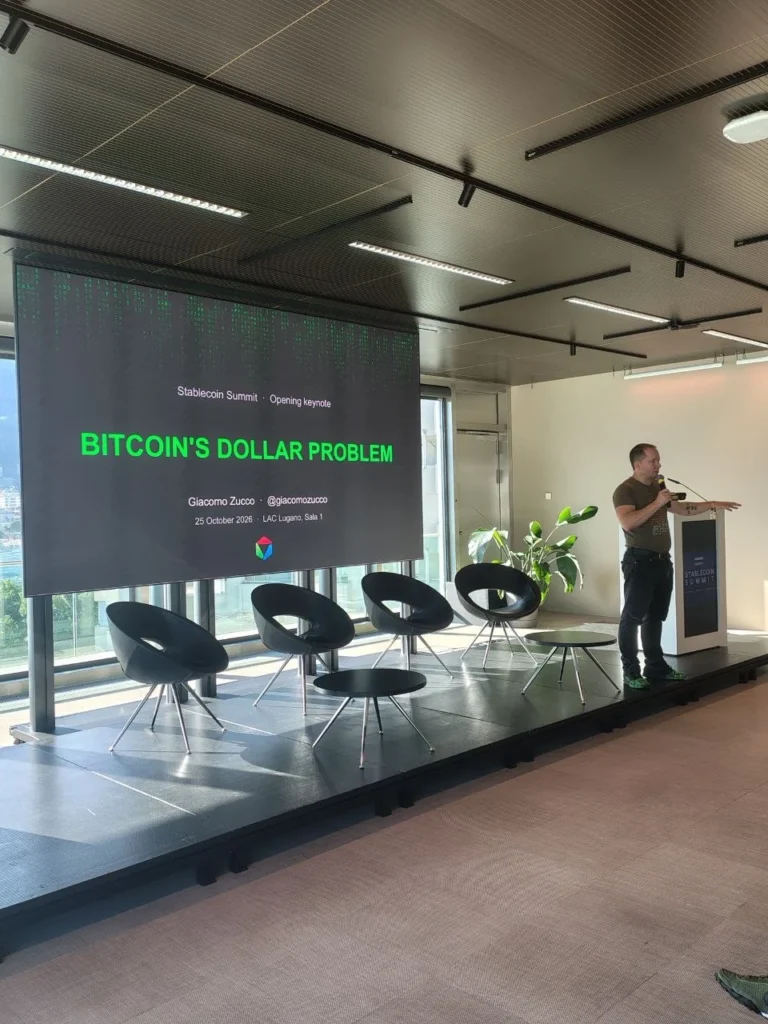
At the Stablecoin Summit in Lugano, hosted by RGB Protocol Association on October 25th, 2026, Giacomo Zucco, Vice President of the Plan ₿ Foundation and co-founder of the Association, opened the day with the keynote “Bitcoin’s Dollar Problem”. He looked at bitcoin vs stablecoins in everyday use cases and explained why issuers choose blockchains and why RGB Protocol on Bitcoin fits a future of many Bitcoin layers.
Watch the full keynote in the video below, with subtitles in English and Chinese.
In Brief
- Bitcoin’s dollar problem: many past Bitcoin use cases, from remittances to merchant payments, now run on dollar stablecoins
- Short-term stability: businesses and individuals without a long savings horizon need protection from bitcoin volatility
- Regulatory arbitrage: a regulated primary market and a freer secondary market on a blockchain
- The long term: in a hyperbitcoinized world, Bitcoin infrastructure plays the role of the internet for local networks
- RGB across security models: one asset protocol for on-chain transactions, Lightning channels, and other Bitcoin layers
Bitcoin vs Stablecoins: Bitcoin’s Dollar Problem
Giacomo started from a fact: many use cases once expected to drive Bitcoin adoption now happen in USDT, to a lesser degree in USDC, and to an even lesser degree in other stablecoins. For example, in 2016 and 2017, people in Venezuela used bitcoin for remittances, capital flight, and some payments, and businesses such as Overstock accepted bitcoin for e-commerce. Today, however, most of those flows move through stablecoins.
Lugano can be considered a local example. In fact, close to 400 merchants in the city accept bitcoin, but most of them convert to fiat right away, and bitcoin volumes in the city stay one order of magnitude below those of LVGA, the local Swiss franc stablecoin with a cashback mechanism.
According to Giacomo, better wallets or faster payments alone cannot close the gap. Indeed, the same monetary properties that make bitcoin attractive as a store of value make it a poor choice for spending: with two currencies at hand, people spend the weaker one first and keep the stronger one. Overall, bitcoin as a store of value has done better than he expected in 2013, while bitcoin as a medium of exchange has done worse, partly because of competition from stablecoins.
Why Assets Other Than Bitcoin
Giacomo recalled the first presentation of RGB, at the Building on Bitcoin conference in Lisbon on July 4th, 2018, where most of the talk went into the theory of assets on Bitcoin. The questions from 2018 remain the same today:
- Why use assets other than bitcoin?
- Why put them on a blockchain?
- Why on RGB specifically?
Above all, his answer is short-term stability. Over the years, bitcoin protects savings from the debasement of the dollar and of many local currencies. Over a few weeks or months, however, its price can still swing a lot. As Giacomo put it:
“It’s not a get-rich-quick scheme, but it is a don’t-get-poor-slowly scheme.”
Giacomo Zucco
To illustrate the point, Giacomo gave the example of a company he opened in Lugano: with a capital of 100,000 francs in bitcoin, the regulator would have asked for 130,000 because of volatility, against 100,000 in USDT. For a company that receives money and pays contractors the next month, a 30% drop is a real problem. On the contrary, for an individual with a multi-year buffer, volatility works in their favor. For most people, transferring dollar-backed digital assets is also far simpler than holding bitcoin and shorting it with futures.
As for the long term, Giacomo expects bitcoin to look more stable mainly by comparison, in case of a crisis of the dollar, rather than through lower volatility alone. Even then, tracking other assets keeps a role: commodities, markets, stocks, bonds, and derivatives still exist on a Bitcoin standard, and some people want exposure to their price movements.
Why on a Blockchain: Regulatory Arbitrage
If a centralized issuer redeems the tokens anyway, a database such as SQLite could prevent double spending without miners or a decentralized network. Therefore, the choice of blockchains needs another explanation, and Giacomo found it in regulatory arbitrage.
A payment company like PayPal or Satispay, with dollar or euro credits in its own database, must apply KYC and AML, handle disputes and chargebacks, and collect data on its users, with risks for their privacy and security. With a blockchain, on the other hand, the primary market stays regulated: the issuer applies KYC and AML at issuance and redemption. The secondary market, however, where users transfer the tokens among themselves, runs on infrastructure outside the issuer’s control, and the issuer can at most blacklist specific addresses.
According to Giacomo, the arbitrage can last a long time, possibly ten years, yet it remains unstable, since a government can always order an issuer to stop. In the short term, he added, the arbitrage doesn’t need real decentralization, only its appearance, which is why chains such as Tron or Polygon work just as well for the purpose. Tokenized shares are now following the same path, but they reach the window of opportunity later.
Still, in the short term, the clear advantage of a native Bitcoin protocol lies in trustless swaps between these tokens and bitcoin.
The Long Term: the Internet and the Mainframe
Then, for the long term, Giacomo used a metaphor. In 1996, a company that needed a closed internal network used a mainframe: the internet had just been commercialized, and building closure and control on top of a global network made no sense. In 2026, by contrast, the same company uses the internet and builds only the last mile, such as a company portal, because the internet already provides key distribution, software libraries, hardware, cables, and user habits.
Similarly, in a hyperbitcoinized world, Giacomo sees the same logic for Bitcoin. People spend bitcoin once they hold it in full and have no fiat left, and at that point everyone already has a Bitcoin wallet, Bitcoin addresses, and familiarity with Bitcoin software. As a result, a company issuing shares, or a city such as Lugano with its own local tokens, would reuse the Bitcoin infrastructure instead of a separate database or another chain. In short, for Giacomo, Bitcoin is one option among many for stablecoins in the short term, and the natural choice in such a world.
The Original Vision of RGB
Giacomo went back to the origins of RGB. The starting point was client-side validation, an idea by Peter Todd to improve Bitcoin privacy and scalability.
Client-side validation, however, raises two challenges for user experience:
- The first concerns backups, since a seed phrase alone is no longer enough.
- The second is the need to stay online for every incoming payment.
Lightning channels face the very same challenges, so the idea behind RGB was to bring client-side validation to Lightning channels and build on the work Lightning developers had already done on user experience.
Lightning as a Network of Security Models
At first, the Lightning Network was a network of bilateral channels, and every payment moved through a chain of atomic swaps between peers. Giacomo still considers the design a success: in Lugano, Lightning payments go through most of the time, privacy is good, and the network can grow to millions of users, a scale out of reach for any blockchain. Over time, though, Lightning ran into user experience challenges and some scalability bottlenecks, and new solutions appeared, each with its own security trade-offs.
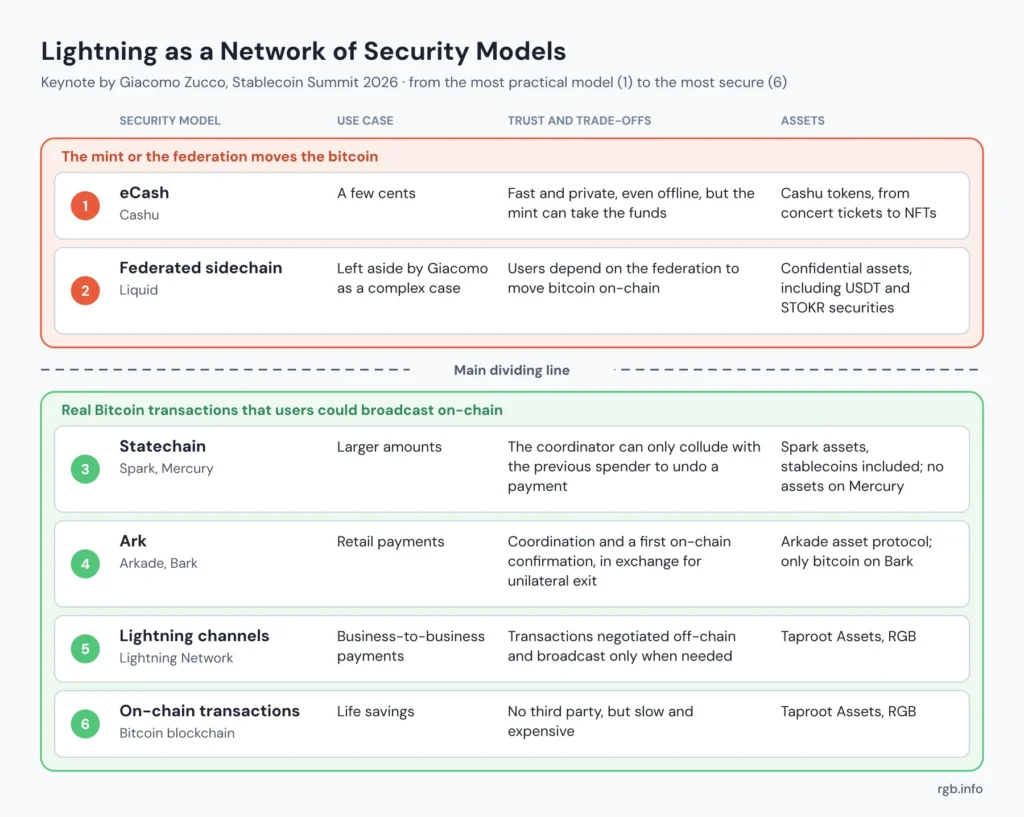
For a couple of years, Giacomo has therefore looked at the Lightning Network as more than a network of channels. In his view, Lightning is a single network for invoices, swaps, and routing that connects different security models, each suited to a different amount of money.
Around the same time, Giacomo and other builders noticed that almost every one of these models had its own asset standard. The diagram below sums up his chart, from the most practical model to the most secure one. The last column comes from the Q&A, where Giacomo explained the main dividing line of the chart: with eCash and Liquid, users depend on the mint or on the federation, while from statechains onward, every step is a real Bitcoin transaction that users could broadcast on-chain.
RGB as a Cross-Security-Model Asset Protocol
According to Giacomo, the structure of RGB fits all of these security models. RGB already works on-chain and on Lightning channels, and he mentioned the work of KaleidoSwap on RGB on Liquid, a proof of concept on regtest with an atomic swap between Bitcoin and Liquid. In his final vision, atomic swaps connect RGB assets across every security model, from Liquid to on-chain transactions and Lightning channels.
Later, in the Q&A, asked which wallets cover more than one box of the chart, Giacomo answered that most asset protocols live in a single security model, while RGB has covered two from the start, on-chain transactions and Lightning channels.
Open Questions: Stable Channels and RGBTC
Giacomo showed one last slide with two open points, both still unresolved for him.
The first point concerns stable channels, a different path to price stability. Until then, the keynote had focused on a centralized issuer: the issuer creates the asset on RGB, users move it freely, and the issuer then handles the redemption. Stable channels, instead, use bitcoin as collateral and an oracle to track the dollar price. Giacomo gave the example of a Lightning channel of one bitcoin, where each party puts in half. If bitcoin loses 50% of its value, the party who wants dollar stability takes the whole channel. If bitcoin doubles, the same party takes only 0.25 bitcoin, and the rest goes to the other party. In practice, one party sells the volatility risk to the other.
According to Giacomo, the model doesn’t remove centralization, but reduces it a lot. The oracle is neither issuer nor redeemer and has no bank account or treasury. It is only a trusted machine that publishes prices, possibly a simple Tor server, so it could be made quite resistant to regulation. However, overcollateralization is always inefficient from an economic point of view, and every deal has a breaking point in the bitcoin price.
The second point is RGBTC, and it goes back to the very origin of RGB. At the beginning, Giacomo wanted RGB for bitcoin itself rather than for other assets, because his goal was to bring client-side validation to bitcoin. RGBTC would move bitcoin to RGB through bridges based on BitVM, BABE, or other advanced cryptography tools.
Conclusion: a Message to Bitcoiners and to the Fiat World
In his conclusion, Giacomo invited Bitcoin maximalists to face the reality of stablecoins, since they are a rational response of the market to an arbitrage opportunity and deserve serious analysis.
To people from the fiat side, he explained that any blockchain can serve a short-term arbitrage, while long-term use of Bitcoin infrastructure means building on the open, neutral, global standard, just as companies build their websites on the public internet instead of a private network of their own.
Our Take: the Keynote and RGB Today
Two points of the keynote connect directly with RGB on mainnet today.
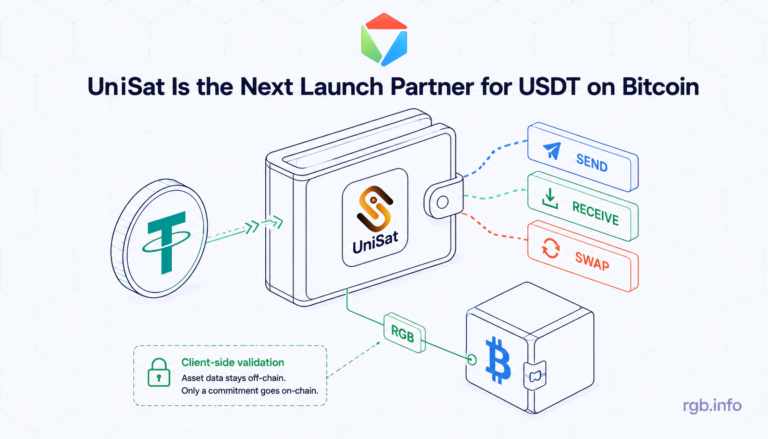
The first concerns the secondary market. In Giacomo’s analysis, the value of a blockchain for stablecoins is in the transfers outside the issuer’s database. With RGB, transfers also stay private: thanks to client-side validation, the details of a transfer remain with sender and receiver, Bitcoin holds only a commitment, and the amount of tokens in each allocation is usually a private owned state, in the words of the documentation “someone owns, nobody knows”. Therefore, for users of stablecoins, privacy comes on top of the freedom of the secondary market, without a public ledger of every balance.
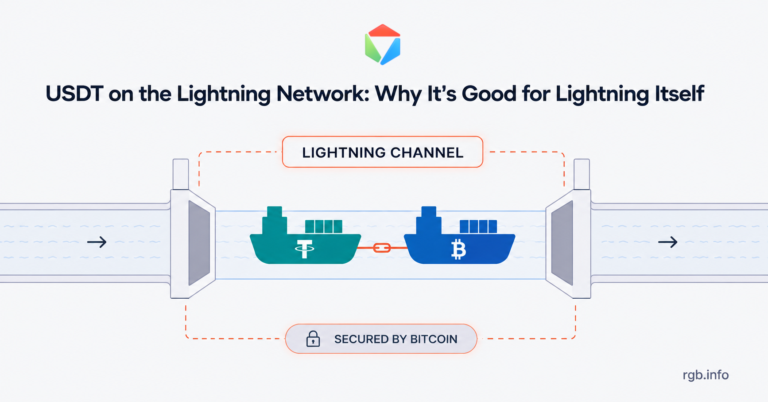
The second concerns the Lightning Network. Lightning channels can move RGB assets and route payments across channels, just like regular Lightning payments. In other words, the “network of security models” from the keynote already includes RGB assets on two of its levels: on-chain transactions and Lightning channels.
The full keynote, with the Q&A, is in the video above, with subtitles in English and Chinese. For more videos from the RGB ecosystem, subscribe to the RGB Protocol YouTube channel.
Further Reading
- Stablecoin Summit Recap: Keynotes and Panels in Lugano
- Giacomo Zucco at Baltic Honeybadger 2025: RGB from Origins to Use Cases
- Giacomo Zucco RGB Talk: The RGBTC Vision Explained