Giacomo Zucco at Baltic Honeybadger 2025: RGB from Origins to Use Cases
At Baltic Honeybadger 2025 in Riga, Latvia, Giacomo Zucco, director of Plan B Network and co-founder of the RGB Protocol Association, talked about the arrival of RGB Protocol on Bitcoin on mainnet with v0.11.1, the origins of the protocol, and its main use cases in the short and long term.
Watch the full interview in the video below.
Note: the interview dates back to August 2025. The products and plans in this article reflect the state of the project at the time.
In Brief
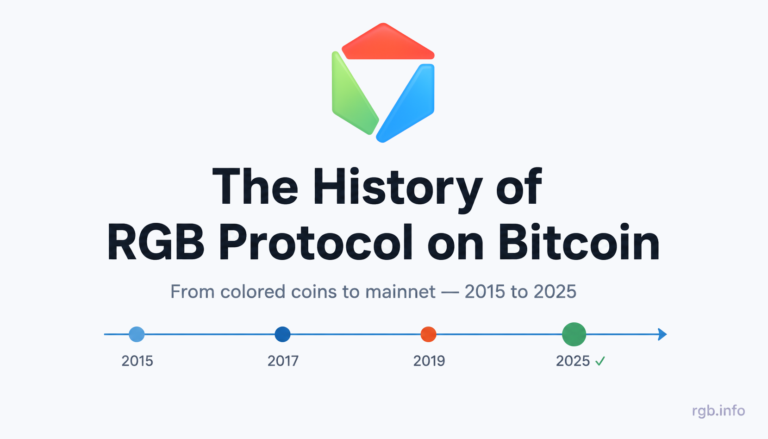
- From colored coins to client-side validation: the research behind RGB, from 2016 to the first public presentation in Lisbon
- A role for the Association: coordination around one brand and a small set of interoperable protocols
- Two killer use cases: USDT in the short term, RGBTC in the long term
- RGB in a multi-layer Bitcoin: the on-chain level of a wider ecosystem of swaps between asset protocols
From Colored Coins to Client-Side Validation
For Giacomo, the release of v0.11.1 on mainnet came after many years of ideas, research, and development. The long wait had two causes: the concept was radical, and RGB relied on the Lightning Network, itself in rapid evolution during the same years.
Back in 2016, Giacomo and his team analyzed the colored coin protocols of the time, such as Coinprism, Colu, CoinSpark, Omni, and Counterparty. In their analysis, these protocols harmed Bitcoin’s fungibility and privacy, added spam to the blockchain, worsened scalability, and created odd incentives for miners, of the kind known today as MEV.
In the same period, Peter Todd presented an idea for Bitcoin itself: client-side validation, with all the validation logic off-chain and the blockchain used only against double spending, through a construct called single-use seals. Giacomo and Peter Todd were working together in a Bitcoin research laboratory in Milan, and they reached a conclusion: client-side validation might be out of reach for Bitcoin itself, but it could be the best way to issue generic assets on Bitcoin.
However, the user experience was a problem. The receiver of an asset needs to be online at the moment of the transfer and needs a new backup after every payment, a step back compared to a seed phrase. A couple of years later, Giacomo noticed the same trade-offs in the Lightning Network, so a working Lightning Network meant a realistic path for client-side validation as well.
According to Giacomo, the name RGB came from his wife Mir, as a reference to the old colored coins and to the names of the people behind the project. The first public presentation of RGB took place at the Building on Bitcoin conference in Lisbon.
The Role of the RGB Protocol Association
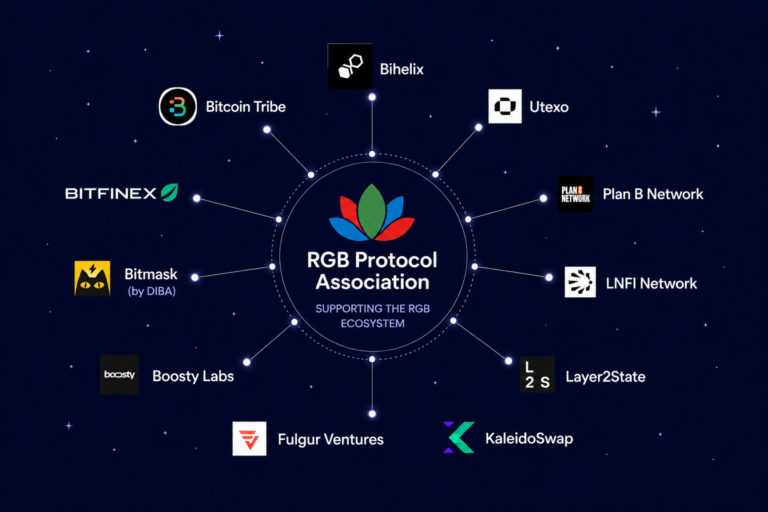
Giacomo described the purpose of the RGB Protocol Association as the typical one of an association behind an open-source protocol: support for its development and adoption. A protocol works only with wide use, ideally as a single standard or as a small set of interoperable protocols, so a shared brand gives people a common point of coordination.
In Giacomo’s words, the tasks of the Association include progress on research, still far from complete, as well as the promotion and expansion of the protocol and the convergence of different ideas.
Short Term: USDT on RGB
For Giacomo, the short-term killer use case is USDT. Paolo Ardoino has mentioned RGB several times in tweets and public interviews, and Bitfinex has supported RGB, together with other companies, for many years.
Giacomo described USDT as a form of legal arbitrage. A company that moves dollar-denominated credit on its own centralized database must follow the same rules as PayPal: KYC for every user, censorship, and blacklists.
On a neutral layer outside the control of any company, the situation is different.
The primary market, where the issuer mints and redeems the tokens, remains fully regulated.
The secondary market, where the tokens simply pass from one user to another, falls partly outside regulation. Regulators can still impose blacklists in some cases, but overall, the result is much better for the freedom of transactions.
Without a proper protocol on Bitcoin, the only layers available for stablecoins are chains whose native tokens harm investors. Many Bitcoin maximalists would rather move stablecoins on a layer with no indirect promotion of a speculative token. Unlike a speculative token, USDT doesn’t offers any prospect of profit: at best, one USDT is worth one dollar.
For the user, the deal stays honest, and the only benefit is some freedom in the secondary market.
RGB can offer the issuer the same plausible deniability in the secondary market, with no speculative token in between. However, as with any regulatory arbitrage, the advantage may not last if regulators become smarter or more active.
Long Term: RGBTC
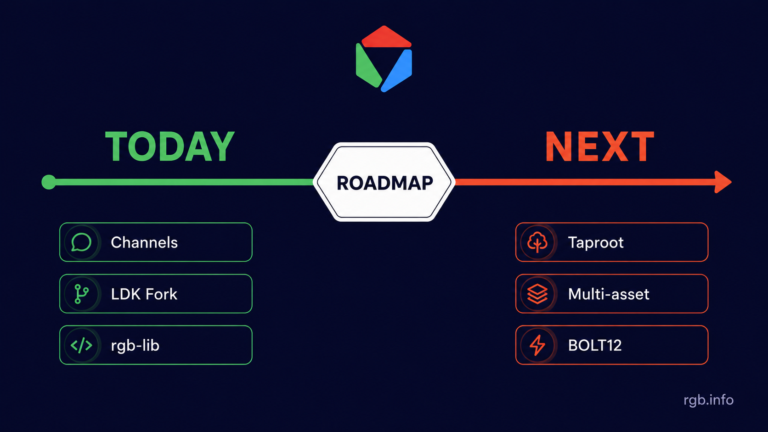
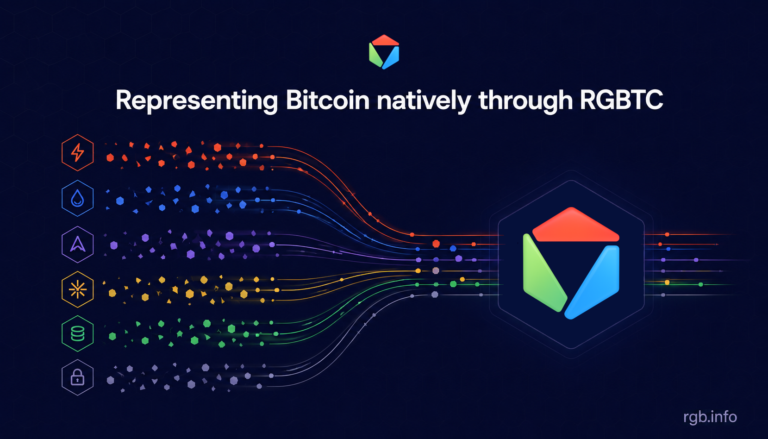
The long-term use case goes back to Peter Todd’s original idea: client-side validation for bitcoin itself. With a proper two-way peg, an RGB token could unlock real bitcoin UTXOs, and RGB could host RGBTC, a representation of sets of actual UTXOs inside RGB tokens.
According to Giacomo, RGBTC would bring a big boost to Bitcoin’s privacy and fungibility: for a UTXO spent on-chain, the visible amount would no longer reveal the real value of the transfer, because an RGB amount could sit behind the same single-use seal. In addition, a single spend could batch many transfers, with gains in scalability and fewer incentives for censorship and manipulation by miners.
What About Scam Tokens on RGB?
Asked about the risk of scam tokens on RGB, Giacomo expected them: any new way to issue assets attracts scams, and some may even use the RGB name. His advice for anyone who comes across an “RGB token” is to stay away from it, because it will be a scam.
The interviewer pointed out that tokens on Bitcoin already exist, and Giacomo agreed: RGB brings no new problem and, at most, dilutes the mind share among protocols for token issuance. Moreover, the novelty effect fades fast. After a first wave, scammers move on in search of the next novelty, while RGB remains available for real use cases: USDT in the short term and RGBTC in the long term.
RGB in a Multi-Layer Bitcoin
Giacomo sees Bitcoin moving toward a model where Lightning becomes a universal language for invoices, swaps, and routing across different security models. Many wallets already receive sats through eCash, Liquid, Spark, Ark, Lightning channels, or on-chain transactions, with atomic swaps among all of them.
Swap services like Boltz work in a trustless way, and wallets such as Aqua, Phoenix, Minibits, and Blitz Wallet rely on these swaps to apply different security models to different amounts.
In his view, assets are heading in the same direction. After a phase of competition among protocols, with questions such as “Liquid confidential assets or RGB?”, RGB, new and highly abstract, is in a good position as a generic asset protocol with seamless swaps toward other asset protocols.
Giacomo imagines a wallet where an asset of very little value arrives as an eCash token, with the centralized issuer acting as the mint. As the value or criticality of the asset grows, the asset moves to Liquid confidential assets, Spark, or Ark, each with its own asset protocol. Finally, when on-chain Bitcoin UTXOs become necessary for protection against double spending, the role goes to RGB.
In his words, RGB is for issued assets what on-chain swaps are for the Lightning ecosystem, the final level of maximum security, and the two paradigms can work in harmony.
Giacomo Zucco at Baltic Honeybadger: the Full Interview
The full interview is in the video above. For more videos from the RGB ecosystem, follow @RGB_Bitcoin.
Further Reading
- History of RGB Protocol on Bitcoin: From 2015 to Mainnet
- Giacomo Zucco RGB Talk: The RGBTC Vision Explained
- Federico Tenga: RGB Protocol on Bitcoin, Plan ₿ Forum 2022
Interview recorded at Baltic Honeybadger 2025, Riga, Latvia. Video on the RGB Protocol YouTube channel.