RGB Protocol v0.11.2-rc.2: Bridge Claims and Safer Validation
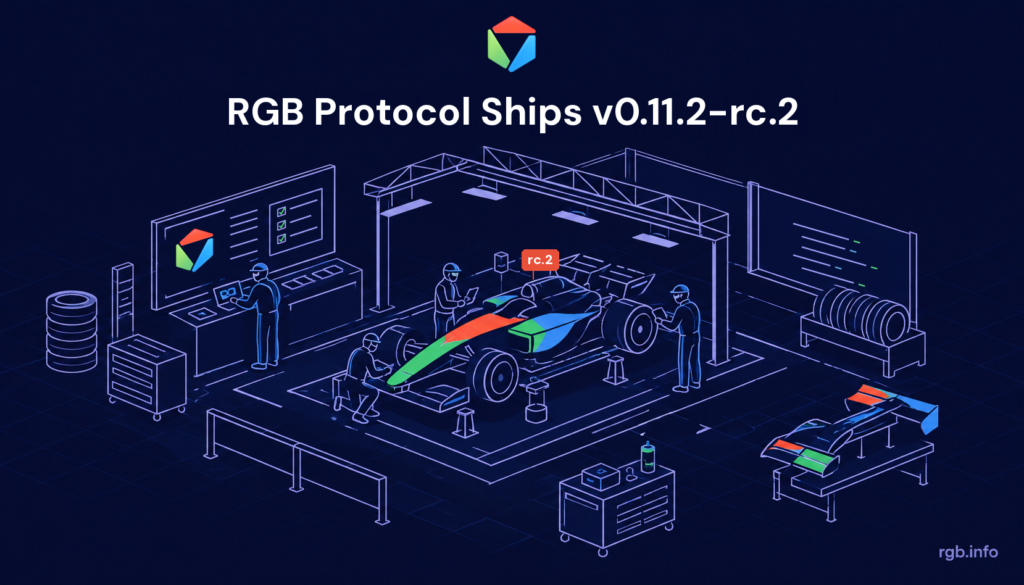
RGB Protocol on Bitcoin v0.11.2-rc.2 is out for testing, as the second release candidate of v0.11.2. On November 11, 2026, five core libraries tagged 0.11.2-rc.2, and three supporting libraries shipped 1.0.6.
This article covers the changes since rc.1. For the changes between v0.11.1 and rc.1, see the article on 0.11.2-rc.1.
In Brief
- RGB Protocol v0.11.2-rc.2 is a test version. v0.11.1 remains the latest stable release.
- Bridged assets get a new structure: “external anchors” become claims, and each lock claim now commits to a specific Bitcoin transaction.
- Validation is safer against crafted consignments, with a rebuilt history graph and a set of fixes in the AluVM virtual machine.
- Consignment terminals are gone in rc.2.
- Large transfers work as consensus allows: up to 65,535 inputs per transition, and the Bitcoin transaction gets prepared in a single pass instead of one transition at a time.
- A payment with a void invoice no longer loses rights: extra rights go back to the change output.
- The BFA, IFA, and PFA schemas have new identifiers, and all three are still marked as not production-ready. The NIA, CFA, and UDA identifiers stay the same.
RGB Protocol v0.11.2-rc.2 is the latest release candidate shipped by the RGB developers. As with rc.1, Cargo, the package manager of Rust, skips -rc versions by default: a project asking for 0.11.1 keeps receiving 0.11.1.
What Is New in RGB Protocol v0.11.2-rc.2?
The release candidate brings eight groups of changes, from the bridge mechanism to the tests.
1. From External Anchors to Claims
In rc.1, the Bridged Fungible Asset (BFA) schema was released to allow bridging assets from another blockchain. New units can be minted on the RGB side only after the confirmation of a matching lock on the original chain. In rc.2, the mechanism receives new names and a stricter link to Bitcoin (rgb-consensus, rgb-ops).
New names. ExternalAnchor becomes Claim, and its MintEvent variant becomes Lock. The contract instruction behind the check changes name from pma to plc, with the same opcode byte. The validation errors follow the same renaming, and a new UnknownClaim error reports a resolution for a claim outside the list of pending claims.
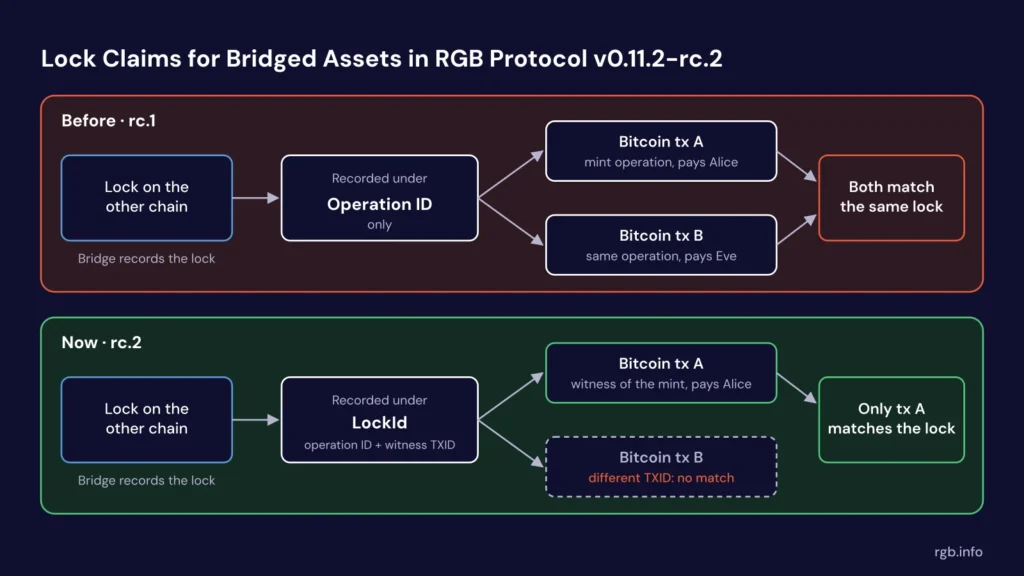
Each lock claim now commits to its Bitcoin transaction.
- Before: a lock claim referred only to the mint operation. The identifier of the operation fixes the number of the Bitcoin output receiving the new units, but not the script deciding who can spend the output (in practice, its address). The same mint operation could therefore appear in a different Bitcoin transaction, with an output of the same number paying someone else, and still match the lock on the other chain.
- Now: the lock claim also refers to the witness transaction, the Bitcoin transaction carrying the mint. The bridge records each lock under a new
LockId, a hash of the operation identifier and the witness transaction ID, so each lock matches a single Bitcoin transaction.
Confirmations on the other chain. The resolver is the component checking the claims on the other chain. The number of confirmations a lock needs is a choice of the resolver, as for the finality of witness transactions on Bitcoin. A lock with too few confirmations counts as unconfirmed, with no error. The after_block field of the claim also becomes before_block.
2. A Lighter Validation Graph
To validate a consignment, rgb-consensus builds a graph of the asset history.
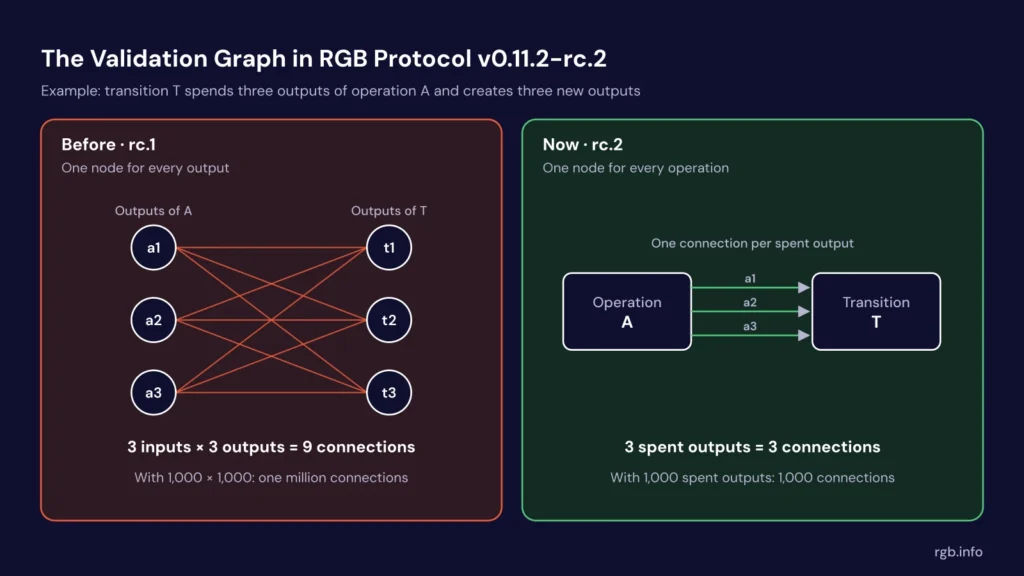
- Before: the graph held a node for every output of every operation, including unspent outputs, and connected each input to every output of the spending operation. In a transition with many inputs and many outputs, the number of connections grew with the product of the two, and the validator then copied the finished graph together with its index. A malicious consignment could exhaust the memory of the validator.
- Now: the graph holds one node per operation and one connection per spent output. Its size grows linearly with the number of operations and spent outputs, and the validator moves the graph instead of copying it. Validation is also faster.
The same release fixes the order of revealed transitions inside a bundle: a revealed transition now comes after all of its parents.
3. Consignment Terminals Removed
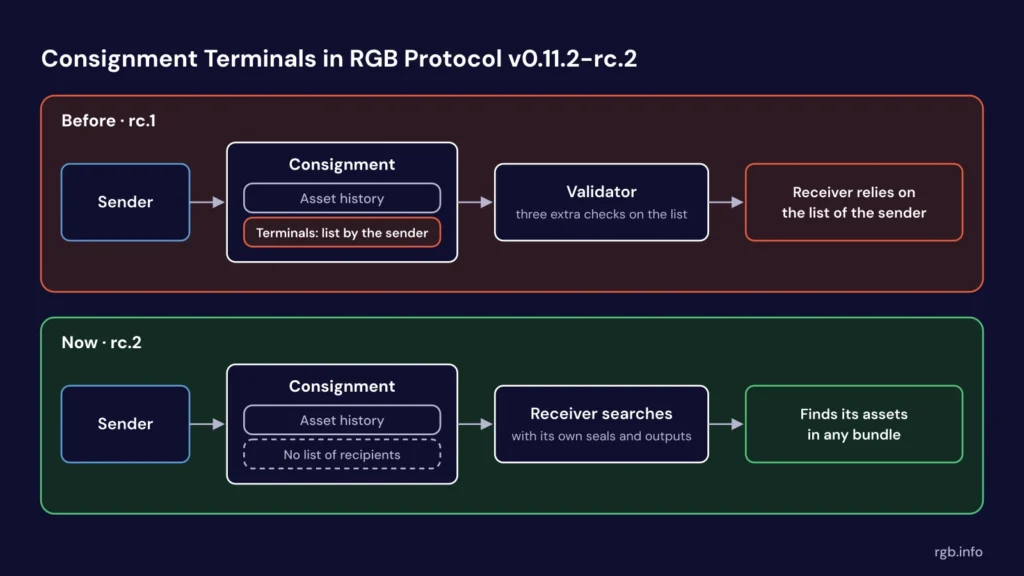
Before, every consignment carried a list of terminals: some of the outputs receiving the assets in the latest transfer, the ones the sender wanted the receiver to know about. The validator checked the list against the content of the consignment.
In rc.2, a consignment no longer declares its recipients (rgb-consensus, rgb-ops, rgb-api). Each receiver finds its own assets in the content of the consignment, with the help of the outputs and secret seals in its wallet.
- Before: the receiver relied on the list of terminals written by the sender, and the validator needed three dedicated checks to confirm the list. On import, the wallet revealed only the seals listed as terminals.
- Now: the receiver searches the consignment directly with the new function
assignments_to, which returns every assignment to the given seals or outputs, in any bundle. On import, the wallet reveals every concealed seal with a secret known to the wallet, in any bundle. The consignment carries less data, the validator runs fewer checks, and the receiver relies only on the history proven by the consignment, with no declaration from the sender.
rgb-ops also adds spent_opouts, the outputs spent in the consignment, and terminal_ops, the transitions with no later transition in the consignment. On the sender’s side, nothing changes: the outputs and secret seals passed at composition still select the state for the consignment.
The section on terminals in the article on rc.1 therefore no longer applies to rc.2.
4. Fixes in the AluVM Virtual Machine
AluVM runs the scripts of RGB contracts. rgb-aluvm 0.11.2-rc.2 fixes several cases in which a script could behave in an unexpected way.
| Case | Before | Now |
|---|---|---|
| Returns from subroutines | The virtual machine saved the call itself as the return point, so the script ran the same subroutine again, in an endless loop | The script continues from the instruction right after the call |
| Instructions impossible to decode | The run ended as a success | Execution stops with a failure |
| Libraries unknown to the resolver | Execution went on as normal | Execution stops with a failure |
| Leftovers from a failed run | Frames left by an earlier failed run could affect the next run | Every run starts with an empty call stack |
In addition, the call counters now stop with a failure before an overflow, and running past the end of the code works like the return instruction ret.
A full byte for vts. In rgb-consensus, the vts instruction now fills a full byte. Before, the instruction wrote only 4 bits, so the next instruction started in the middle of a byte, and the assembler dropped the last half byte of the library. Now, four zero bits complete the byte. Scripts containing vts produce different bytes, and so get new library identifiers.
5. Transfers with Many Inputs
A single RGB transition can spend up to 65,535 inputs. Four changes in rgb-ops and rgb-api concern large transfers.
| Change | Before rc.2 | In rc.2 |
|---|---|---|
Inputs per transition (rgb-ops) |
At most 255, far below the consensus limit | Up to the consensus limit of 65,535 |
Two assignments to the same seal (rgb-ops) |
The second replaced the first, or disappeared in the case of rights | Both assignments in the transition |
Preparation of the Bitcoin transaction (rgb-api) |
One transition at a time: hours of work with 65,535 inputs | The whole batch of transitions in a single pass |
Extra rights with a void invoice (rgb-api) |
Lost: the payment spent every right of the requested type, but gave the receiver only one | Back to the change output, with extra transitions |
About the Bitcoin transaction. To prepare a transfer, the wallet adds the RGB transitions to the Bitcoin transaction under construction, a PSBT. Before rc.2, the work grew with the square of the inputs, and even spending a UTXO with 65,535 allocations (each moved by its own transition) took more than 15 minutes. In rc.2, each transition also gets decoded only once, and a new error reports a batch spending the same output twice.
About rights. A void invoice asks for a single right. In rc.2, the extra transitions also move the state of other types, since the BFA and IFA schemas now use a dedicated transition for each type of assignment (see section 6). Among the schemas in rgb-schemas, only IFA and BFA use rights, and neither is production-ready.
6. Schemas: New Identifiers for BFA, IFA, and PFA
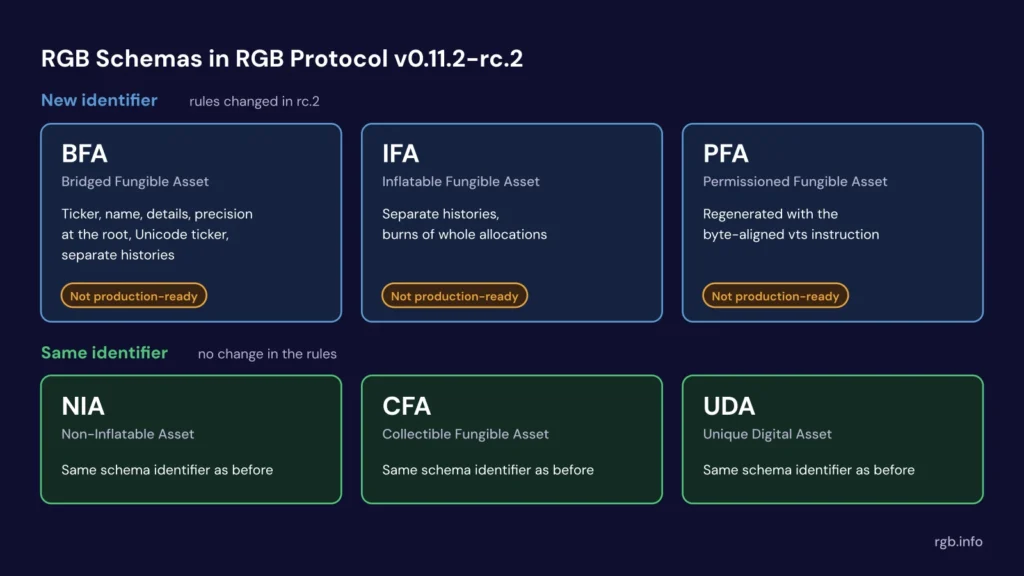
rgb-schemas 0.11.2-rc.2 changes three schemas, all still marked as not production-ready in the rgb-schemas README.
- BFA: ticker, name, details, and precision move to the root of the global state, and the ticker accepts any Unicode character instead of ASCII letters and digits only. Chains of mint rights are no longer allowed, and the mint metadata
afterBlockbecomesbeforeBlock. - BFA and IFA: unrelated histories now stay separate, with a dedicated default transition for each type of assignment. Burn transitions have no change and must burn whole allocations.
- PFA: regenerated with the byte-aligned
vtsinstruction (see section 4).
Why the identifiers change. The identifier of a schema works like a fingerprint: any change in the rules produces a new identifier. As a result, BFA, IFA, and PFA get new identifiers, while NIA, CFA, and UDA keep the same ones, with no change in their rules.
7. Supporting Libraries 1.0.6
rgb-strict-encoding1.0.6 adds an encoding for a single Unicode character: its 1 to 4 bytes in UTF-8, with no length prefix.rgb-strict-types1.0.6 completes the support for the Unicode character type.- Before: decoding a value of the type reached a placeholder in the code and stopped the program.
- Now: the value becomes a string. A list of bare characters gets rejected, since a list of characters needs a named element type.
rgb-ascii-armor1.0.6 updatesrgb-strict-encodingto 1.0.6.
The new ticker of the BFA schema relies on the Unicode support of the 1.0.6 libraries.
8. Tests
The rgb-tests suite now runs on 0.11.2-rc.2. Two more of the tests published by @0xaudron received a fix on November 11, after the release.
The first covers byte operations of the virtual machine with no implementation (rgb-aluvm), the second the comparison of enumerated types (rgb-strict-encoding). Both fixes are on the main branch of each library and not yet in a tagged release. Open pull requests by the RGB developers propose tests and fixes for further cases, including the text export of oversized consignments.
Should You Update to RGB Protocol v0.11.2-rc.2?
- Wallet users: no action needed. v0.11.1 remains the stable release.
- Developers building on
rgb-liborrgb-lightning-node: no action needed. Those tools are not using v0.11.2 yet. - Developers building directly on the 0.11.1 core libraries: the 1.0.6 supporting libraries are available as a regular dependency update.
- Developers testing 0.11.2-rc.1: expect some adaptation work. Bridge components carry new names (
Claim,Lock,plc,LockId), the validation graph has a new type (OpsDag), and terminals are gone. The BFA, IFA, and PFA schemas have new identifiers, as do scripts containingvtsand two internal type libraries. Feedback from testing is welcome in the issue tracker of each repository.
FAQ About RGB Protocol v0.11.2-rc.2
Is RGB Protocol v0.11.2-rc.2 a stable release?
No. RGB Protocol v0.11.2-rc.2 is a release candidate, a version for developers who want to test the new code. v0.11.1 remains the latest stable release, and Cargo skips -rc versions by default.
Is RGB Protocol v0.11.2 related to RGB v0.12?
No. RGB v0.12 is a separate, non-production rewrite by another organization (rgb.tech / RGB-WG), without support from the RGB Protocol Association. RGB Protocol v0.11.2 continues the v0.11.1 line, the version in production on Bitcoin mainnet, with code in the rgb-protocol and RGB-Tools organizations on GitHub and documentation at docs.rgb.info. Despite the higher number, v0.12 is not a newer version of v0.11.2.
Which RGB schemas are production-ready?
The rgb-schemas README marks PFA, IFA, and BFA as not production-ready. NIA, CFA, and UDA carry no such mark, and rgb-lib does not allow the IFA schema on mainnet.
Release Notes
Core libraries, 0.11.2-rc.2:
rgb-aluvm0.11.2-rc.2rgb-consensus0.11.2-rc.2rgb-ops0.11.2-rc.2rgb-schemas0.11.2-rc.2rgb-api0.11.2-rc.2
Supporting libraries, 1.0.6:
Where to Find the Code
- rgb-protocol hosts the core protocol libraries, including the eight updated in this release, and the
rgb-testsrepository. - RGB-Tools hosts the higher-level tools, such as
rgb-libfor wallet development andrgb-lightning-nodefor RGB assets on the Lightning Network.