USDT on the Lightning Network: Why It’s Good for Lightning Itself
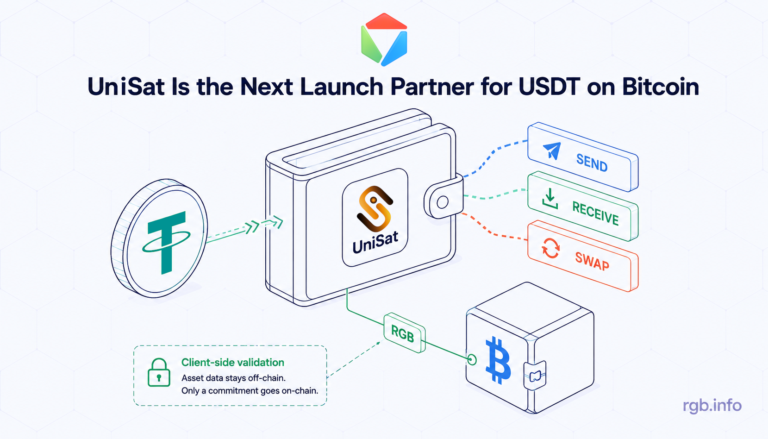
USDT on the Lightning Network is the next step for RGB Protocol on Bitcoin’s stablecoin infrastructure. Utexo is building the pieces that will make it work end to end: RGB Lightning Nodes, a wallet development kit, and a cross-chain bridge.
In Brief
- USDT is coming to Bitcoin through RGB Protocol on Bitcoin; the next step is carrying those transfers over the Lightning Network.
- RGB Lightning channels carry satoshis and RGB assets side by side, anchored to the same Bitcoin-backed security as ordinary Lightning payments.
- Utexo is building the infrastructure: the RGB Lightning Node (RLN) and a Wallet Development Kit (WDK) that other apps can plug into without reimplementing the protocol layer.
- Transfers stay private by default through RGB’s client-side validation, but holders can selectively disclose specific transaction details for compliance when needed.
- USDT on Lightning is good for Lightning itself: more adoption means more routing revenue for Lightning companies, which funds infrastructure that benefits every Lightning user, not just USDT holders.
How Does RGB Work on the Lightning Network?
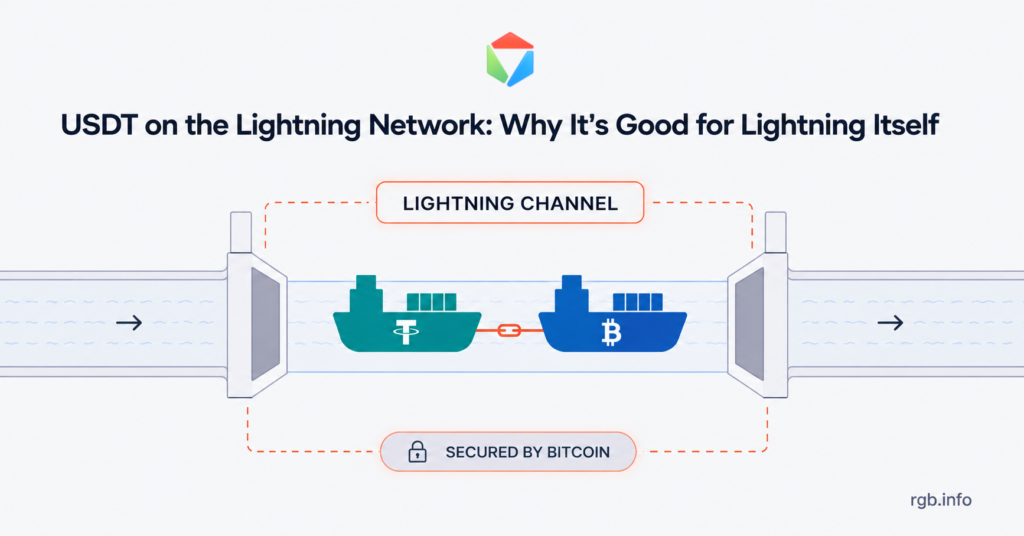
A normal Lightning channel moves satoshis back and forth between two people, instantly and off-chain. An RGB channel does the same thing, but it can also carry RGB assets (including USDT) alongside the satoshis, over that same instant, low-fee connection.
Under the hood, every time a Lightning channel balance is updated, a small piece of data is created to record which party owns what amount.
RGB adds one more piece to that data: a record of which RGB assets belong to which side of the channel. RGB anchors that record to the Bitcoin transaction that would close the channel, so it inherits the same security guarantees as the satoshis: if either side tries to cheat by broadcasting an old, outdated state, the other side can claim everything in the channel, assets included.
Because the asset moves inside the same Lightning payment, sending USDT over an RGB-enabled channel will feel exactly like sending satoshis over Lightning. It will be fast, cheap, and off-chain, even though it is technically Bitcoin’s second layer doing the work.
What Happens When USDT Moves Over Lightning?
The Technical Foundation: State Transitions
Every RGB transfer, whether it happens on-chain or inside a Lightning channel, rests on the same building block: a state transition. A state transition simply updates who owns a given piece of an asset. The RGB documentation describes it as taking a previously defined state and moving it forward to a new one.
The important part is how that update is verified. RGB never broadcasts the transfer to a public, global ledger the way a normal blockchain transaction would. Instead, the recipient checks the entire history of that specific asset back to the moment it was first issued, confirming each step was valid and properly committed to a Bitcoin transaction. Only the two parties involved in a given transfer ever see the details of that transfer, while everyone else sees nothing beyond an ordinary-looking Bitcoin transaction.
The same verification process is also what makes selective disclosure possible: because each transfer is a private, cryptographically verifiable record that the parties involved hold, a holder can choose to reveal the details of a specific transaction to a chosen third party (an auditor, for example) without broadcasting anything publicly or exposing the rest of their transaction history.
What Is Utexo Building?
Utexo is one of the ecosystem projects building on RGB Protocol v0.11.1. The company is developing the infrastructure that allows the deployment of this model for USDT specifically.
At the center of Utexo’s stack is the RGB Lightning Node (RLN), the Lightning node software that natively validates RGB assets, so a channel can carry USDT the same way it carries satoshis. Rather than asking every developer to run and maintain this kind of node themselves, Utexo offers it as managed infrastructure, handling node creation, upgrades, backups, and monitoring through a dashboard or an API.
Applications that want more direct control can also run their own node and use it directly. However, Utexo’s own documentation recommends testing it on regtest or testnet before trusting it with real funds.
For teams building wallets rather than running infrastructure, Utexo also provides a Wallet Development Kit (WDK): a set of software packages, built on rgb-lib, that expose RGB and RGB Lightning capabilities through standardized wallet abstraction interfaces. Wallet builders who already rely on compatible account and signing abstractions will soon be able to integrate RGB support directly, without reimplementing the protocol layer from scratch.
Combining RGB’s client-side verification with Lightning’s routing network, Utexo reports transfer times of around 200 milliseconds, in the range of a card payment, while keeping the settlement privacy and Bitcoin-backed security described above.
In addition, the Mint will handle the cross-chain side: moving USDT already circulating on Ethereum, Tron, and Solana onto Bitcoin via RGB, so liquidity that already exists elsewhere can flow onto this new rail.
Why Does USDT on the Lightning Network Matter?
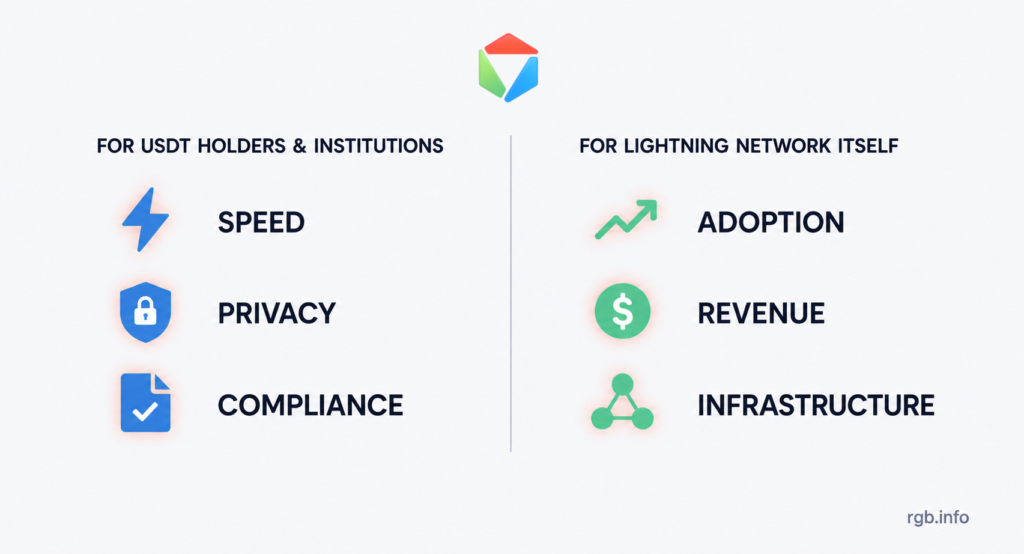
For USDT Holders and Institutions
Most USDT today moves on networks with no connection to Bitcoin. Bringing it onto Bitcoin, and specifically onto Lightning, changes a few concrete things for anyone who already holds or uses it.
- Speed and cost. Lightning payments settle in milliseconds, and without the fee spikes that come with congested blockchains. A USDT transfer over RGB and Lightning behaves like any other Lightning payment, because it is one.
- Privacy by default. Because RGB never broadcasts transfer details publicly, USDT payments on this rail do not appear on an open ledger where anyone can inspect, trace, or link them back to a person, unlike transfers on a fully transparent chain.
- A path to compliance, on the holder’s terms. Privacy by default does not mean privacy with no way out. The same state-transition mechanism that keeps transfers private also allows a holder to selectively reveal specific transaction details to a chosen party, like a compliance officer or auditor, without exposing anything to the wider public. This distinction matters for institutions that need to satisfy reporting requirements without giving up the privacy guarantees that make the rail worth using in the first place.
- Bitcoin as the settlement layer. RGB issues and settles USDT with Bitcoin’s own security underneath, rather than wrapping or bridging a representation of it from another chain. Users get a stablecoin that keeps the dollar peg they already trust, now backed by Bitcoin’s own track record for uptime and censorship resistance.
None of this added infrastructure will require users to do anything differently. Utexo is building the RLN nodes, the WDK, and the Mint precisely so the complexity stays on the infrastructure side: once they ship, USDT on the Lightning Network will simply work.
Is USDT on Lightning Good for Lightning Itself?
USDT on Lightning is a win for the people who use it, and it changes the underlying economics of the network.
- More demand, more adoption. Stablecoin demand tends to outpace demand for a volatile asset: most people who want to send or hold digital dollars are not looking to take on Bitcoin’s price risk in the process. Bringing that demand onto Lightning pulls in a category of activity the network has struggled to attract on satoshis alone, which translates into adoption.
- More volume, more revenue. More adoption means more transaction volume routed through Lightning channels, and more volume means more routing revenue for the companies that run Lightning infrastructure (node operators, liquidity providers, and Lightning Service Providers).
- A second revenue stream: trading. USDT can also open up revenue beyond routing: atomic BTC-USDT swaps directly inside Lightning channels, priced and settled the same way routed payments already are today. Trading fees of this kind can end up outweighing routing fees on their own. Either way, more revenue funds further infrastructure investment: deeper liquidity, more reliable channels, and more competition among providers, which tends to push fees down over time.
- A smoother path to Bitcoin itself. Once someone starts using USDT on Lightning, they become familiar with the infrastructure and the tools already built around that Layer 2. Switching to Bitcoin itself becomes easier from there — the obstacle of learning new tooling is already gone, and the only thing left to argue is that Bitcoin is the better asset.
- Shared infrastructure, shared upside. None of that value stays locked inside USDT. It flows into the same channels and the same routing network that satoshi-only Lightning payments already rely on, funding growth in Bitcoin’s second layer itself. Even someone who holds Bitcoin only, with no interest in stablecoins at all, still benefits from the deeper liquidity and stronger infrastructure that USDT volume sustains.
Whether the beneficiary is a USDT holder sending money at Lightning speed, a node operator earning fees on the volume behind it, or a sats-only Bitcoiner riding on infrastructure someone else helped fund, the outcome points the same way: value flowing back onto Bitcoin’s own infrastructure.