RGB Goes Live on Bitcoin: Anant Tapadia and Federico Tenga on the Stephan Livera Podcast
In episode 692 of the Stephan Livera Podcast, Anant Tapadia and Federico Tenga talked about RGB Protocol on Bitcoin. Anant is product lead at Bitcoin Tribe, while Federico is head of R&D at Bitfinex. Together, they covered the launch on mainnet, USDT on Bitcoin and Lightning, real-world assets, and the differences from other asset protocols.
Watch the full episode in the video below.
In Brief
- Assets on top of Bitcoin: no sidechain, no federation, and compatibility with Lightning and future scalability layers
- USDT against native bitcoin: a dollar exposure for bitcoiners, with no wrapped BTC on other chains
- One commitment, many transfers: a fixed on-chain footprint for any number of RGB transfers
- Liquidity in the asset itself: Lightning channels denominated in USDT, with no double swap at every payment
- Adoption through products: builders on a neutral playground under Bitcoin rules
Stephan Livera’s First Question: What Is RGB?
Stephan Livera opened the episode with a simple question: what is RGB, and what is new? Federico described RGB as a protocol for tokenization on top of Bitcoin, with some smart contract capabilities. In his words, “on top of Bitcoin” means directly on Bitcoin, so there is no sidechain, no federation, and no other trust trade-off. RGB also works with Bitcoin scalability solutions. Today, the main one is the Lightning Network, but in principle RGB is compatible with Ark, statechains, and future layers as well.
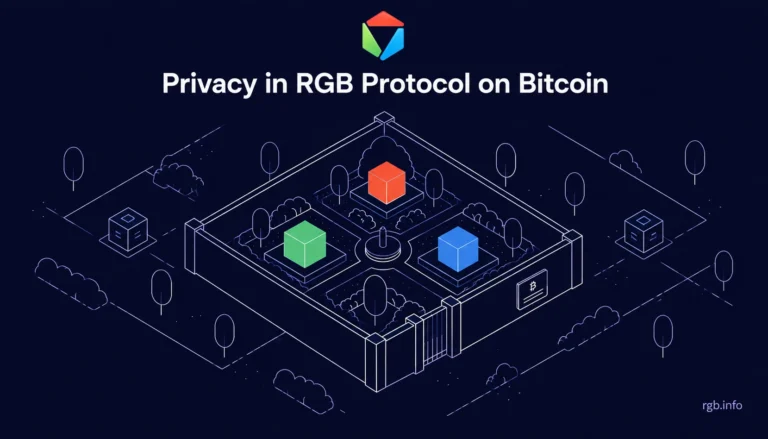
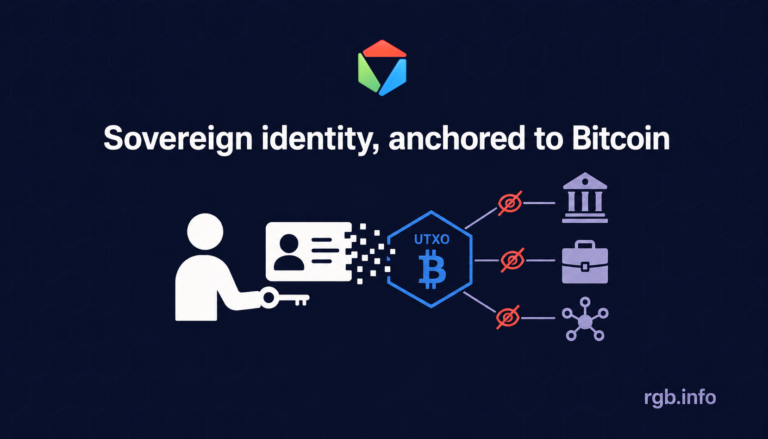
Anant, instead, used the image he gives to new team members. UTXOs are envelopes that carry sats, and RGB uses the same envelopes for additional purposes. Issuance, transfers, and validation all live off-chain, while only a hash goes into the envelope. In other words, RGB does more with Bitcoin without any change to Bitcoin. At the time, the big news was the launch of RGB on mainnet. According to Anant, Tether had also reaffirmed its commitment to RGB. In addition, a pilot with a test token, TUSDT, had run well on mainnet, with users from many countries.
Why Bitcoiners Need Non-Bitcoin Assets
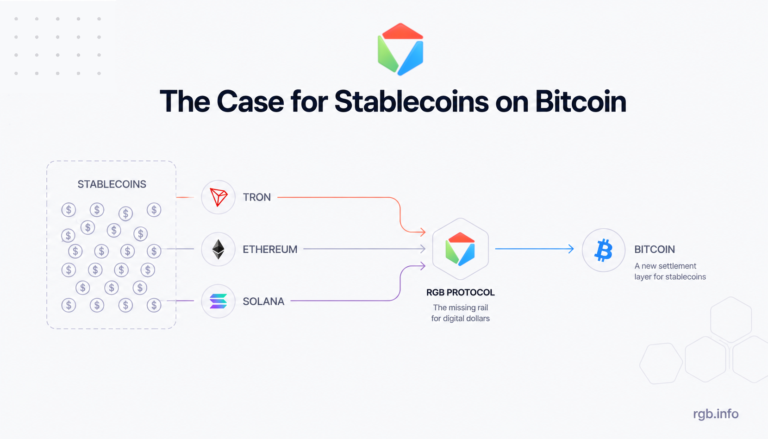
Next, Stephan Livera raised an obvious question for a Bitcoin audience: why would bitcoiners need RGB assets at all? Federico’s favorite use case is USDT. Bitcoin is the largest asset in the industry. However, people who trade bitcoin against USDT on decentralized exchanges end up with wrapped, centralized versions of bitcoin. Since USDT already has a centralized issuer, bringing USDT to Bitcoin makes much more sense than the opposite. As a result, users can trade USDT directly against native bitcoin.
Even a Bitcoin maximalist may need some dollar exposure. For example, with 99% of savings in bitcoin, the remaining 1% still needs management. Today, the options are cash, a KYC exchange, or altcoin chains with wallets such as MetaMask. A dollar asset native to Bitcoin, therefore, removes the need for any of them.
RGB for the End User: On-Chain and on Lightning
Stephan Livera then asked what RGB looks like for a bitcoiner who simply wants some USDT. For an on-chain transfer, the experience resembles any other wallet. First, the receiver shows an invoice as a QR code. Then, the sender scans the code and sends the asset. Some interaction between the two wallets happens, but always behind the scenes. Meanwhile, sats act as the fuel for every operation. On Lightning, instead, the UTXO with the asset stays off-chain until the closure of the channel. Federico explained that the trade-offs match the trade-offs of ordinary Lightning. The only difference is a channel denominated in an RGB asset instead of bitcoin.
As for liquidity, wallets can manage USDT channels just as many Lightning wallets manage bitcoin channels today. Alternatively, they can offer swaps on the fly. For popular assets like USDT, Federico expected a whole network of channels in the asset. For less popular assets, on the other hand, swaps on the fly could work better. Either way, the choice belongs to application developers, because the protocol sets no constraint. Low latency also matters for trading. Once USDT is on Lightning, atomic swaps between USDT and bitcoin settle as fast as a Lightning payment. With a direct channel to the counterparty, settlement can take about a millisecond, instead of 30 minutes of wait for a confirmation.
Building Bitcoin Tribe
Stephan Livera then turned to Anant and his experience with an RGB wallet. At Bitcoin Tribe, the team focused on the core of RGB. In particular, the wallet hides the concept of sats from the user: the sat balance remains visible, but the user never has to manage sats directly. Anant also described a recent feature for new users. Thanks to the feature, a new user can receive an asset, for example $5 of USDT, without any sats in the wallet. According to Anant, smooth single transfers with an efficient use of sats come first. After that, a move to Lightning will be easy. Moreover, each player in the ecosystem covers a different niche, toward the same goal: sending and receiving any asset, to anyone, anywhere.
How an RGB Transfer Works
Stephan Livera also asked how a user creates and transfers an RGB asset. The first step is the issuance of the asset, and in RGB the issuance is open to anyone. The issuer defines the asset according to a predefined schema and keeps the data off-chain. Then, the issuer commits a hash into a UTXO. As a result, the Bitcoin blockchain learns nothing about the asset, its value, or its supply.
In a transfer, the sender spends the UTXO with the asset. In parallel, the sender also passes all the details of the asset to the receiver. The receiver verifies the history off-chain and then checks the commitment of the sender on-chain. This model is client-side validation. According to Anant, wallet development becomes more complex, but the experience stays simple for the user.
Federico then explained the two commitment methods of RGB. Opret is simpler for wallet developers, and it avoids overlaps with future protocols on Taproot. Tapret, instead, places the commitment inside the Taproot output, with an even smaller footprint. According to the documentation, an Opret commitment takes 34 bytes. Moreover, each transaction carries a single commitment. As the documentation on Multi Protocol Commitments explains, the commitment is the root of a Merkle tree over all the RGB transfers. For a simple one-to-one transfer, the gain is small. However, an exchange may process withdrawals for thousands of users, or a DEX may send thousands of payouts. In both cases, a single on-chain transaction with a fixed number of bytes can cover the whole batch.
Beyond Stablecoins: Real-World Assets
Later, Stephan Livera asked whether RGB is mainly a stablecoin story. For Anant, stablecoins are a huge and proven example of a real-world asset. However, RGB supports any asset, such as equity in a company, gold, bonds, or the simple collectibles the team issues for fun. Value exists outside of Bitcoin too, and RGB lets that value use the network of wallets, transfers, and custody already in place on Bitcoin.
Federico counted three products with proven market fit in the industry: bitcoin, stablecoins, and speculative memecoins. Tokenized real-world assets, on the other hand, still need to prove their value at scale. If they take off, Bitcoin will be a better home for them than other chains. Still, his main interest remains stablecoins on Lightning. Payment and trading volume in USDT means more fees for Lightning nodes and more money for better products. In the end, Lightning improves for everyone, including people who care only about bitcoin.
The RGB Ecosystem in October 2025
When Stephan Livera asked for an overview of the RGB ecosystem, Federico mentioned these projects:
- Bitcoin Tribe, in his view the most popular RGB wallet, with a strong mobile experience
- Iris Wallet, the mobile wallet of Bitfinex, built on the same library as Bitcoin Tribe
- KaleidoSwap, a DEX on top of Lightning
- ThunderStack (today Utexo), an infrastructure service for integrations with RGB and RGB on Lightning
- BitMask, a browser-based RGB wallet
- LNFI, an exchange with an RGB integration
- a few wallets focused on the Asian market, and other teams in the middle of their integrations
Stephan Livera’s Comparisons: RGB, Liquid, Taproot Assets and Layer 1s
Stephan Livera then asked how RGB compares with Liquid and Taproot Assets. According to Anant, Liquid is federated, so users need to trust the federation. Taproot Assets has a very close design, but as far as he knew, it relies on centralized indexers for part of its state. RGB, by contrast, stays fully peer-to-peer, private, and efficient, because any number of transfers fits into a single hash. Federico placed RGB at the end of the spectrum with maximum security. In other words, if a user accepts the trust assumptions of Bitcoin, RGB adds no further assumption. He also agreed that Taproot Assets is the closest design, with RGB ahead on privacy and batching.
On payments, Federico questioned a model with two swaps on the fly for every payment, one at each end of the route. Two exchange rates mean two spreads, more latency, more failed payments, and higher costs. Liquidity in the asset itself is harder to bootstrap. However, issuers have every interest in building such liquidity. For USDT, Federico even saw the possibility of a Lightning network bigger in USDT than in bitcoin, at least for a period of time. Anant added that at least 70% of users would likely pay and get paid in USDT, so they would need no swap at all.
Finally, compared with Ethereum, Solana, or Tron, RGB inherits all the advantages of Bitcoin as a base layer: security, decentralization, reliability, and long-term sustainability. In addition, users trade against real bitcoin instead of wrapped BTC, with no native token in between and with access to the Lightning Network.
Large RGB Issuers and Adoption: Stephan Livera’s Last Questions
Stephan Livera also raised a criticism heard among some Bitcoin developers: a large RGB issuer could one day push for contentious soft forks. Anant replied that RGB has no on-chain smart contract, so users trust the issuer and nobody else. Moreover, an RGB transaction looks like any other Bitcoin transaction. A miner who wants to roll back a specific transfer, therefore, first needs to find the transfer among ordinary transactions. Federico added that a large USDT transfer creates the same incentive for a reorg as a large bitcoin transaction. The defense is also the same: more confirmations. And if a government forced the issuer onto a KYC fork of Bitcoin? Bitcoin would go on serving its users, while anyone interested only in bitcoin could ignore the fork.
On adoption, Anant was clear: users won’t choose a wallet for the RGB label. Instead, they want a solution that is cheaper, faster, and always available. So the job of product teams is to turn the advantages of RGB into those benefits, without users having to think about the protocol. Federico agreed, since adoption comes from good products, and the real question is how to attract builders. Other layers are always someone else’s playground, because someone controls the chain or profits from its token. RGB, instead, offers a neutral playground under Bitcoin rules only. In his view, such neutrality can attract large use cases, deep liquidity, and good builders.
The Full Stephan Livera Podcast Episode on RGB
The full episode of the Stephan Livera Podcast on RGB is in the video above. To learn more about RGB, Federico recommended rgb.info, with educational resources and developer tools. For more videos from the RGB ecosystem, follow @RGB_Bitcoin.
Further Reading
- Bitcoin Tribe Wallet: Anant Tapadia at Tuscany Lightning Summit 2025
- RGB Protocol on Bitcoin, Explained From the Start: Federico Tenga at Plan ₿ Forum 2022
- Giacomo Zucco at Baltic Honeybadger 2025: RGB from Origins to Use Cases
Episode 692 of the Stephan Livera Podcast on RGB, published in October 2025. Video on the Stephan Livera YouTube channel.