The Taiwan Stablecoin Market and Bitcoin
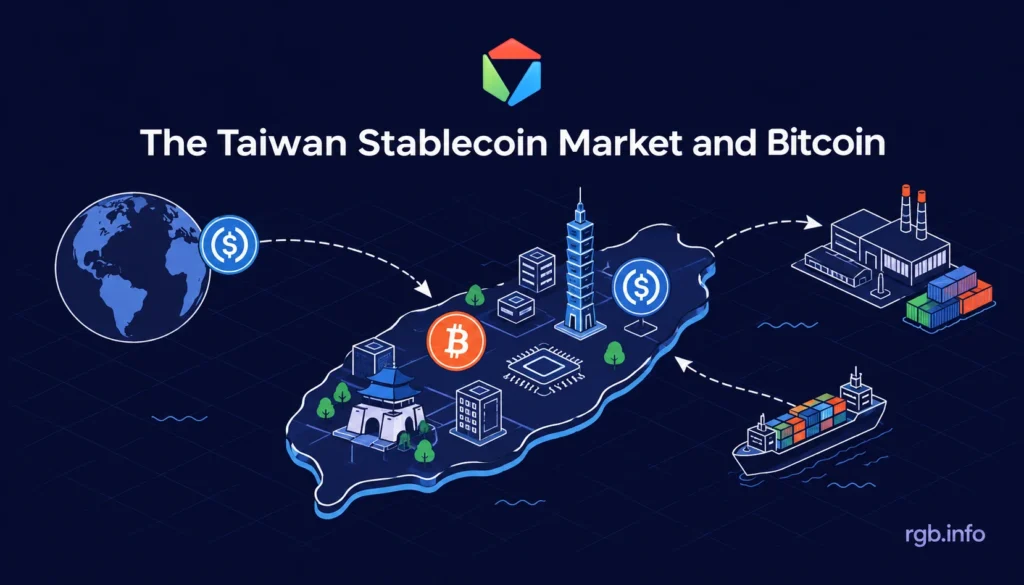
What drives the Taiwan stablecoin market? This article summarizes a conversation with Alex Chen, Growth Manager at BlockTempo (动区动趋), a Taipei-based crypto media outlet. The conversation took place on an X Space on October 14, 2026, in a Chinese-language community call hosted by @RGB_Bitcoin, and covered BlockTempo’s work, the Taiwan stablecoin market, and the view from Taiwan on stablecoins running on RGB Protocol on Bitcoin.
Note: the data and statements in this article come from Alex Chen and do not represent statements by the RGB Team. Please do your own research for more information.
In Brief
- Retail use in the Taiwan stablecoin market centers on trading and onchain activity, with remittances largely out of reach for ordinary users
- Taiwanese companies accept stablecoins mainly at the request of customers in countries with foreign exchange controls, and speed plays little part in the decision
- Taiwan’s Virtual Asset Service Act sets the first conditions for stablecoin issuers, while the details wait on sub-regulations expected in 2027
- Awareness of RGB in Taiwan is still limited and comes mostly from users active during the 2024 Ordinals wave
- For USDT on Bitcoin and Lightning, Alex sees the ecosystem and its use cases as the deciding factor, and advises RGB projects to find a local partner first
From DeFi Summer to BlockTempo
Alex Chen joined crypto at the end of 2020, in the last stretch of DeFi Summer, when a good friend from high school saw the opportunity and suggested getting involved in the sector. Work with DeFi projects and NFTs came first, followed by regulation, stablecoins, and exchanges.
What Is BlockTempo?
BlockTempo (动区动趋) is a Taipei-based crypto media outlet, which Alex describes as the largest in the Traditional Chinese-speaking world, with a strong focus on new technology, from AI to emerging assets. Its readers want to follow new technology, from crypto and blockchain in the early days to AI today. They also want to know which assets deserve attention and how the rules around those assets evolve.
The readership is broad, and comprises retail users, companies trying to understand the sector, people already working in the industry, and government staff looking for the latest information. BlockTempo also summarizes new regulation from different countries, so readers on both the consumer and the business side come to the site, each with different priorities.
Conferences, Meetups and Market Entry
Beyond news, BlockTempo has organized well-known conferences such as ABS, along with smaller offline meetups on Bitcoin, DeFi protocols, stablecoins, and at times, memecoins.
The team also helps clients enter the Traditional Chinese-speaking market with a go-to-market strategy. As Alex explains, Taiwan belongs to the wider Chinese-speaking world, but audiences there differ in habits and in the content they want, so the strategy has to fit the specific audience.
Crypto in Taiwan is still a niche compared with the total population. According to public figures from one regulated operator, fewer than one in ten people have opened an account and traded crypto. Those users are quite active, though. In the early days they wanted to understand trends and technology, and today they also follow regulation and their own asset allocation.
For newcomers to the Taiwan stablecoin market, Alex points to BlockTempo’s articles as a starting point, with explanations of the current rules in Taiwan and of where people can trade or use stablecoins on DeFi platforms. When a law comes out, the outlet publishes a clear explanation right away, so nobody needs to read every article of the Virtual Asset Service Act.
How Do Retail Users Take Part in the Taiwan Stablecoin Market?
Retail users in Taiwan hold stablecoins mainly for trading and for the onchain economy, according to Alex, whether through DeFi protocols, mining, or other onchain projects.
Remittances are a different story. According to Alex, under the Virtual Asset Service Act a stablecoin counts as a commodity without the attributes of cash. Remittance services require recognition from the competent authorities, so ordinary users rarely come into contact with that side of the market.
Why Do Taiwanese Companies Accept Stablecoins?
According to Alex, Taiwanese companies accept stablecoins mainly because their customers ask to pay with them. The advantages people usually mention play a smaller part in the decision.
Alex covered the topic in an article written in July, after a panel at the 2026 Taiwan Venture Capital & Private Equity Annual Conference in Taipei, where banks and companies shared their experience. Stablecoins are often praised for fast transfers, for public onchain records, and for the absence of T+2 settlement (the completion of a transaction two business days after the trade). As Alex explains, however, none of those advantages is the main reason for companies to accept them.
The push comes from abroad. In fact, in countries with foreign exchange controls, such as Bangladesh and India, or in parts of Central and South America, customers can struggle to send dollars out of the country. At the same time, many of them need to pay Taiwanese suppliers, given Taiwan’s very important role in the global supply chain for AI and hardware. When a payment comes due and the dollars cannot leave the country, defaulting is no option, so these customers offer to pay in stablecoins instead.
As a consequence, a Taiwanese company that agrees faces two practical questions:
- how to receive the stablecoins
- how to record them in its accounts
Some companies have already found answers, with help from banks. Within the Taiwan stablecoin market, a few banks hold custody qualifications, which allow them to safeguard stablecoins on behalf of companies, and they also help with on-ramp and off-ramp services, the conversion between stablecoins and traditional money. Looking ahead, banks and companies are focusing on services such as custody and lending.
What Are Taiwan’s Stablecoin Rules?
Taiwan regulates stablecoins through the Virtual Asset Service Act, a law of 56 articles passed at third reading on June 30, 2026, and promulgated by the president on July 22. Articles 34 to 41 cover stablecoins.
At the time of the conversation in October 2026, Taiwan had not yet decided whether its stablecoins would be pegged to the New Taiwan dollar, the US dollar, or another fiat currency. However, the law already sets out the conditions for issuers:
- The issuer must be a company limited by shares
- Issuance requires consent from the central bank and permission from the Financial Supervisory Commission (FSC)
- Full reserve assets must be held at a domestic financial institution and placed in trust
- As in the United States, no form of interest or yield may be paid on the stablecoin
The text does not limit issuance to banks, and the FSC has said the same. The central bank, however, has indicated this year that banks should be the issuers. The details for the Taiwan stablecoin market depend on nine sub-regulations due in 2027 (by the first quarter at the earliest, according to the FSC, with the law taking effect at the same time), so Alex reads the current text as an initial framework, with plenty of room for adjustment.
Can Foreign Stablecoins Be Used in Taiwan?
Yes. According to Alex, foreign stablecoins such as USDT and USDC can be used in Taiwan, with registration required for the businesses using them. Together, USDT and USDC account for more than 80% of global issuance, so Taiwan could hardly ban them outright.
The Financial Supervisory Commission has taken a fairly flexible approach: USDT and USDC can appear on a company balance sheet, classified as a financial asset, an intangible asset, or inventory.
Alex has no detailed figures on the Taiwan stablecoin market, but expects the split to resemble global market share: over 60% USDT and over 20% USDC. In practice, Taiwanese users find both USDT and USDC convenient, whether for trading or for use on different DeFi platforms.
Whether Taiwan will have a stablecoin of its own, or issue a US dollar stablecoin, remains an open question ahead of the sub-regulations.
How Well Known Is RGB in Taiwan?
Awareness of RGB Protocol on Bitcoin is still fairly low in the wider Taiwanese community, according to Alex.
BlockTempo has already covered RGB, and Alex knows the project well after a long period of contact with the team.
RGB last reached a broad audience during the Bitcoin ecosystem boom around the 2024 inscriptions and Ordinals, a very controversial moment for the Bitcoin community. Newer users may not know the protocol, while users active in that period may know its role in the Bitcoin ecosystem.
Stablecoins on Bitcoin caused real excitement when they first appeared, because the Bitcoin chain could not support them before. For Alex, though, the most important question with any stablecoin is its usage: which scenarios can a stablecoin on Bitcoin actually serve?
What Would Drive Demand for USDT on Lightning?
If USDT arrives on Bitcoin and Lightning Network, Alex expects user interest to depend again on the use cases.
Alex already uses Lightning in everyday life: when a friend pays during a trip abroad, Alex sends back the equivalent amount in BTC over Lightning. The method is convenient, since BTC is one of the largest positions in Alex’s portfolio.
A stablecoin could work the same way, but many people treat stablecoins as a tool for trading or for joining projects. Here the ecosystem makes the difference. A holder of stablecoins on Lightning who still has to move them to another chain to join a project loses the convenience of Lightning. When an ecosystem offers something users want to try, they will naturally bring their stablecoins there, on the Bitcoin chain or on Lightning Network.
How Can RGB Projects Enter the Taiwanese Market?
Alex describes Taiwan as a very friendly environment for all kinds of projects, with users diverse enough that a project can usually find people who like its ecosystem.
The approach depends on the audience. Experienced users have already seen many projects, so a product, a service, or an ecosystem needs real effort to catch their interest. Newcomers need a way to understand the ecosystem early and take part, which gives them a basis for the next step.
The most important step, according to Alex, is finding the right local partner, with an understanding of both the Taiwanese market and the project. The Chinese-speaking market is large, but Taiwan differs considerably from the rest, because culture and habits differ among Chinese speakers in Malaysia, Singapore, the United States, and other places. Therefore, a good local partner with a real understanding of RGB comes first.
Where to Follow BlockTempo
All BlockTempo news is available on the official website, blocktempo.com.
Further Reading
- USDT on the Lightning Network: Why It’s Good for Lightning Itself
- Stablecoins by the Numbers: Volume, Liquidity, and the Case for RGB Protocol on Bitcoin
- BlockTempo: Complete explanation of Taiwan’s Virtual Asset Service Act (in Chinese)