Stefano Pellegrini: RGB Since Mainnet at Tuscany Lightning Summit 2026
At the Tuscany Lightning Summit 2026 in Viareggio, Italy, Stefano Pellegrini, RGB Protocol Team from Bitfinex, talked about the main improvements of RGB Protocol on Bitcoin since last year’s mainnet announcement: a new schema, a faster wallet, SPV proofs, and the place of RGB among Bitcoin’s layer 2 protocols.
Watch the full interview in the video below.
Note: the interview dates back to May 2026. The sections below add the current status where it has changed since then.
In Brief
- New schema: IFA adds inflation and burning, and remains not production-ready today
- Faster wallet: a fast sync in rgb-lib runs in a more or less fixed amount of time, with a full scan always available
- SPV proofs: a receiver can verify the transaction history through block headers, with less dependence on indexers
- A connector and a layer on top: Stefano Pellegrini sees Lightning HTLCs as the link across layer 2 protocols, with RGB assets on top of all of them
Stefano Pellegrini on RGB Schemas and Wallet Sync
First, Stefano Pellegrini presented IFA (Inflatable Fungible Assets), an RGB schema for assets with inflation rights assigned to UTXOs or addresses of the issuer or its delegates. In addition, IFA supports burning, which is useful for larger protocols: for example, a user burns some USDT in order to claim something on another blockchain, as in a bridge. The rgb-schemas repository still marks IFA as not production-ready today, and rgb-lib does not allow IFA on mainnet.
On tooling, the main improvement concerns wallet sync. Previously, the rgb-lib wallet requested updates for every address it had ever generated, so a simple sync could take several minutes after a couple of years of use, or even a couple of months. Now, a fast sync runs in a more or less fixed amount of time, regardless of the activity on the wallet. Moreover, a full scan remains available for missed transactions or inbound funds still out of sight.
SPV Proofs in the Consignment
According to Stefano Pellegrini, the next theme on the pipeline was RGB support for SPV proofs. A receiver gets all the client-side data in a consignment and has to check the presence of every transaction of the history on-chain. An indexer can answer; however, the process is slow, and the indexer learns which transactions interest the receiver.
With SPV proofs inside the consignment, instead, the receiver only needs the corresponding block headers, which reveal little about wallet activity. As a result, a light, pruned Bitcoin node can provide and validate those headers, for an easier path to a fully non-custodial and trustless setup.
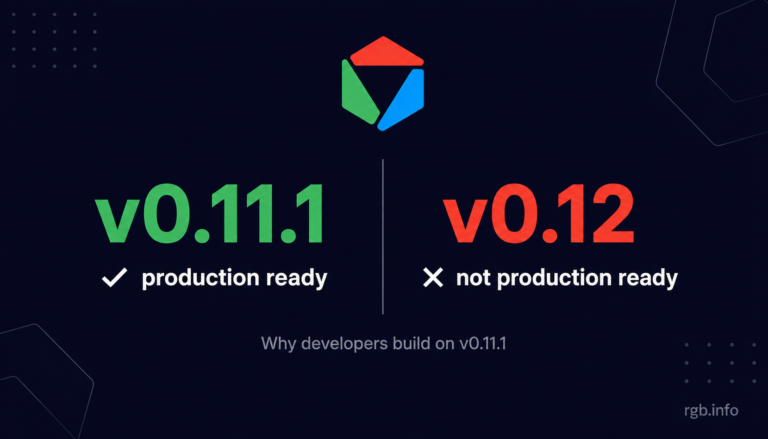
Since the interview, SPV proofs have reached the v0.11.2-rc.1 test version, while v0.11.1 remains the latest stable release.
Lightning as a Connector, RGB on Top
In his view, no single solution will take over Bitcoin scaling. Lightning sparked many alternatives, such as Ark and Spark, each with its own trade-offs on security, storage and liveness; moreover, the amounts one can safely move on Spark differ from the amounts on Lightning. Therefore, he sees the Lightning HTLC protocol as the connector across all these layers, with one invoice format for everybody: for example, a sender could spend Lightning sats and a receiver could get them on Ark.
Because of its very small footprint on any transaction, on-chain or off-chain, RGB can sit on top of everything and bring to RGB assets whatever is possible with satoshis. In addition, swaps complete the picture. For example, a user can pay a USDT invoice with sats and never own USDT, while the merchant receives USDT directly and the service provider in the middle earns fees on the exchange. As a result, Stefano Pellegrini expects RGB to bring more liquidity and more on-chain fees to Bitcoin, to the benefit of everyone’s security.
The full interview is in the video above. For more videos from the RGB ecosystem, follow @RGB_Bitcoin.
Further Reading
- RGB Protocol v0.11.2-rc.1: First Release Candidate After v0.11.1
- How Privacy Is Preserved in RGB Protocol on Bitcoin
- Interoperability on Bitcoin: Mo Harchegani at Tuscany Lightning Summit 2026
Interview recorded at the Tuscany Lightning Summit 2026, Viareggio, Italy. Video on the RGB Protocol YouTube channel.