Real-World Asset Tokenization on Bitcoin with RGB Protocol
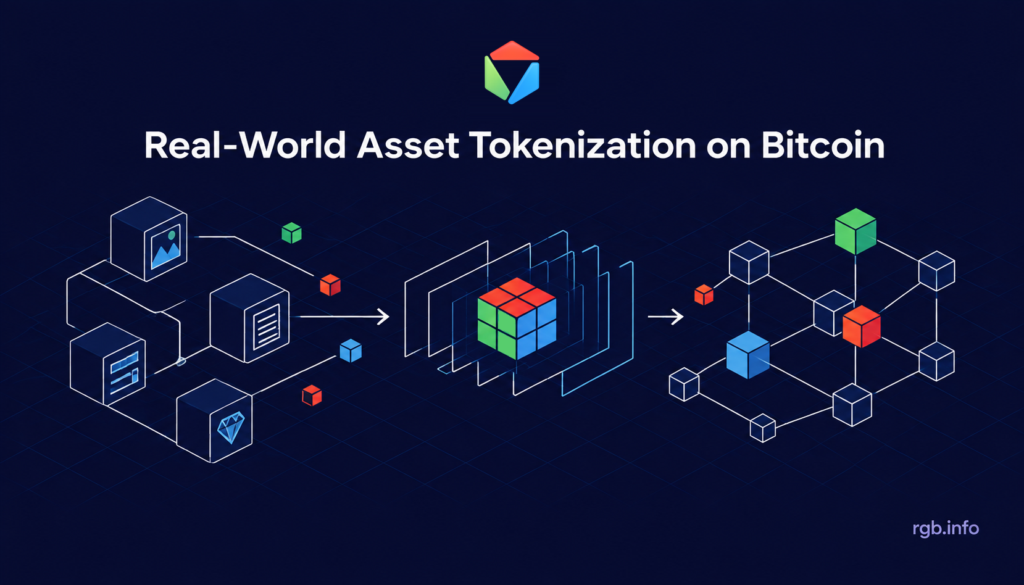
Shares in a private company, a gold bar in a vault, a painting in a gallery: each asset comes with an owner, a set of rights and a paper trail. Real-world asset tokenization on Bitcoin moves the record of ownership into a digital token, with Bitcoin as the settlement layer. In particular, RGB Protocol offers a way to issue the token without using sidechains, with private ownership records. The article covers the tools available today, the schemas still in development and the limits an issuer should weigh before a launch.
RWA Tokenization on Bitcoin in Brief
- A token for a real-world asset represents a claim: the asset itself, and the legal right to it, stay outside the blockchain.
- RGB binds each token to a Bitcoin UTXO through single-use seals and keeps asset data with the owners, off the public ledger.
- Three schemas are available on mainnet today: NIA for a fixed supply, CFA for collectibles in fungible units, UDA for unique assets.
- On the other hand, PFA, for transfers approved by the issuer, IFA, for new issuance and burns, and BFA, for assets bridged from other chains, remain in development.
- An issuer gains privacy and Bitcoin-level security, but with clear limits: no forced recovery of tokens and client-side data in the custody of each holder.
What Is Real-World Asset Tokenization on Bitcoin?
A real-world asset (RWA) is an asset that exists outside the blockchain: equity, bonds, real estate, commodities, receivables, works of art. Tokenizing such an asset means creating a digital token for a claim on the asset. As a result, the claim passes from one owner to the next like any other digital asset, with each transfer leaving a clear record.
The token does not hold a physical object. In fact, the link between the token and the asset rests on the issuer, on custodians for physical assets, and on the law of the jurisdiction. In other words, a blockchain records the holder of the token, while a court or a public registrar decides the rights of the holder.
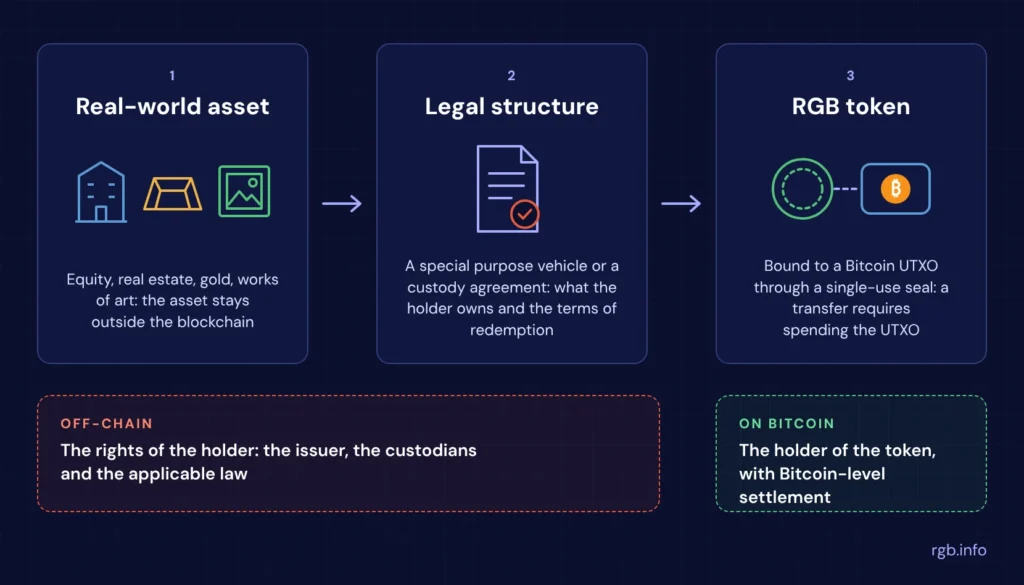
Beyond the token itself, an issuer needs a set of features, with details that vary from asset to asset:
- Contract terms, readable by every holder, with a reliable link to the legal documents.
- Supply rules: a fixed amount, or new tranches under a declared cap.
- Transfer rules for assets with legal limits on their owners, such as shares in a private company.
- Redemption, with proof of the removal of redeemed units from circulation.
- Confidentiality of the register of holders and of the size of each position.
- Settlement on a secure and neutral network.
How Does RGB Represent an RWA?
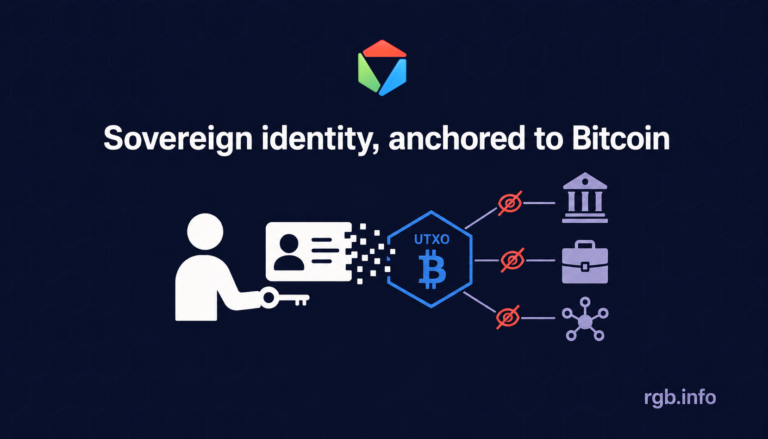
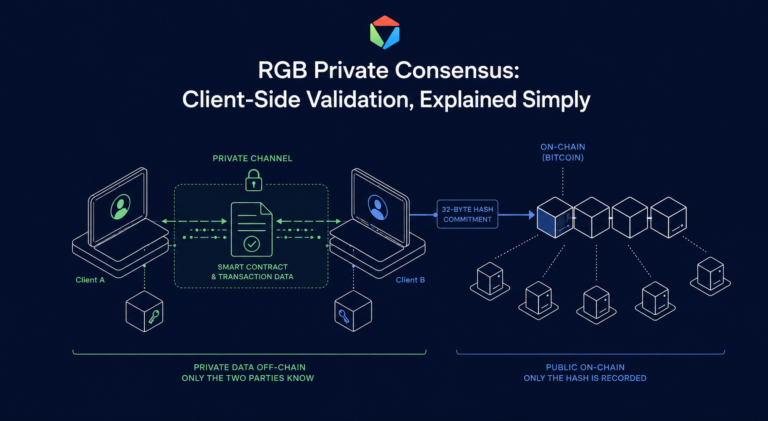
When it comes to real-world asset tokenization on Bitcoin with RGB, each asset takes the form of a contract, with rules fixed at issuance by a schema. Each asset is assigned to a Bitcoin UTXO, an unspent output of a previous transaction, which acts as a single-use seal. Since Bitcoin allows each UTXO to be spent only once, the asset passes to a new owner only when the UTXO is spent, and nobody can transfer the same asset twice.
Moreover, asset data stays with the parties of each transfer. With client-side validation, each owner checks the history of a received asset on their own device, while Bitcoin receives only a commitment, a short hash of the data. Consequently, balances, amounts and the list of holders never reach the public blockchain.
Each schema available on mainnet carries a Contract Terms field: a text describing the contract, with an optional media attachment. The UDA schema also accepts attachments identified by a hash digest. The file itself travels by other means, and anyone with a copy can compare it with the digest in the contract. For example, an attachment can hold a deed, a valuation or a certificate of custody. Therefore, any later change to the file shows up as a mismatch with the digest.
Which RGB Schemas Support RWA Tokenization on Bitcoin Today?
The documentation lists the schemas implemented so far. Three of them are suitable for an issuance on mainnet today, as they are production-ready:
| Schema | What it represents | Possible use for an RWA |
|---|---|---|
| NIA (Non Inflatable Asset) | A fungible asset with a supply fixed at issuance | Units of a closed-end fund, a bond issue of a fixed size |
| CFA (Collectible Fungible Asset) | A fungible asset similar to NIA, with an extra field describing the collectible | Fractions of a single work of art or of a gold bar in a vault |
| UDA (Unique Digital Asset) | A single non-fungible token, with embedded media and attachments | A deed for a property, a certificate for a unique object |
In particular, an NIA asset cannot grow beyond the amount created at issuance, so the issued supply also serves as an upper bound on the circulating supply. A UDA, in turn, has a single issuance of one token, with no fractions.
Which RGB Schemas Are Still in Development?
Three more schemas address common needs of regulated issuers. The rgb-schemas repository marks all three as not production-ready at the time of writing:
- PFA (Permissioned Fungible Asset): the issuer signs every transfer, and the wallet of the recipient checks the signature against a public key in the contract. For example, the documentation cites company shares, with legal constraints on the potential owners.
- IFA (Inflatable Fungible Asset): the issuer can create new units after the first issuance, up to a total supply declared in the contract. In addition, holders can burn units, for example at redemption, with a declared amount as proof of their removal from circulation. Finally, the issuer can link the asset to a new contract, only once, for a move to a newer version of the schema.
- BFA (Bridged Fungible Asset): an asset bridged from a different chain through lock claims, with mint, burn, link and propagate transitions.
Issuers of securities should follow the progress of PFA and IFA closely, because transfer approval and secondary issuance are common requirements in the sector.
What Do Issuers Gain With RGB?
For an issuer, real-world asset tokenization on Bitcoin with RGB starts from Bitcoin security. Ownership is based on Bitcoin UTXOs, with no sidechain or separate set of validators in between. A double transfer of the same asset would require spending the same UTXO twice, which would be an attack on Bitcoin itself. The outcome is a register with the same settlement guarantees as a bitcoin payment.
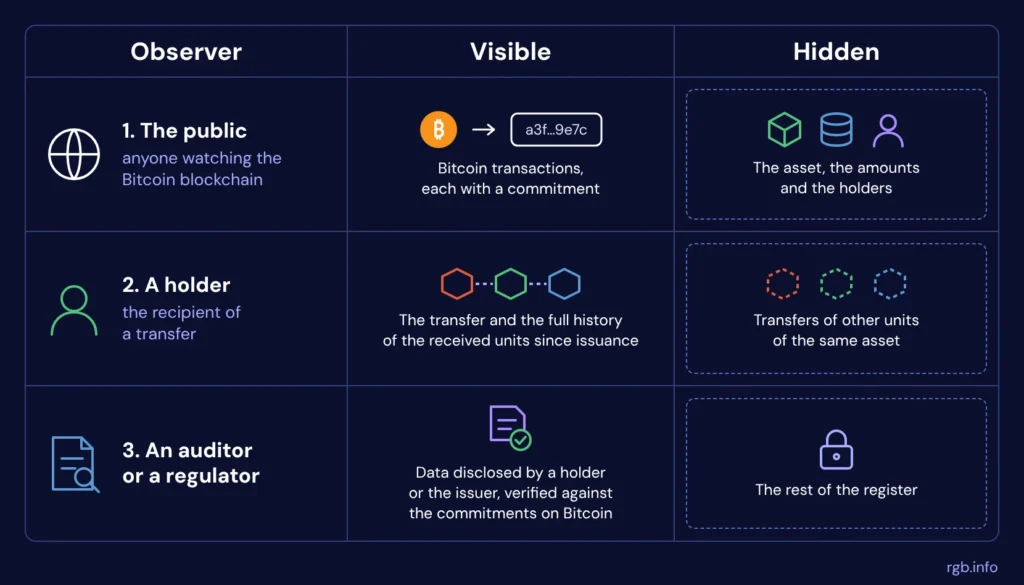
A second advantage is privacy. On a public chain, anyone can read the register of holders of a token, competitors included. With RGB, instead, the data of each transfer passes directly from the sender to the recipient, in a package called a consignment, while Bitcoin receives only a commitment. As a result, amounts and holders never appear on the blockchain, and the details stay with the parties of each transfer, as explained in How Privacy Is Preserved in RGB Protocol on Bitcoin.
Day-to-day operations bring further advantages. The issuer picks a standard schema with known rules instead of writing a custom smart contract, so the amount of code to audit is limited.
Fees are paid in bitcoin, because each transfer anchors in an ordinary Bitcoin transaction, with no need for an extra token. The system also has room to scale: the blockchain stores only commitments, with a single commitment potentially covering several contracts at once through multi-protocol commitments.
Finally, assets can move over Lightning. RGB Lightning Node opens payment channels with RGB assets and routes asset-denominated payments across multiple channels, with the same user experience and security assumptions as regular Lightning payments. In practical terms, each Lightning commitment transaction carries an extra output with the anchor to the RGB state transition, so every update of the channel also updates the state of the asset.
What Are the Limits for Issuers?
Before an issuer considers RGB for real-world asset tokenization on Bitcoin, a few points deserve attention.
The first concerns the legal link with the asset, which stays off-chain. RGB enforces the rules of the token, but the bond between token and asset depends on the issuer, the custodians and the law. The limit applies to every blockchain, so each token still needs a legal structure, for example a special purpose vehicle or a custody agreement, that defines what the holder owns and the terms of redemption.
A second limit concerns regulated issuers in particular: some rules for securities require the power to freeze or move a token, for example after a theft or a court order. With RGB, a transfer happens only when the owner spends the UTXO that holds the asset, so no issuer can move or freeze tokens on its own. The IFA schema includes a reject list URL for operations to treat as invalid; yet, according to the documentation, wallets remain free to ignore the list. Similarly, with PFA an issuer can refuse a signature and block a transfer, but without any power of seizure.
Another limit concerns the custody of the data. Proof of ownership lives in client-side data, beyond the seed phrase, so a lost device without a backup can mean a lost asset. For this reason, rgb-lib, the library behind several RGB wallets, includes an encrypted backup with a password.
Checks on supply also work differently than on a public chain, because RGB has no public counter of circulating units. Instead, auditors rely on the cap declared at issuance, on burn proofs and on data from the issuer. At the same time, privacy still leaves some space for oversight: since the data of each transfer is kept by the parties, a holder or the issuer can disclose it selectively to an auditor or a regulator, who can then verify it against the commitments on Bitcoin. Such a disclosure covers only the history of the units in question, so the rest of the register stays private.
Which Real-World Assets Fit RGB Best?
Overall, RGB suits assets with known holders and a strong need for confidentiality: shares of private companies, private funds, unique objects in custody. On the contrary, the fit is weaker where regulation requires forced recovery of tokens, or where the asset needs to work as collateral in lending protocols on other chains.
In short, for a launch today, real-world asset tokenization on Bitcoin with RGB relies on NIA, CFA and UDA. Later, transfer approval and secondary issuance will follow with PFA and IFA, once both schemas reach production.
Real-World Asset Tokenization on Bitcoin: Frequently Asked Questions
Can I tokenize a real-world asset on RGB today?
Yes, with NIA, CFA or UDA, the schemas available on mainnet. Transfer approval by the issuer (PFA) and secondary issuance (IFA) remain in development.
Does RGB make a token legally binding?
No. RGB enforces the rules of the token, while the rights of the holder depend on the issuer and the applicable law.
Who can see the holders of an RGB asset?
The public sees only Bitcoin transactions with commitments. In contrast, each holder sees the history of the received units. In addition, with PFA, the issuer signs every transfer. Holders and the issuer can also share the data with an auditor or a regulator.
Can an issuer freeze an RGB token?
Not on its own. In fact, a transfer requires the spending of the owner’s UTXO, and a reject list in the IFA schema works only in wallets with support for the list.