RGB as The Universal Asset Standard for Every Bitcoin Layer
Based on the talk “RGB as a Multi-L2 Standard” by Federico Tenga at the Tuscany Lightning Summit 2026, Viareggio, Italy, May 12–13, 2026.
In Brief
- RGB Protocol on Bitcoin uses client-side validation to issue and transfer assets natively on Bitcoin, without publishing transaction data on-chain.
- Ownership of RGB assets is tied directly to Bitcoin UTXOs. It’s the same security model as Bitcoin itself, with no extra trust assumptions.
- As Bitcoin’s layer 2 ecosystem grows (Lightning, Ark, Spark, sidechains), each network is building its own token standard, creating fragmentation.
- RGB’s architecture makes it natively compatible with all existing and future Bitcoin layers, positioning it as the single universal asset standard across Bitcoin’s multi-layer ecosystem.
- No bridges are required to move RGB assets between layers — settlement happens permissionlessly through the Bitcoin main chain.
Bitcoin Is Building a Multi-Layer Ecosystem.
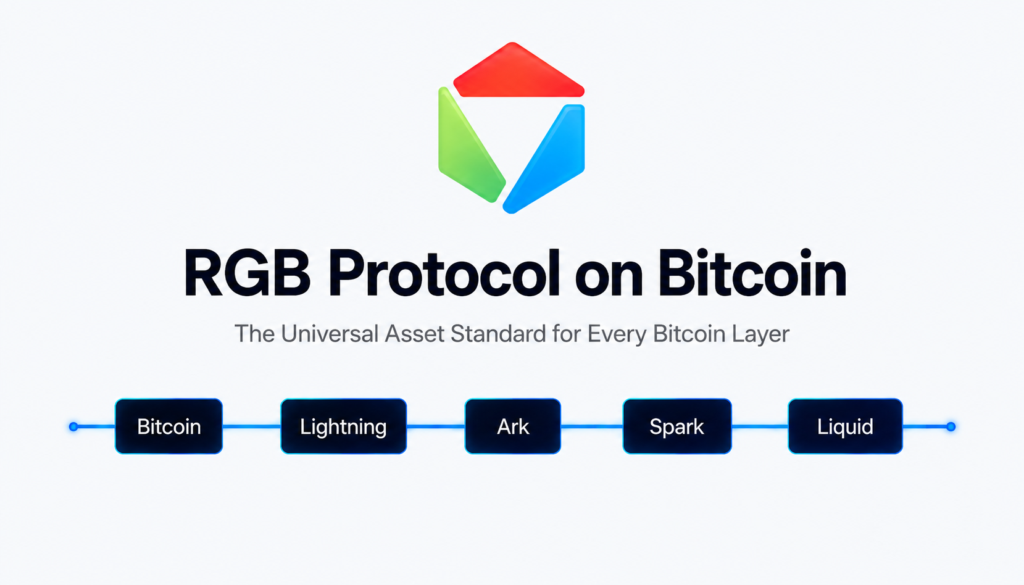
RGB Protocol on Bitcoin is the universal asset standard for Bitcoin’s multi-layer ecosystem: a protocol that allows digital assets issued on Bitcoin to move natively across Lightning, Ark, Spark, sidechains, and any future layer, without bridges.
Tether’s decision to bring USDT to Bitcoin via RGB Protocol drew significant attention to a protocol that has been in development for nearly a decade. According to Federico Tenga, co-founder of the RGB Protocol Association and Head of R&D at Bitfinex, the significance of RGB goes far beyond stablecoin issuance.
At the Tuscany Lightning Summit 2026, Tenga made the case that RGB is positioned to become the universal asset standard for Bitcoin’s entire multi-layer ecosystem, solving a fragmentation problem that is only just beginning to emerge.
“Instead of having a different asset standard for every scalability solution, we can have a single asset standard for tokens that can be on-chain, that can move to Lightning, from Lightning they can be moved to Ark, they can be moved to Spark, to statechains, to sidechains.”
What Is RGB Protocol on Bitcoin?
RGB Protocol on Bitcoin is an open-source protocol for issuing and transferring digital assets natively on Bitcoin. It employs client-side validation: the Bitcoin blockchain is used only as a commitment layer to prevent double-spending, while all asset data is kept off-chain and exchanged directly between sender and receiver.
In practice, each RGB transfer commits a hash of the asset state inside a standard Bitcoin transaction, so the actual asset data never touches the chain. This approach has two immediate consequences.
- Privacy: as Tenga explained, “a blockchain observer cannot even say that an RGB transaction is happening, unlike what happens with most other protocols in the wider crypto ecosystem.”
- Scalability: because RGB assets add no data to Bitcoin transactions, they don’t increase the on-chain footprint, meaning that the same transaction that moves satoshis also anchors an RGB state transition, with no extra block space required.
Ownership is tied to UTXO control, the same security model as Bitcoin itself. The underlying UTXO can be a single-sig, a multisig, or any Bitcoin Script construction; what matters is only the ability to spend it. As Tenga put it, with RGB you get the full security of Bitcoin with no additional trust assumptions (no validators, no federations, no intermediaries).
For a deeper dive into how RGB Protocol on Bitcoin works, read this article by Federico Tenga.
What Is the Fragmentation Problem for Bitcoin Assets?
Bitcoin’s layer 2 landscape has expanded rapidly. Today, developers and users can choose between Lightning, Ark, Spark, Liquid, and various statechains, each offering different trade-offs in trust, speed, and scalability.
This diversity surely creates value, but it also creates a significant problem for anyone trying to issue assets on Bitcoin: each network is building its own token standard.
- Taproot Assets — designed for Lightning on LND
- Ark tokens — native to the Ark protocol
- Spark tokens — native to Spark
- Liquid assets — native to the Liquid sidechain
As Tenga observed, each network has ended up with its own asset standard, which means that a Taproot Assets token and an Ark one are incompatible with each other, even though both protocols settle on Bitcoin. Thus, moving an asset from one network to the other requires a swap provider with liquidity on both sides.
For payment interoperability, this system is manageable. However, bigger problems arise for assets: fragmented liquidity, multiple standards to integrate, and a dependency on bridge operators who need to maintain liquidity on both sides.
Why RGB Is Different
RGB’s architecture was not specifically designed to solve this fragmentation, but the design choices that were made in building it happen to address it directly.
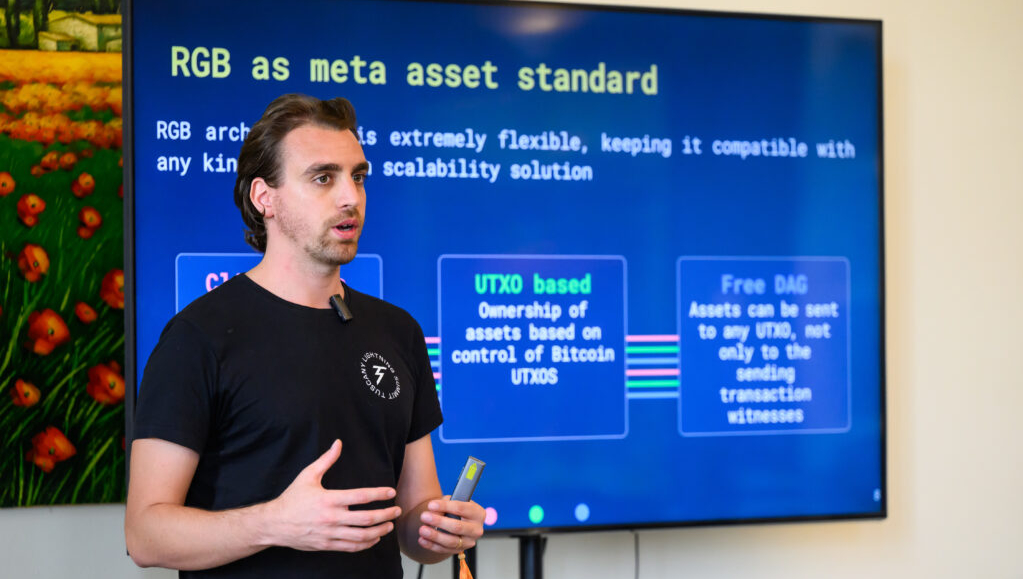
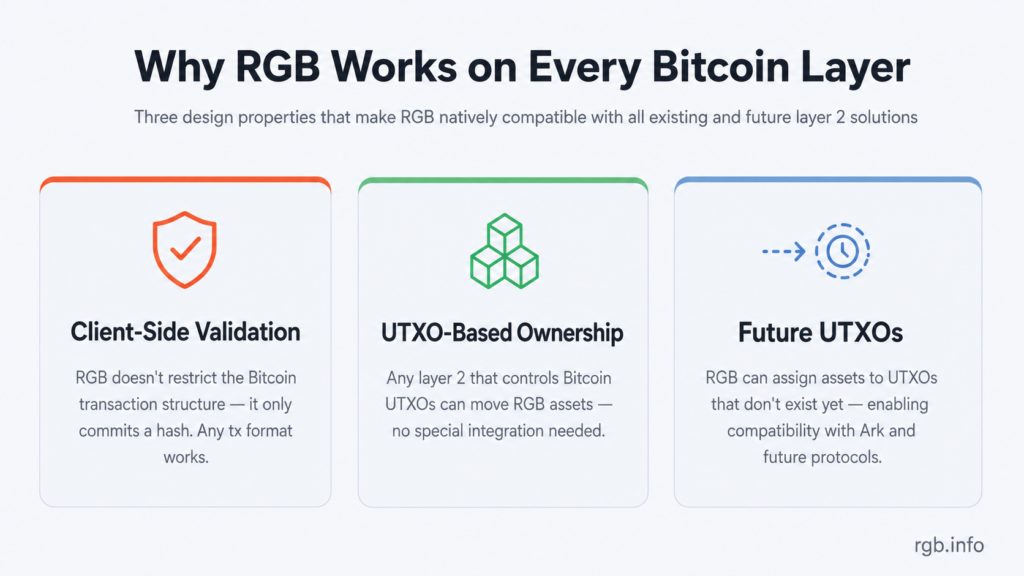
Client-side validation means RGB does not restrict the structure of the underlying Bitcoin transaction. As Tenga explained, because asset data is kept entirely off-chain, RGB doesn’t care how the Bitcoin transaction is structured: how many outputs it has, what script it uses, how many inputs, or whether a future protocol uses sequence numbers or timelocks in unusual ways. RGB only needs to commit a hash inside the transaction. Everything else is irrelevant.
UTXO-based ownership means that if a layer 2 protocol can move Bitcoin UTXOs, it can also move RGB assets, without requiring any special integration.
“Whatever way a Bitcoin layer 2 finds to control UTXOs and move value around, you can do the same with RGB assets, because RGB assets are connected to UTXOs the same way satoshis are.”
In other words, any scalability improvement that works for satoshis will also work for RGB assets, automatically.
The ability to send assets to future UTXOs is a property that sets RGB apart from every other asset protocol, and removes a structural bottleneck for layer 2 service providers. In general, most asset protocols can only assign assets to outputs of the current transaction. Instead, RGB can assign assets to any UTXO on the Bitcoin blockchain, including ones that don’t exist yet.
Let’s take the example of Ark. Payments are batched in rounds, and each participant knows their output identifier before the round is confirmed on-chain. RGB can assign assets to that future output right now: something no other asset protocol can do.
“You even have the possibility to send assets to a UTXO that doesn’t exist yet — which can be very nice when you want to integrate with certain layer 2 solutions.”
The RGB team never designed this compatibility protocol by protocol. As Tenga explained, “it was just a general design that happened to be compatible with all of these solutions”, and by extension, with any future layer 2 that hasn’t been imagined yet.
Permissionless by Design
The practical implication of this architecture is significant: moving RGB assets between Bitcoin layers does not require any bridge infrastructure.
If a user wants to move RGB assets from a Lightning channel to Ark, the process is straightforward: you close the Lightning channel, receive the assets on-chain, then send them to an Ark service provider (ASP), without going through any bridge operator, liquidity dependency, or cross-chain swap.
As a matter of fact, the only bridge needed is the Bitcoin main chain itself. To move an asset from Lightning to Ark or Spark, a user simply settles back on-chain and then enters the new layer. Swaps can be added on top to make the process faster, but the underlying rebalancing happens in a permissionless way, without building any extra infrastructure.
All of the above is in contrast to the multi-standard scenario, where moving an asset from one network to another requires an operator with sufficient liquidity on both sides: it’s a dependency that doesn’t scale as new networks emerge.
This has significant implications for asset issuers, that most coverage of RGB has so far overlooked.
In a fragmented ecosystem, every new layer 2 protocol represents a new integration burden.
For example, to make USDT available on Lightning, Ark, Spark, and Liquid, Tether would need to separately support four different token standards, and repeat the process for new protocols. An issuer might choose to integrate the two or three most popular networks, but they are unlikely to track and support every new layer tool that appears. In this scenario, new protocols would launch without access to the assets users actually want.
RGB Protocol on Bitcoin inverts this dynamic entirely. Once an asset is issued on RGB, users can freely move it to any compatible layer, without the issuer having to take any action, or even being aware of it.
The issuer’s role ends at issuance. What happens next is up to the users and the wallets they choose.
As a consequence, as Bitcoin’s layer 2 ecosystem grows and new protocols emerge, the new systems will not need to convince Tether — or any other major issuer — to support them. They just need to integrate RGB.
What Is the Current Status of RGB Across Bitcoin Layers?
As of mid-2026, the status of RGB across Bitcoin’s layers is as follows:
| Layer | Status |
|---|---|
| Bitcoin mainchain | ✅ Fully Supported (v0.11.1, July 2025) |
| Lightning Network | ✅ Fully Supported (RGB Lightning Node) |
| Ark | 🔬 Proof of concept |
| Statechains | 🔬 Proof of concept |
| Liquid | 🔬 Proof of concept |
“The concepts have already been proven through prototypes, but they still didn’t reach the maturity needed for production readiness. The thing is, it has been proven that RGB is compatible with all of these technologies.”
As Tenga saw it, the economics will do the work. Shared liquidity across all layers is simply more valuable than the same liquidity fragmented across competing standards — and that natural incentive, he believed, will push the ecosystem toward convergence on a single asset standard.
How Does RGB Compare to EVM Asset Standards?
Tenga drew an explicit parallel to the EVM ecosystem, where interoperability between Ethereum-compatible chains has enabled a relatively robust asset economy. The Bitcoin ecosystem has struggled to obtain the same result, until now.
“The fact of having a single standard for all the different Bitcoin layer tools allows us to create an asset economy on top of Bitcoin that can be a bit stronger and a bit more able to compete with EVMs and other parts of the crypto industry.”
USDT launching on RGB Protocol on Bitcoin is the first real-world test of this thesis. Once it is live on RGB, it doesn’t need a separate integration for Ark, Liquid, or Spark: it’s up to users and wallets to move it to whichever layer they prefer.
“Now the work we are doing on RGB is even more important — it’s not just another way to have assets on top of Bitcoin or on top of Lightning, but it becomes a protocol that solves a problem that the ecosystem is about to face, in a new and unique way that wouldn’t easily be replicated by protocols that made different trade-offs in their design.”
Further Reading
For a complete account of how RGB Protocol on Bitcoin came to be, from its origins as a tokenization protocol to Lightning compatibility and the v0.11.1 mainnet launch — see The History of RGB Protocol on Bitcoin on our blog.