What You Can Issue on Bitcoin Today: Birkan Kayadibi at BTCHEL 2026
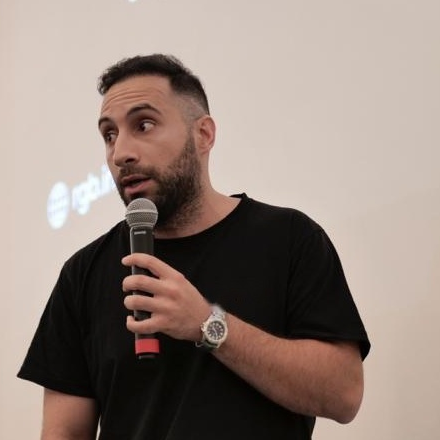
At BTCHEL 2026, The Nordic Bitcoin Conference in Helsinki, Birkan Kayadibi, COO of RGB Protocol Association, gave a talk with a simple question as its title: “What can you actually issue on Bitcoin?”
The whole talk was based one thesis: the dollar left Bitcoin for engineering reasons, but they now belong to the past.
In Brief
- Where and when: BTCHEL 2026, Kaapelitehdas (Cable Factory), Helsinki, Day 1, September 25, 2026, OG stage.
- Five asset types on mainnet: RGB Protocol on Bitcoin offers five implemented schemas today: NIA, IFA, PFA, CFA and UDA.
- A two-way deal: Bitcoin gains usage for Lightning and a place in institutional finance; stablecoins gain privacy, predictable fees and the most secure settlement layer in existence.
- A huge market elsewhere: about $307 billion in stablecoins, half of all USDT on Tron, and almost none of it on Bitcoin.
- USDT on the way: Tether announced its plan in August 2025, Utexo is building the infrastructure, and partners already at work on integrations, but no launch date yet.
How Can You Issue Assets on Bitcoin Today?
With RGB, you can issue assets on Bitcoin through five implemented schemas, on mainnet, with no change to Bitcoin itself.
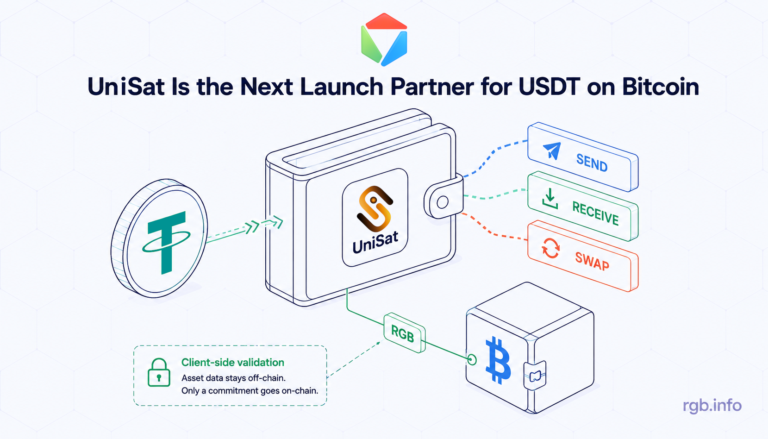
The first idea behind the system is client-side validation. On Ethereum, every node in the world stores every token transfer forever. With RGB, the data about an asset and its history travels only between the parties of each transfer: the sender passes the proofs, and the receiver’s wallet verifies the proofs.
The second is the single-use seal. Each piece of ownership is tied to a Bitcoin UTXO, and a UTXO can be spent only once. RGB “does not invent a new consensus mechanism to prevent double spending. It borrows the one that has been running for seventeen years.”
His analogy came from land registries: a registry could publish every contract in a newspaper, or stamp a unique notarized seal and let the parties keep the documents. Bitcoin is the stamp; RGB is the documents. All Bitcoin sees is a small cryptographic commitment inside an ordinary transaction.
Four consequences follow from the design:
- Privacy between users: balances and transfers aren’t a public feed. The issuer keeps full knowledge of its own issuance and can meet its obligations.
- No chain bloat: a node with no interest in RGB stores nothing extra and validates nothing extra.
- Lightning: since ownership is anchored to UTXOs, assets can live inside Lightning channels.
- No fork: no soft fork, no new opcode, no change to Bitcoin at all.
The five asset templates, or schemas, are another basic of the design:
| Schema | Name | Use |
|---|---|---|
| NIA | Non Inflatable Asset | A fungible token with a supply fixed at issuance |
| IFA | Inflatable Fungible Asset | A fungible token whose holder of the inflation right can issue more, up to a total supply set at issuance, and which supports burning |
| PFA | Permissioned Fungible Asset | A fungible token where the issuer must sign every transfer, e.g. company shares with legal limits on owners |
| CFA | Collectible Fungible Asset | Similar to NIA, with an extra field describing the collectible |
| UDA | Unique Digital Asset | A unique, non-fungible asset, with embedded media or attachments |
According to Birkan, IFA has the shape of a stablecoin: a token minted for every incoming dollar, a token burned for every outgoing one. PFA addresses the problem that usually blocks regulated instruments on public chains, the idea that “anyone can transfer to anyone”.
He also pointed out two absences from the list: no general-purpose virtual machine and no DeFi composability. RGB uses private contracts built from the templates, a deliberate choice, because “the attack surface of a stablecoin should be as small as possible”.
Of the five, Birkan’s thesis is that two matter most right now: stablecoins (IFA) and real-world assets (mostly PFA), the areas with real demand and with institutions already signing agreements.
Why Does Bitcoin Need Stablecoins?
Birkan met the room’s most likely objection directly, conceding that much of what has landed on Bitcoin in recent years is noise. However, he argued that RGB differs in two aspects: no arbitrary data on-chain and no change to Bitcoin’s consensus rules.
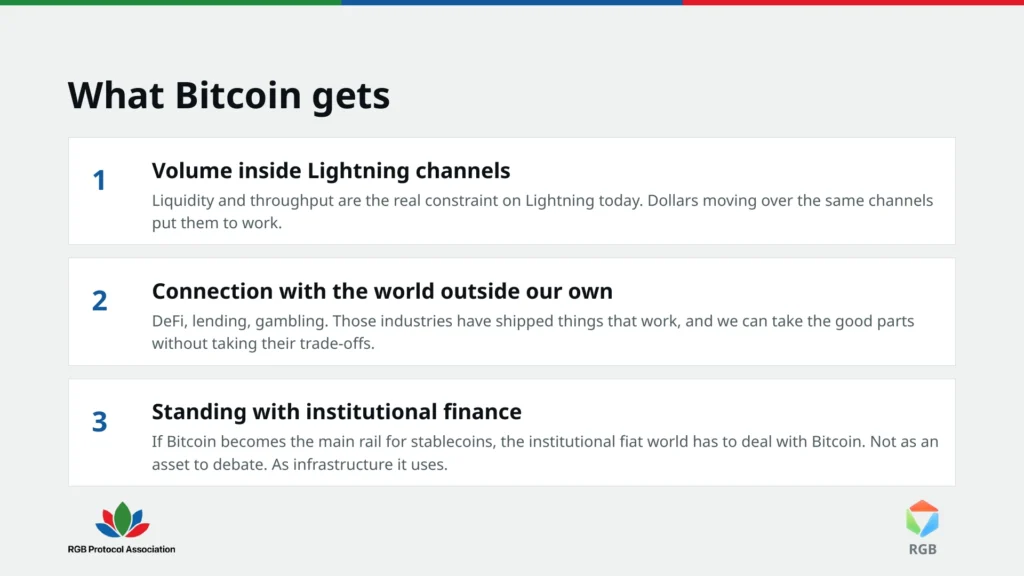
He then listed three benefits for Bitcoin:
- Lightning. The real limit of the Lightning Network today is volume: channels hold unused capacity for lack of traffic. Dollars moving through the same channels would put the capacity to work, with routing fees for the node operators already in the room.
- Contact with the outside world. DeFi, lending and gambling have shipped products at scale with real users. Birkan suggested learning from their experience without copying them: “We can take the good parts without taking their trade-offs.” In his words, “careful and isolated are not the same thing.”
- Standing. If Bitcoin becomes the main rail for stablecoins, the institutional fiat world has to use Bitcoin as everyday infrastructure, far beyond a line in a risk report. According to Birkan, a shift with more weight than any ETF.
“I want everything to be on Bitcoin”, with everyone free to use it in their own way.
What Do Stablecoins Get from Bitcoin?
Stablecoins gain three things from Bitcoin:
- Privacy. On every major chain, a stablecoin balance is public. Anyone can watch a company’s treasury, follow its suppliers and work out its margins: it’s the first complaint of corporate treasurers.
- Speed and predictability. Lightning settles instantly at a stable cost, with no gas auctions and no wait for a block.
- Security. Settlement anchored to the chain with the highest rewrite cost in the world, controlled by no one in particular.
Tether can find none of the three features on other chains, so the reason why USDT is coming back to Bitcoin in quite clear.
How Big Is the Stablecoin Market?
Birkan drew some data from DefiLlama and the April 2026 report Stablecoins: from DeFi primitive to global financial infrastructure by Bessemer Venture Partners, which shows a market that reaches well beyond crypto:
- About $307 billion in stablecoins in circulation, with $184 billion in USDT alone, roughly 60% of the market.
- About 45 times the size of March 2020, when the supply of fiat-backed stablecoins stood at $6.8 billion.
- $10.9 trillion in adjusted transfer volume in 2025 (excluding bots and internal movements), up 91% in a year. For comparison, Visa processed $14.2 trillion in the same year: a different metric, in Birkan’s own words, but the same order of magnitude.
- $400 billion in real-world payments in 2025, double the previous year, with about 60% business-to-business: suppliers, payroll and cross-border invoices.
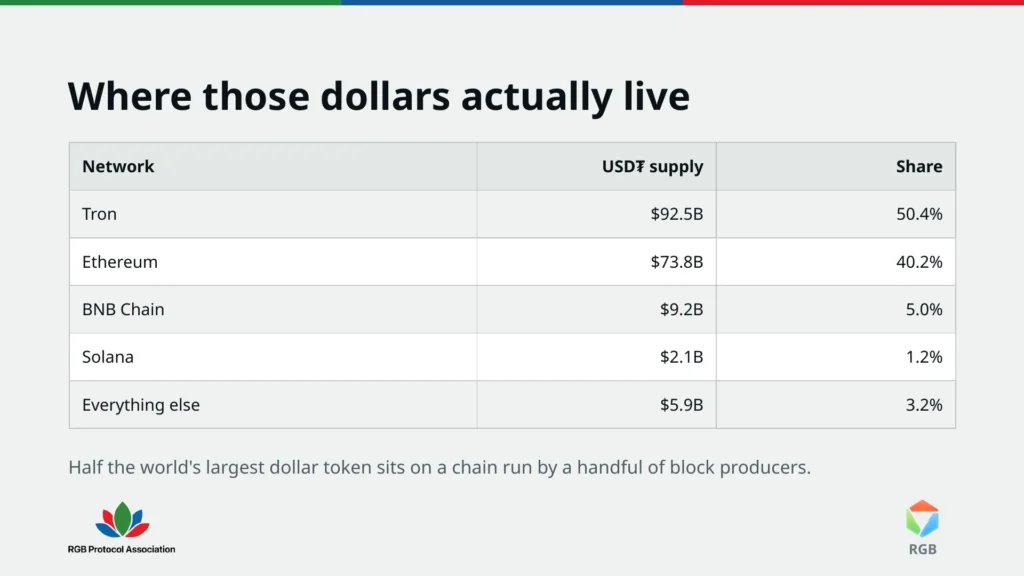
Today, half of all USDT, about $92 billion, is on Tron, and around 40% on Ethereum. Tron remains useful for people sending money home from countries such as Argentina or Turkey, their own families’ country of origin. However, the chain is secured by a small number of block producers, that exposes every transfer publicly.
Bitcoin’s share of the world’s digital dollars, meanwhile, is close to zero. The most secure and neutral settlement network ever built carries almost none of them.
Real-world assets tell the same story: tokenized treasuries are worth nearly $13 billion, 13 times the value of April 2024. According to Birkan, regulated issuers need two things before they can use a public chain:
- control over who can hold and transfer the asset
- privacy for each holder’s balance.
PFA provides the first, client-side validation the second. Both are part of the asset itself, with no wrapper on top.
How Will USDT Reach Bitcoin?
Tether’s announcement. On August 28, 2025, Tether announced its plan to launch USD₮ on RGB, on Bitcoin. CEO Paolo Ardoino’s words: “Bitcoin deserves a stablecoin that feels truly native, lightweight, private, and scalable.” The announcement came eleven years after USDT’s first launch on Bitcoin, via Omni, and about a month after RGB v0.11.1 reached Bitcoin mainnet in July 2025.
Who builds the rails. Utexo, a member of RGB Protocol Association, describes itself as a Bitcoin-native execution and settlement layer and leads the commercial rollout with four components:
- SDKs for RGB assets and Lightning payments in Node, browser and mobile apps, including modules for Tether’s Wallet Development Kit
- Managed RGB Lightning nodes, with remote signing for key management
- Mint, to move USDT between other networks and Bitcoin
- Swap, for non-custodial cross-chain swaps, including dollars against bitcoin
How a dollar gets to Bitcoin. A user deposits USDT on one of the supported networks (Ethereum, Arbitrum, Polygon, Plasma or Tron). Three independent signer nodes validate the deposit and co-sign the release, with keys that never leave the secure hardware enclaves of the nodes. The user then holds USDT on Bitcoin, on the RGB layer, ready for transfer or exchange against BTC.
Birkan was open about the trade-off: while a dollar crosses between chains, users rely on a federation of signers and their hardware. Once the asset is on Bitcoin, trust goes back to client-side validation and the user’s own UTXOs. “Bridges are the hard part of this industry and anybody telling you otherwise is selling something.”
The integration partners: exchanges, wallets and payment companies with a signed agreement or an integration in progress, with no room for simple expressions of interest.
- UniSat was announced in September 2026 as the next launch partner, with more than one million weekly active users;
- RGB-native wallets such as KaleidoSwap, Iris and Tribe;
- On the payments and infrastructure side, BTCPay Server, Bitrefill, BiHelix and the modules inside Tether’s WDK.
According to Birkan, more names will come from the companies themselves.
The protocol is on mainnet, the intention is public, the tooling and integrations are under construction. The issuance date will come after Tether’s approval.
A Closing Message
The dollar left Bitcoin because of the scaling limits of asset data on the base layer, and because other chains were cheaper and easier. With client-side validation, the data stays with the users, and Bitcoin surpasses other chains on the settlement side.
So, which assets can you issue on Bitcoin? Fixed-supply tokens, inflatable tokens for stablecoins, permissioned tokens for regulated instruments, and unique assets. On mainnet, today.
Birkan also invited the audience to the Agentic Dollars on Bitcoin hackathon, in Turin on October 17–18: stablecoins, agents and payments, open to anyone, with or without a Bitcoin background.
For anyone who wants to go deeper into the topics of this article, RGB Protocol Association extends a second invitation: the Stablecoin Summit in Lugano, on Sunday, October 25, 2026, one morning on digital dollars and Bitcoin during Plan ₿ Week.
Further Reading
- Stablecoin Summit in Lugano: One Morning on Digital Dollars and Bitcoin
- Tether CEO Paolo Ardoino on Bitcoin’s Future: Why USDt Could Move to RGB Protocol on Bitcoin
- The Business Case for USDT on Bitcoin: Utexo’s Bet on RGB and Lightning
- UniSat Is the Next Launch Partner for USDT on Bitcoin