Darius of LNFI Network on Bitcoin, Nostr, and Why RGB Was the Missing Piece
This article is based on an X Space recorded on July 29, 2026, the first Chinese-language community call hosted by RGB Hub, in collaboration with LNFI Network. Darius (@dariusnostr) is a co-founder of LNFI Network, a multi-asset DeFi platform for the Bitcoin Lightning Network.
In Brief
- Darius bought his first bitcoin in 2015 as a university student in Singapore, after discovering a bitcoin futures trade yielding roughly 250% APY.
- Before founding LNFI, he worked in traditional finance (private equity at Blackstone, quant trading) before moving full-time into crypto in 2019.
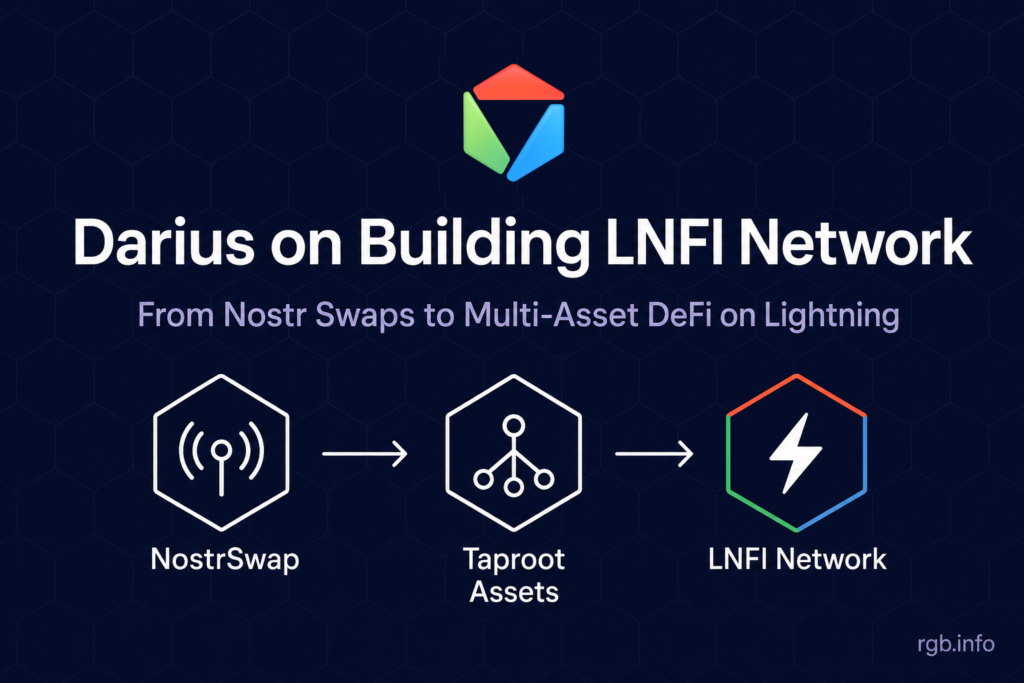
- LNFI started as NostrSwap in 2023, born out of disappointment with centralized, exploit-prone DeFi on Ethereum; it evolved through Nostr Assets before becoming LNFI Network (short for Lightning Finance).
- RGB Protocol on Bitcoin was always on LNFI’s roadmap, but the team waited until 2025, after meeting Federico Tenga, to judge the protocol mature enough to integrate.
- LNFI’s next 1-2 years: a faster LN Exchange ahead of USDT, a node service for self-custodial large traders, and “Lightning abstraction” so users no longer need to know which asset protocol (RGB, Taproot Assets, Spark, Ark) their funds live on.
How Did You First Get Into Bitcoin?
I first came across Bitcoin as an undergraduate at the National University of Singapore, around 2014 or 2015. Ethereum had just completed its ICO, and the whole campus was talking about blockchain. It felt exciting, almost cool, to be part of that conversation.
I bought my first bitcoin in 2015, when it was only worth a few tens of dollars. Around the same time, I found a post on an early forum, BitcoinForum.com, describing what was probably the world’s first bitcoin derivative: a futures product. You could deposit bitcoin on an exchange and sell futures against it, a cash-and-carry trade. Given how volatile bitcoin was back then, that trade alone could return something like 250% APY in a single year, compared to the 8% my finance classes considered a good return on stocks. That’s when bitcoin really got under my skin, and I started digging deeper into what it, and blockchain in general, actually were.
What Did You Do Before Founding LNFI Network?
When I graduated, around 2015 or 2016, Singapore didn’t really have a blockchain job market yet, Bitmain didn’t even set up its Singapore office until 2017. So I went into traditional finance instead: private equity at Blackstone, then quantitative trading. I kept following the top DeFi projects on Ethereum on the side, and eventually contributed to a few of them.
I only moved into crypto full-time in 2019, working on tokenomics design, algorithms, and quant trading. Then came 2020 and 2021, the “DeFi summer”, when bitcoin ran from around $8,000 to the tens of thousands. Almost every friend I had in traditional finance jumped ship into crypto around that time. Before starting LNFI, I worked on some fairly prominent projects, Street Finance and dYdX among them.
Founding a company is a different kind of pressure entirely. You’re the founder, there’s no real time off. You have runway, payroll to make every month, servers to pay for, so you do whatever it takes to make the product work.
What Led You to Found LNFI Network?
By 2023, I’d grown genuinely disappointed with DeFi on Ethereum and other EVM chains. There was hidden centralization everywhere, theft, front-running, sandwich attacks, and the market mood was bad, bitcoin was sitting around $30-40k. I felt that DeFi, as people had imagined it, wasn’t supposed to look like that.
Around then, my co-founder Luke came to me after digging into Nostr, a decentralized information protocol, not a blockchain. What made it interesting is that Nostr uses the exact same elliptic curve (secp256k1) and seed phrase standard (BIP39) as Bitcoin: the same seed phrase can generate keys for both. With Ordinals and BRC20 assets getting hot at the same time, we built our first product, NostrSwap, a peer-to-peer swap service for BRC20 tokens. It didn’t really take off.
Not long after, we found Lightning Labs’ Taproot Assets whitepaper, published in 2022, and realized you could issue assets on the Bitcoin base layer and run them on Lightning for near-instant settlement, instead of waiting at least ten minutes for on-chain confirmation. We folded Taproot Assets in and renamed the project Nostr Assets. As Lightning increasingly became the technical core of what we were building, rather than Nostr, we renamed again, this time to LNFI Network: LN for Lightning, FI for Finance. Lightning Finance. That’s the name we’ve kept since.
Looking Back, What Were the Key Milestones?
Honestly, the whole space moves so fast that we’ve never stopped iterating. We started with Ordinals support, brought in Nostr, shipped the first version of NostrSwap, added Taproot Assets, then leaned further into Lightning. More recently, that’s meant integrating RGB Protocol on Bitcoin, including RGB’s own approach to running on Lightning.
Every one of those steps felt like a milestone at the time, but the ecosystem keeps getting more complex, there’s Ark now, there’s Spark, each with its own variants. It never really slows down.
What Were the Biggest Challenges Building LNFI?
A few things stand out. Finding the right angle took a long time, we repivoted more than once. Education costs are genuinely high: most people still think in on-chain terms, shaped by years of Ethereum and Solana, so explaining off-chain settlement is a real uphill climb, and bitcoin’s own asset landscape keeps fragmenting further, which doesn’t help.
We also launched a community token in 2023, which turned out to be something of a double-edged sword, it affected our ability to acquire new users afterward in ways we hadn’t fully anticipated. And USDT still hasn’t properly launched on Lightning: at the start, there were at least twenty teams building toward issuing USDT on Taproot Assets, and most of them have quietly given up since. Nostr adoption has stayed fairly low too, though I’ve noticed renewed interest lately, mostly tied to AI use cases.
Why Did LNFI Decide to Support RGB Protocol on Bitcoin?
RGB Protocol on Bitcoin had been on our roadmap from early on. We first looked at it seriously back in 2023, around when Taproot Assets first shipped, but concluded the protocol wasn’t mature enough yet, so we shelved it.
The situation changed around late 2024 or early 2025, when we met Federico Tenga at a Lightning-focused conference in Singapore or Hong Kong. He walked us through how far RGB had come and what set it apart from Taproot Assets. By 2025, we felt the timing was finally right, there was a stable, working mainnet version, and the RGB ecosystem clearly needed the kind of DeFi infrastructure we could bring. We committed to it fully.
Since then, we’ve stayed close with Federico and helped bring some of RGB’s earliest assets to market on LNFI, including PepeRGB ($PPRGB), the first memecoin issued on RGB Protocol, and SUS, another early RGB20 asset traded on our platform. That work put us in touch with what I’d call the first real wave of RGB users.
What changed my thinking most, though, was hearing how Federico now frames RGB itself. Bitcoin today has Ordinals, Runes, Taproot Assets, Spark assets, Ark assets, and more, a genuinely fragmented landscape. RGB’s real value isn’t being just another multi-asset protocol, it’s acting as the bridge between all of them, letting an asset move from one protocol to another and reducing how split up bitcoin’s liquidity has become. I’d call it one of the most important connective pieces to land since USDT went live on bitcoin.
What’s LNFI’s Roadmap for the Next Year or Two?
Three things, mainly. First, a major upgrade to LN Exchange, our order book, aimed at latency low enough to compete with well-known centralized order books, in preparation for USDT’s real launch. Second, a node service for large holders who want genuine self-custody while trading. Third, and this is the one I care about most, “Lightning abstraction.” Right now, Lightning has too many competing asset protocols, RGB, Taproot Assets, Spark, Ark, and building or even just using any of them is getting more complex by the day. Users shouldn’t need to know or care which protocol their USDT happens to live on to use it. That complexity should sit behind the interface, not in front of it.
I really hope RGB and LNFI keep growing together.
What Would You Say to Someone in the Chinese Community Just Discovering RGB?
Start slow, and lean on AI to learn the core concepts, or even to help you build a simple first prototype if you want to develop something. I think Nostr combined with RGB is a genuinely interesting, still mostly unexplored space. On the Taproot Assets side, Ark Labs has been building tVTXOs, virtual outputs that embed Taproot Asset commitments into Ark’s off-chain layer, as a friendlier route to self-custodied asset transfers. I’d bet someone builds something similar for RGB before long.
There’s a lot of room left to explore. Keep an open mind, ship something small, and let the market tell you if it’s worth pursuing.
Any Advice for Young Builders on Bitcoin?
Honestly, I think most of the interesting exploration on Ethereum and other EVM chains has already happened. Bitcoin is still the frontier that hasn’t been fully mapped out. Even outside of RGB specifically, look at what Jack Dorsey’s team has been shipping recently, tools like Buzz that let you build through prompts instead of hand-writing everything, which could genuinely change how people collaborate on code, maybe even replace the GitHub-style workflow we’ve used for twenty years. Pair that with Lightning settlement for paying out completed work, and it gets interesting fast.
Building today isn’t the hard part, a good idea and some AI assistance can get you to a working MVP quickly. The hard part is building in public, sharing what you’re making before it’s polished, so people can tell you honestly whether it’s worth pursuing. That’s the step people skip, and it’s the one that matters most.
From the Audience
Listeners also put Darius on the spot with a few practical questions.
On trading fees, he confirmed LN Exchange charges fees in whichever asset is being bought or sold, the same convention used by major exchanges like Binance and OKX, rather than settling fees only in sats.
On market structure, LNFI currently runs mostly peer-to-peer, since it suits lower-liquidity assets better; the order book, LN Exchange, will take on a larger share of volume as liquidity grows, a gradual transition rather than a switch. Someone raised the current cap on order size, and Darius agreed it made sense before USDT properly launched, but should loosen once real liquidity arrives and the market can set its own size naturally.
On what happens once USDT ships, he confirmed LNFI’s existing, self-issued USDT on Taproot Assets will be fully converted to RGB-based USDT, with future trading pairs depending on how liquidity develops from there.
Please find the new Telegram community for Chinese-speaking builders and enthusiasts here: t.me/rgb_zhongwen.