USDT Back to Bitcoin: Viktor Ihnatiuk on the Stephan Livera Podcast
In a new episode of the Stephan Livera Podcast, Viktor Ihnatiuk, CEO of Utexo, talked about bringing USDT back to Bitcoin with RGB Protocol on Bitcoin. He covered the first users he expects, the integrations with wallets and exchanges, lending, the business model of Utexo, compliance and the security of the bridge, and a new proof of concept for fee sponsorship in rgb-lib.
Watch the full episode in the video below.
In Brief
- Privacy first: Viktor expects businesses to be the first users of USDT on Bitcoin
- Integrations before launch: large exchanges and wallets first, distribution partners next
- One standard for every layer: RGB as a common asset standard for Lightning, Liquid, Ark and Spark
- Compliance and security: a blacklist server for flagged UTXOs and a bridge audited by Oxorio
- Fees without BTC: a proof of concept in rgb-lib lets a third party pay the Bitcoin fee of a transfer
From Boosty Labs to Utexo: Bringing USDT Back to Bitcoin
Viktor has worked full time in Bitcoin since 2015, when he started the first Bitcoin conference in Ukraine. He later built Boosty Labs, a development company with about 150 developers, working for clients across the Bitcoin and crypto industry, and then a venture studio focused on Bitcoin.
In 2023, he met Oleg Mikhalsky of Fulgur Ventures and Federico Tenga. Together they started an R&D lab for RGB, which worked with Federico’s team on the launch of RGB on mainnet in 2025. Viktor then founded Utexo, with the goal of bringing USDT back to Bitcoin from other chains. Today, the company offers a bridge, an SDK and APIs for wallets and exchanges.
Why Businesses Will Bring USDT Back to Bitcoin First
Viktor expects business users, not retail, in the first phase. The first rollout of USDT on Bitcoin works on-chain, with a block every ten minutes or so. Support for RGB over Lightning, through the RGB Lightning Node, is planned for the end of the first quarter of 2027 or soon after.
Slow confirmations may bother some users, but not the businesses that move large amounts. They want their transactions visible only to their counterparties. According to Viktor, privacy will bring the first wave of USDT users from Tron and Ethereum to Bitcoin. With Lightning, privacy improves further, because a payment no longer needs an on-chain transaction at all.
Wallets, Exchanges and Lending
Stephan pointed to the strong network effect of USDT on Ethereum and Tron, the main obstacle to bringing USDT back to Bitcoin. Viktor learned from Lightning that a good technology stays unused without support from the exchanges and wallets of everyday users, so Utexo follows a two-stage strategy:
- from zero to one: integrations with the largest exchanges and wallets before the launch, with UniSat among the launch partners;
- from one to a hundred: distribution partners that serve many companies with their infrastructure.
Swaps are also a business opportunity for wallet builders. Today, a wallet that holds only bitcoin has little to swap, but with USDT on Bitcoin, even a Bitcoin-only wallet can let its users switch between BTC and USDT.
Non-custodial lending is another opportunity for Viktor. With bitcoin and USDT on the same chain, a lender and a borrower can set up a loan with HTLC-style contracts and no custodian in the middle. He thinks large DeFi lending protocols could bring part of their BTC-USDT liquidity to Bitcoin itself. Utexo is also looking into on-chain spot and perpetual trading for the BTC-USDT pair.
RGB as a Standard for Every Bitcoin Layer
Asked about Liquid, Taproot Assets and Spark, Viktor recalled the talk by Federico Tenga about RGB as a standard across Bitcoin layers at the Tuscany Lightning Summit 2026. KaleidoSwap has shown proofs of concept of RGB on Liquid and on Ark, and RGB already works on Lightning.
Viktor does not want Lightning, Ark, Spark or Liquid to win at the expense of the others. Each layer serves its own use cases, and a single asset standard can connect all of them, without a separate format for each small ecosystem.
How Utexo Works: Revenue, Compliance and Security
According to Viktor, Utexo has three sources of revenue:
- a fee of 10 basis points on bridge transfers, open to institutional clients only;
- transaction fees, with batching of many transfers into a single Bitcoin transaction;
- an intent-based swap platform across Tron, Ethereum, Solana, other EVM chains, Bitcoin, RGB and Lightning.
Retail users reach USDT on Bitcoin through the swap platform, with liquidity from market makers.
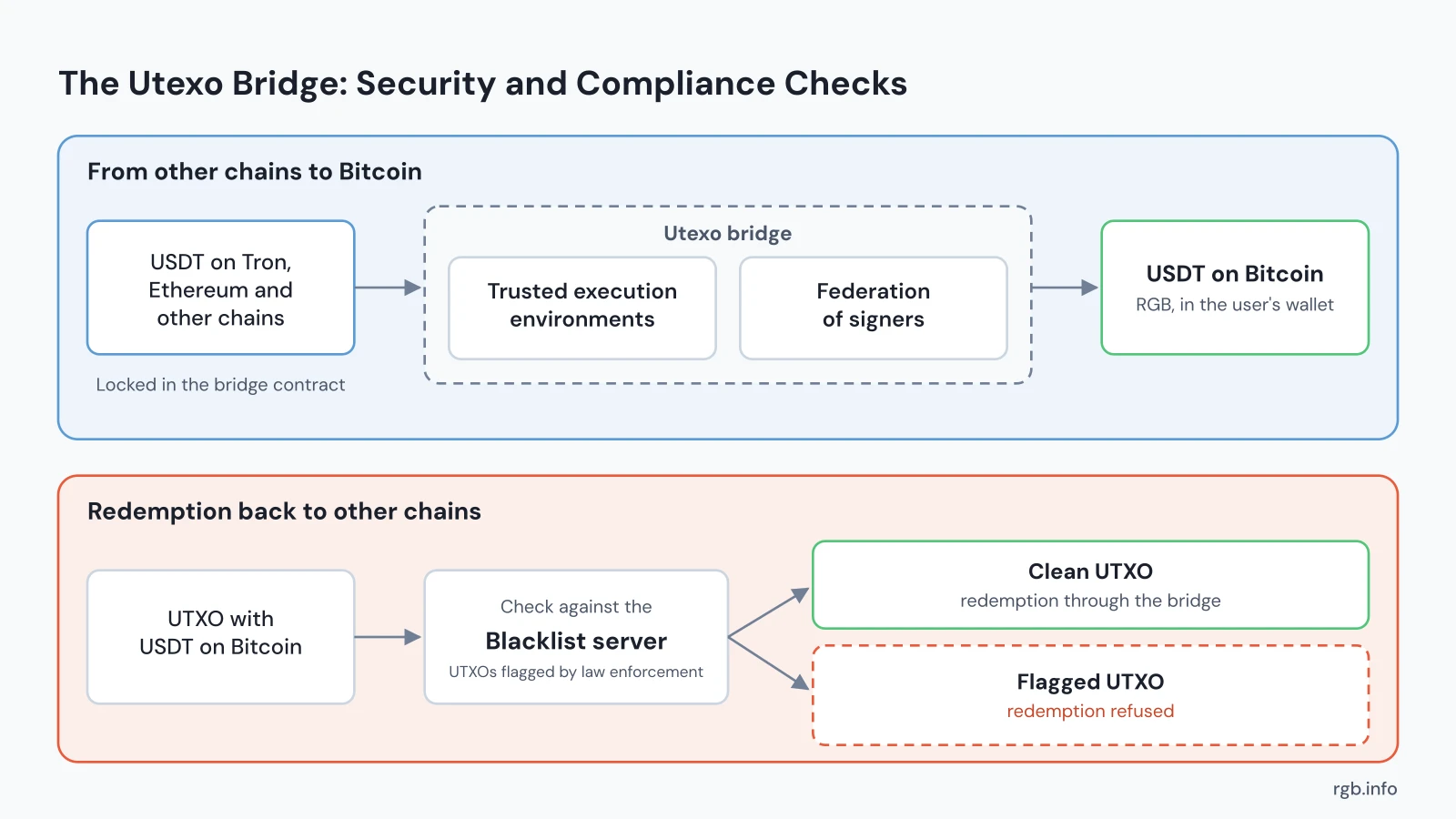
Stephan also raised the question of freezes. On other chains, Tether can freeze USDT at the request of governments, for example after a hack. Utexo follows the same compliance rules, and a small team maintains a blacklist server with the UTXOs flagged by law enforcement agencies or other trusted parties.
It’s important to say that Bitcoin offers no way to freeze a UTXO, so the bridge simply refuses to redeem a flagged UTXO, and no wallet or exchange with the Utexo SDK will send or receive it. Someone could still change the open-source code of a wallet to accept a flagged UTXO, but with no way to redeem it through the bridge, the effort would make little sense.
The bridge relies on trusted execution environments and on a federation of signers, whose identity stays private. Oxorio has audited the smart contracts and the signers of the bridge, and its reports are public.
When Stephan brought up the new wave of AI-driven attacks, Viktor said that AI tokens are now among the biggest costs for Utexo. Every member of the team has the budget and the time to audit the work of the others almost every day. In his words, a failure of Utexo would take down the whole idea of bringing USDT back to Bitcoin with it, so the team puts security first.
How Developers Can Bring USDT Back to Bitcoin
For wallets on a phone, Viktor compared the infrastructure of Utexo with an Electrum server, which provides each wallet with its balance. Developers have three paths for USDT on Bitcoin:
- the Utexo SDK, which hides most of the complexity;
- the Tether Wallet Development Kit (WDK), with the RGB integration from Utexo;
- rgb-lib, the library at the core of the ecosystem, for teams with time and budget for their own implementation, as in the case of UniSat.
Fee Sponsorship: USDT Transfers without BTC
At the end of the episode, Viktor introduced a new proof of concept for fee sponsorship, built by Diego Corral of Utexo. Today, a wallet needs some bitcoin to pay the fee of each RGB transfer. With the proposal, a third party pays the Bitcoin fee and receives a payment in the transferred asset, for example in USDT.
The proposal for rgb-lib, still open for discussion, relies on version 3 (TRUC) transactions, a feature of Bitcoin Core. The sender builds a transaction with no fee and a pay-to-anchor output. A second transaction, from the party that pays the fee, spends that output and covers the fee for both. The RGB side of the transfer stays the same. In the discussion on GitHub, Federico Tenga suggested an open market on top of the proposal, where several parties compete to pay the fee in exchange for the assets assigned to the anchor output.
Frequently Asked Questions
Does USDT on Bitcoin use a new blockchain?
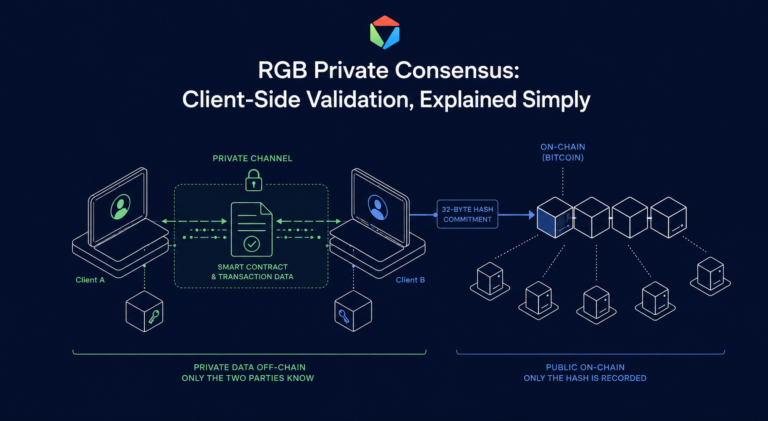
No. With RGB, USDT lives on Bitcoin UTXOs, and thanks to client-side validation, only a compact commitment of each transfer goes on the Bitcoin blockchain.
Who can see a transfer of USDT on RGB?
Only the parties of the chain of transfers, from the Genesis of the contract to the last receiver. An observer of the blockchain sees only UTXOs on the move.
Can a wallet send USDT on Bitcoin without BTC for the fee?
Not yet. Today, every RGB transfer needs some bitcoin for the fee. The proposal for fee sponsorship in rgb-lib, still open for discussion, lets a third party pay the fee in exchange for a payment in the transferred asset.
How can developers add USDT on Bitcoin to a wallet?
With the Utexo SDK, with the Tether WDK and the RGB integration from Utexo, or directly with rgb-lib.
When does USDT on Bitcoin reach Lightning?
According to Viktor, support for RGB over Lightning, through the RGB Lightning Node, is planned for the end of the first quarter of 2027 or soon after.
Further Reading
- USDT on Bitcoin: Utexo, RGB, and Lightning
- Privacy in RGB Protocol on Bitcoin
- RGB Goes Live on Bitcoin: Anant Tapadia and Federico Tenga on the Stephan Livera Podcast

Stephan Livera Podcast, “Viktor Ihnatiuk on Bringing USDT Back to Bitcoin with RGB and Utexo”, published in November 2026. Video on the Stephan Livera YouTube channel.