Stablecoins by the Numbers: Volume, Liquidity, and the Case for RGB Protocol on Bitcoin
Stablecoins have quietly become one of the largest settlement systems in the world. In February 2026 they settled roughly $7.2 trillion in a single month, enough to surpass the US ACH network for the first time, according to data compiled by Artemis and reported across industry trackers. That is no longer a crypto trading story. It is a payments and liquidity story, and the numbers reward a close reading, because they reveal a great deal about where digital dollars are going, and where they are not.
This is an attempt to read those numbers honestly: what the volume figures actually measure, where the liquidity sits, who is arriving, and one structural question the data keeps pointing back to.
In Brief
- Stablecoins settled around $7.2 trillion in February 2026 alone, surpassing the US ACH network for the first time.
- Liquidity is highly concentrated: USDT and USDC together account for roughly 83% of supply, but the ranking flips on transaction volume — USDC processed $18.3 trillion in 2025 against USDT’s $13.3 trillion.
- Institutions are arriving at scale: Mastercard’s $1.8 billion acquisition of BVNK, Visa’s fast-growing stablecoin card volume, and the GENIUS Act and MiCA both becoming law.
- Almost none of this liquidity settles on Bitcoin. Volume concentrates on Tron, Ethereum and its layer 2s, and increasingly Solana — Bitcoin has been largely absent from the digital-dollar layer it helped inspire.
- RGB Protocol on Bitcoin closes that gap: dollars issued and moved natively on Bitcoin and Lightning, private by default through client-side validation, with only a small cryptographic commitment ever touching the chain.
How Much Are Stablecoins Really Moving?
The headline figure most often cited is transaction volume. According to Artemis, reported by Bloomberg, stablecoin transaction volume grew 72 percent in 2025 to around $33 trillion. Using a broader framing, a16z put the figure closer to $46 trillion. Either way, the throughput now rivals or exceeds that of major card networks.
Before treating any single number as gospel, one caveat matters more than any of them. Blockchains record how value moves, not why. A raw on-chain volume figure counts every transfer, including internal reshuffling, self transfers, and automated contract loops that have nothing to do with real economic activity. This is why adjusted estimates diverge so sharply: Visa reports around $10.2 trillion of adjusted volume over a trailing year, while Artemis estimates roughly $26 trillion. Neither is wrong. They are measuring different things. Any serious read of the stablecoin market starts by treating one big number with suspicion and asking which methodology produced it.
Where Does the Liquidity Sit?
Liquidity is the steadier signal. The stablecoin market reached around $322 billion in supply in 2026, with stablecoins now representing close to 13 percent of the entire crypto market by capitalisation and more than 230 million on-chain addresses holding a balance, per RWA.xyz. Adjusted monthly volume reached roughly $1.79 trillion, per Visa’s Onchain Analytics dashboard.
That supply is highly concentrated. According to DefiLlama data from mid 2026, USDT leads at roughly 59 percent of supply, around $184.7 billion, with USDC second at about 24 percent. Together the two account for roughly 83 percent of the market.
Here the data contains a genuinely useful paradox. USDT leads by supply, but USDC overtook it by annual transaction volume in 2025, processing $18.3 trillion against USDT’s $13.3 trillion. So the ranking flips depending on whether you measure how many dollars exist or how hard they work. USDT dominates emerging-market activity and centralised-exchange trading, where deep liquidity matters most. USDC leads regulated and institutional flow, helped by MiCA compliance and its role in corporate treasuries. The market is not one thing. It is at least two, split along the line between global liquidity and regulated settlement.
Who Is Arriving?
The most telling recent signal is not on-chain at all. In August 2026, Mastercard closed its $1.8 billion acquisition of the stablecoin infrastructure firm BVNK, first agreed in March 2026. Payments incumbents do not spend at that scale on a passing trend.
The rest of the institutional picture rhymes with it. Visa’s stablecoin-linked card spend reached a multi-billion-dollar annualised run rate through 2025 and into 2026, growing several hundred percent year over year. Business-to-business stablecoin payments, near zero only a few years ago, are now measured in the hundreds of billions. Regulatory frameworks that stalled for years became law, with the GENIUS Act in the US and MiCA in Europe standardising issuance and reserve requirements. The demand base has diversified well beyond traders into fintech apps, payment platforms, and treasury managers, which is what a market being pulled by utility rather than speculation tends to look like.
Where Do These Dollars Actually Settle?
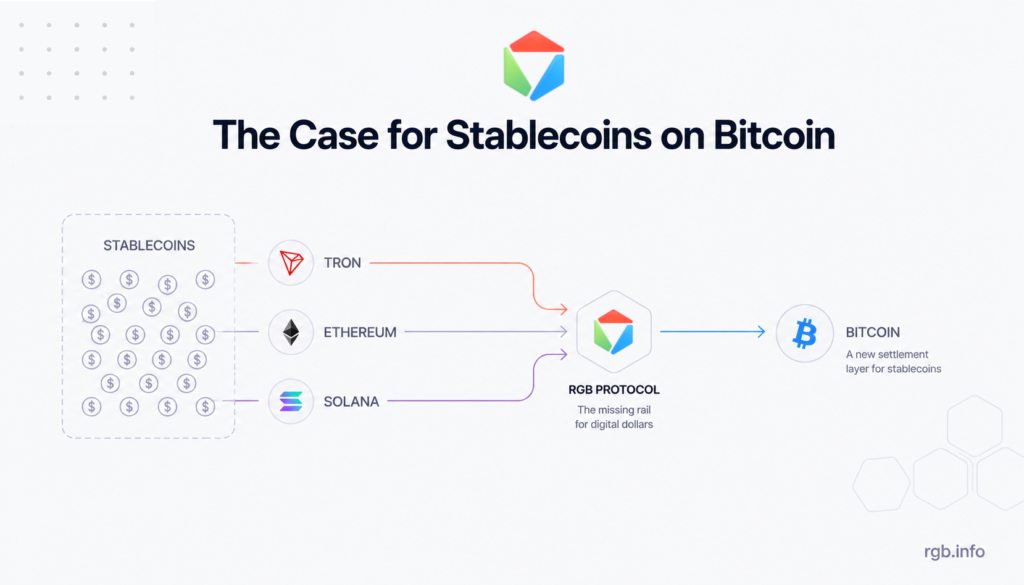
For all that scale, one fact sits underneath the entire dataset and rarely gets stated plainly. Almost none of this liquidity settles on Bitcoin. The volume concentrates on Tron, where fees are sub-cent, on Ethereum and its layer 2s, and increasingly on Solana. The most secure and most neutral settlement network in existence has been largely absent from the digital-dollar layer it helped inspire.
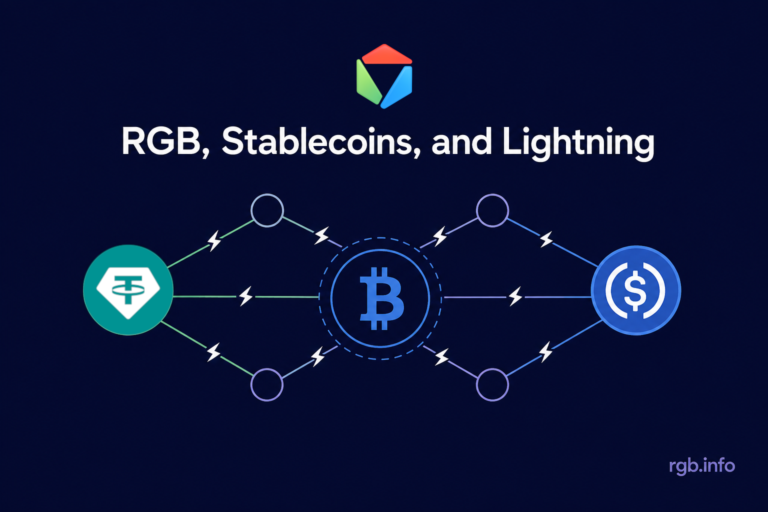
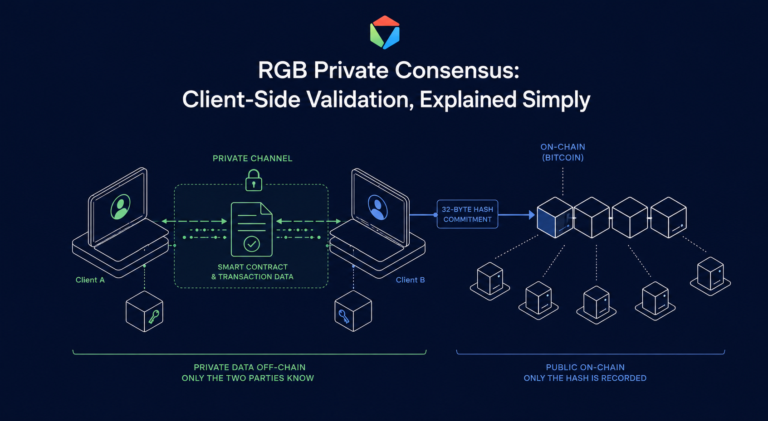
The reason is structural, not ideological. Bitcoin’s base layer never had an expressive enough system to issue assets without bloating the chain, which is precisely why early stablecoin issuance drifted toward other networks in the first place. That gap is what RGB Protocol on Bitcoin closes. It lets dollars be issued and moved natively on Bitcoin and the Lightning Network, with asset data kept private and off-chain through client-side validation, while only a small cryptographic commitment ever touches the chain.
Read against the numbers above, the implications are concrete. The settlement volume that today rivals ACH could inherit Bitcoin’s own security rather than the trust assumptions of the chains it currently runs on. The payments and remittance flows that make up a growing share of that volume could move at Lightning speed, with fees that stay negligible regardless of amount. And the transfers that today sit on fully transparent public ledgers, open for anyone to trace and link, could stay private by default, with selective disclosure available when compliance requires it.
None of this changes what a stablecoin is. It changes where it settles.
The Open Question
The stablecoin market has matured past the point where the interesting question is whether digital dollars are real or temporary. At more than $300 billion in supply, trillions in monthly settlement, and payments incumbents buying their way in, that debate is over. The open question now is which rails all of this settles on, and what security and privacy properties those rails carry.
Bitcoin has spent this cycle mostly outside that conversation. RGB Protocol on Bitcoin is what brings it back in.
Sources
Figures in this article are drawn from Artemis, Bloomberg, a16z, DefiLlama, Visa, RWA.xyz, and CoinDesk, as reported through mid 2026. Volume estimates vary by methodology; see the note above on how stablecoin volume is measured.
Further Reading
- The Business Case for USDT on Bitcoin: Utexo’s Bet on RGB and Lightning
- USDT on the Lightning Network: Why It’s Good for Lightning Itself
- Inside Utexo’s RGB Stack: SDKs, the Bridge, and a Live Wallet Demo