The Business Case for USDT on Bitcoin: Utexo’s Bet on RGB and Lightning
This article is based on Viktor Ihnatiuk’s talk at the Tuscany Lightning Summit 2026, Viareggio, Italy, May 12-13, 2026. He is one of the co-founders and CEO of Utexo.
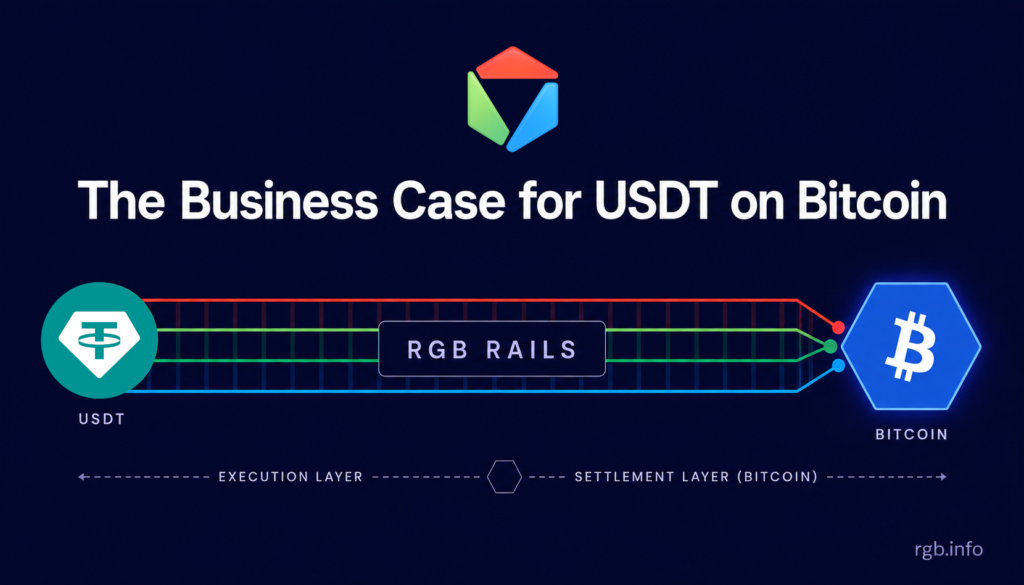
USDT on Bitcoin is the bet behind Utexo. Viktor Ihnatiuk’s talk at the Tuscany Lightning Summit 2026 laid out why he thinks it will work. Utexo’s infrastructure is built on RGB Protocol on Bitcoin and Lightning, and its pitch is simple: USDT never should have left Bitcoin in the first place.
In Brief
- Lightning’s real value isn’t speed, but the same architectural trick behind Visa and Mastercard: separating execution from settlement.
- USDT left Bitcoin for Ethereum and Tron after the 2017 congestion. Utexo’s bet: RGB Protocol on Bitcoin and Lightning will bring it back.
- Utexo raised a $7.5 million seed round led by Tether.
- The model is B2B: integrate into existing wallets, exchanges, and custody platforms, rather than build a new consumer wallet.
- The pitch: private stablecoin transactions that stay compliant, since settlement still anchors to Bitcoin.
Why Does Lightning Have an Image Problem?
For years, Lightning carried a reputation as a niche technology for Bitcoin enthusiasts, without institutional traction.
Ihnatiuk was a first-hand witness of this issue:
“Back in 2022, when I was trying to sell Lightning integration to Ledger, Charles Guillemet, CTO of Ledger, told me that he would never integrate Lightning because of connectivity issues. Ledger should not be online when the transaction is going through, especially if the counterparty also uses a Ledger.”
For this reason, custodial and semi-custodial models for institutions are now solving the problem, which brought individual operators from Ledger to join Utexo round as angel investors.
Beyond connectivity, institutions have historically pointed to liquidity management and channel operations as reasons to stay away. Ihnatiuk cited the idea of state channels, which pushed institutional Lightning adoption forward over the last few years. This innovation also sent custodial infrastructures development forward.
What Is Lightning’s Real Value, According to Utexo?
When talking about Lightning’s headline benefits, people often mention speed and low fees. Ihnatiuk framed them instead as a byproduct of something more fundamental: the architectural separation between execution and settlement.
To explain this point, he drew the comparison to card networks:
“When Visa, Mastercard, or American Express built their businesses, one of the things they did was build a network with lots of different participants, where each one can make money in a different way: the card issuer, the bank acquirer, the PSPs. Middlemen help with distribution. If you want a billion people to use your product, you need a channel partnership model where people are incentivized at every step.”
Lightning, in his framing, offers the same configuration flexibility.
As an example, he described how a wallet integrating Utexo’s infrastructure can offer users a cheaper cost structure than paying gas fees on Tron or Ethereum. In this framework, Utexo pays the wallet a share of the resulting volume, turning what used to be a pure cost center into a source of revenue.
As a consequence, you can create a network that resembles Visa or Mastercard’s model, but settled by Bitcoin instead of a legacy ledger, without inheriting Bitcoin’s block time or throughput limits for every single transaction.
What Is the History of USDT on Bitcoin?
USDT on Bitcoin is not a new idea: it originally launched via the Omni Layer protocol. According to Ihnatiuk, the migration to Ethereum and Tron followed the 2017 boom, when a surge of transactions made the Omni Layer setup too slow and costly to keep up with demand. During that situation, Ethereum and Tron picked up the momentum that Bitcoin had lost.
Today, the stablecoin market is worth close to $300 billion, and most users are not crypto traders: they are people in emerging markets using stablecoins as a hedge against local currency depreciation, for cross-border settlements, remittances, and merchant payouts.
Ihnatiuk’s case is that, via RGB Protocol on Bitcoin and Lightning, USDT on Bitcoin is now positioned to make a comeback:
“RGB, together with Lightning, solves the problems that made USDT leave Bitcoin in the first place, and now it’s coming back.”
What Does Utexo Actually Build?
Unlike what many people believe, Utexo does not build a consumer-facing wallet for USDT on Bitcoin. Instead, its business lies in the integration of RGB and Lightning into infrastructures that already have users: wallets, exchanges, institutional custody platforms, and payment processors.
According to Ihnatiuk, integrations are the real store front to develop for the end user, to allow anyone to use the advantages of this technology. For exchanges, some use cases can include products built for high-frequency traders, while payment companies can integrate instant settlement.
Ihnatiuk described how a friend who runs a payment company pays significant fees to guarantee instant payouts to his users. In fact, they need to work around the settlement delays of the exchanges and the blockchains his company currently relies on. Lightning solves that kind of narrow, high-value business problem directly.
On institutional custody, Utexo has been working with some platforms like Fireblocks, Utila, and Copper. On the exchange side, he pointed to ongoing integrations with several exchanges beyond the largest ones.
Rather than solving every problem at once, the strategy is narrow by design:
“We are not solving all the problems, and this is actually good. We are not building another Ethereum or Solana. What we do is harder at the beginning, because we need to convince people that Bitcoin and Lightning are still cool, but it will be easier going forward, because we don’t need to build a DeFi ecosystem that needs to be interconnected. We are just building rails, and Bitcoin as a brand will sell itself.”

How Is Utexo Funded?
Utexo closed a $7.5 million seed round led by Tether, Big Brain Holdings, and Portal Ventures, with participation from Franklin Templeton, Maven 11, and Fulgur Ventures, among other investors.
Ihnatiuk noted that most of these funds made their track record elsewhere: on Solana, on payment companies, or in the Ethereum ecosystem. In fact, he singled out Tether and Fulgur as the only ones with a Bitcoin-native background among the investors he named. Franklin Templeton’s participation stood out to him in particular, given the firm’s scale as one of the world’s largest asset managers.
In his telling, demand for the round exceeded its final size, and he expects a larger raise to follow before long.
Privacy and Compliance: How Does Utexo Position RGB?
Ihnatiuk connected Utexo’s privacy pitch to the renewed market interest in privacy technology, citing Zcash’s marketing momentum as a signal that investor demand for privacy-focused products aimed at stablecoins has grown substantially over the past year.
His framing of USDT over RGB and Lightning underlines that every finalization is private, but compliant. In fact, every transaction still settles back to Bitcoin, which he described as a structural difference from fully shielded privacy systems.
The mechanism behind that claim lies in RGB’s client-side validation model. Contract and transaction data never touch the Bitcoin blockchain directly, only a cryptographic commitment is inserted. Thus, each party only sees the transaction history relevant to their own transfer, not the full history of every other holder.
Within this model, RGB Protocol also supports selective disclosure at the transition level: a holder can reveal specific transaction details to a chosen recipient, such as an auditor or compliance officer, while keeping those same details concealed from everyone else, without ever broadcasting them publicly. This way, a transaction stays private by default while still being provable, on demand, to any compliance agency.
In addition, he was direct about where he sees RGB’s primary value for Utexo’s business:
“RGB, in that sense, is mainly just a token standard, one that also brings you privacy, but that’s more of a side feature. We chose RGB because USDT is coming to RGB, not to other standards. When you build a payment business, you need a stablecoin, because Bitcoin itself hasn’t been a payment method for the last ten years, stablecoins took over that market.”
His own path to RGB came through an earlier project trading Bitcoin-based tokens against meme coins, where scaling limitations pushed him to look for a more resource-efficient standard, which he found in RGB.
What About AI Agents and Stablecoins?
Ihnatiuk pointed to agent-to-agent payments as one of the fastest-growing use cases for stablecoins. Today, this activity is concentrated on Coinbase’s Base network, via the x402 protocol, which turns HTTP requests into machine-payable transactions. However, he expects x402-style agentic payments to reach Bitcoin as well.
Indeed, Bitcoin is the network AI agents are most likely to gravitate toward by reputation and reach, with Lightning as the practical settlement rail given Bitcoin’s own throughput limits.
What’s Next for Utexo?
Ihnatiuk expects most large-scale integrations to land between August and December 2026, with a handful of smaller, tier-2 exchange integrations arriving sooner. In his telling, the full go-to-market for USDT on Bitcoin is tied to Tether’s own launch timing, which he expects sometime in the summer of 2026.
Learn More
- Introduction to RGB Protocol on Bitcoin: rgb.info/learn/how-rgb-protocol-on-bitcoin-works/
- RGB on Lightning Network: rgb.info/learn/rgb-lightning-network/
- Client-side validation: rgb.info/learn/client-side-validation/
- Utexo: utexo.com
- Utexo docs: docs.utexo.com