Lightning Network as the Common Language of Bitcoin Layers
This article is based on the panel “Lightning as the Common Language of Bitcoin” from Plan B Forum 2025, moderated by Giacomo Zucco, with Kilian Rauch (Boltz), Federico Tenga (Bitfinex / RGB Protocol Association), Marco Argentieri (ArcLabs), and Roy Sheinfeld (Breeze).
At Plan ₿ Forum 2025 in October, a panel moderated by Giacomo Zucco asked a fundamental question about Lightning Network Bitcoin layers: what makes Arc, Spark, Fedimint, Cashu, and Liquid all interoperable with each other?
Their answer: Lightning Network as a shared protocol language, and RGB Protocol on Bitcoin as the universal asset standard that travels across all of them.
The panel brought together Kilian Rauch (CEO, Boltz), Federico Tenga (Bitfinex / RGB Protocol Association), Marco Argentieri (CEO, ArcLabs), and Roy Sheinfeld (CEO, Breeze).
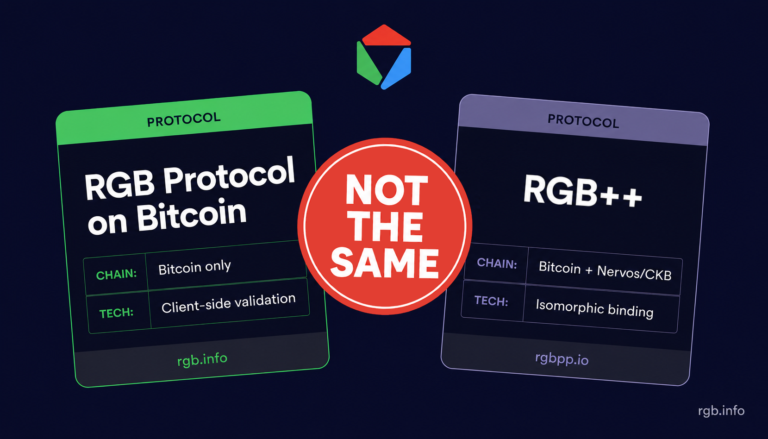
Note: RGB Protocol on Bitcoin (rgb.info, v0.11.1) is the production-ready protocol supported by the RGB Protocol Association. It is distinct from RGB-WG (rgb.tech) and from RGB++ (a separate protocol on the CKB chain by Nervos).
Key takeaways from this panel
- Lightning Network Bitcoin layers — Ark, Spark, Fedimint, Cashu, Liquid — all share a common protocol language that makes them interoperable
- Ark solves Lightning’s last-mile problem by preserving full Bitcoin script programmability inside virtual UTXOs
- RGB Protocol on Bitcoin is the only asset standard natively compatible with all Bitcoin layers simultaneously — mainchain, Lightning, Ark, Spark, and state chains
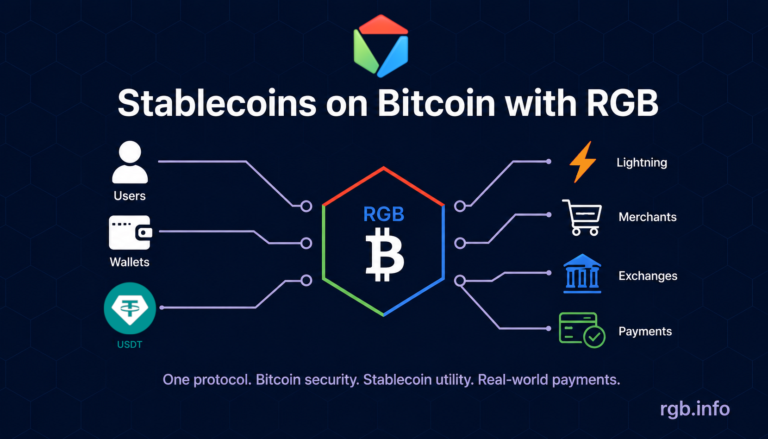
- Stablecoins like USDT can be issued and traded on RGB against real Bitcoin
- RGB transactions are private by design, and asset balances are not visible on-chain
- Ark requires no changes to Bitcoin’s base layer — no soft fork, no consensus change needed
What connects Lightning Network Bitcoin layers?
Lightning Network is a shared interoperability standard — not just a payment channel protocol. Once a Bitcoin sub-network “speaks Lightning,” it can communicate with every other sub-network that does the same, without requiring new protocols or migrations.
Roy Sheinfeld (Breeze) explained the distinction:
“Lightning is more than a technical implementation, it’s also a language. It’s a language that can facilitate interoperability between different sub-networks. Users can live on Spark, on Ark, on Fedimint, on Cashu — but they can still send and receive payments from one network to another through re-imagining the Lightning Network as the common language.”
The BOLT specifications were written to be generic enough that their side effect was cross-network interoperability. Breeze taught Liquid to speak Lightning. Ark was built to speak Lightning natively. The result is an open network without a single point of control, and without requiring users to migrate to any specific sub-network.
How do Ark and swap infrastructure complete the Bitcoin layer stack?
Ark fills the gaps Lightning cannot cover with complex transaction flows and low-frequency users, while professional swap services route liquidity between layers. Both remain structurally open.
Lightning channels, by design, reduce Bitcoin’s programmability: a channel is already a 2-of-2 multisig, and adding further script conditions is impractical. Ark solves this issue by lifting UTXOs to virtual UTXOs that retain full Bitcoin script semantics. As Marco Argentieri (ArcLabs) put it:
“Retaining the same blockchain semantic, like you have an address, you give an address to someone else, you go to sleep, you wake up in the morning, you go fetch your coins, really helps many wallet use cases, most importantly retail, and most importantly also commerce.”
For low-frequency users who cannot justify the overhead of channel management, Ark and Spark provide a last-mile layer where retail and commerce can operate without direct Lightning complexity.
Between layers, professional swap services like Boltz handle liquidity routing across mainchain, Lightning, Liquid, and Rootstock. Boltz open-sourced its backend; four other entities already run compatible services. Switching providers requires nothing more than changing a URL. Roy Sheinfeld put it plainly:
“There’s no vendor lock. Anyone can be a bank. Anyone can run a Lightning node. Anyone can run a swap service.”
Liquidity concentrates with the most capable providers — as in any network — but Bitcoin’s open architecture keeps exit costs near zero: professional efficiency without structural lock-in.
What is RGB Protocol on Bitcoin and how does it work across Bitcoin layers?
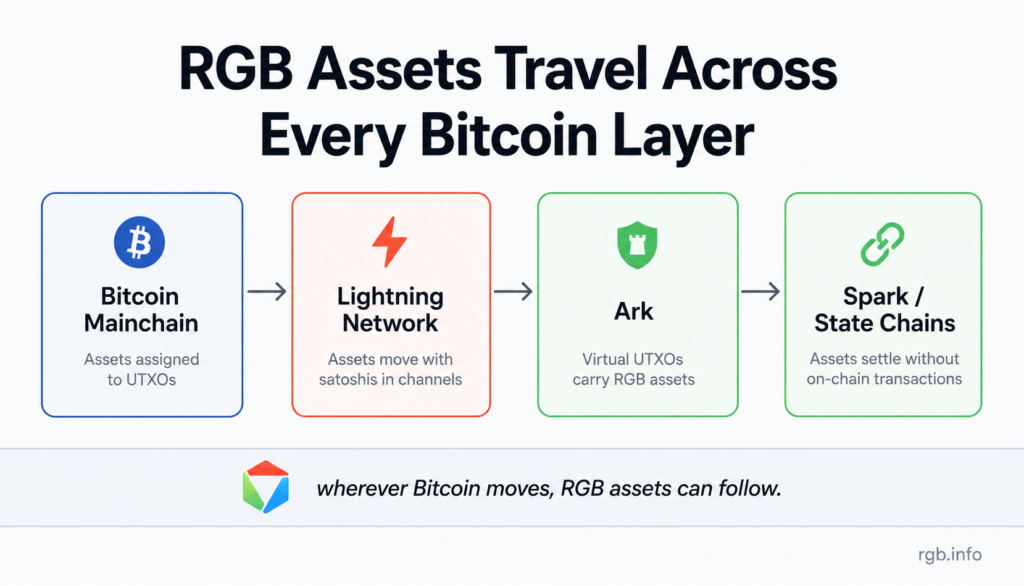
RGB Protocol on Bitcoin is the only asset standard compatible with all Lightning Network Bitcoin layers. Because every layer moves satoshis between UTXOs, RGB assets travel across mainchain, Lightning Network, Ark, Spark, and state chains, with no additional infrastructure required.
Federico Tenga (Bitfinex / RGB Protocol Association) explained the core mechanism:
“RGB is the asset standard that allows you to move liquidity between these different scalability solutions. With RGB, we have the assets on the UTXO, and then the same way we move satoshis around without making a Bitcoin transaction on-chain, we can also move whichever asset was on the same UTXO where there are satoshis.”
Proof of ownership over an RGB asset is identical to proof of ownership over the underlying UTXO: you prove you own the asset by spending the UTXO. This design has a fundamental consequence: wherever Bitcoin moves, RGB assets can follow.
How RGB Protocol on Bitcoin works on each layer:
| Layer | How RGB works |
|---|---|
| Bitcoin mainchain | Assets assigned to UTXOs; ownership transferred by spending the UTXO on-chain |
| Lightning Network | Assets assigned to the channel’s multisig funding output; channel updates track asset balances same as Bitcoin balances |
| Ark | Virtual UTXOs carry both satoshis and RGB assets; same off-chain mechanics move both |
| Spark / state chains | Same UTXO logic applies; assets move without on-chain settlement |
How RGB Protocol on Bitcoin compares to other asset standards:
| Standard | Cross-layer | Mainchain | Lightning | Ark | Spark | Privacy |
|---|---|---|---|---|---|---|
| RGB Protocol on Bitcoin | ✅ all layers | ✅ | ✅ | ✅ | ✅ | ✅ client-side validation |
| Ark ARCHIT token | ❌ Ark only | ❌ | ❌ | ✅ | ❌ | partial |
| Liquid confidential assets | ❌ Liquid only | ❌ | ❌ | ❌ | ❌ | ✅ confidential |
| Taproot Assets | partial | ✅ | ✅ | ❌ | ❌ | limited |
Federico noted that this does not mean RGB must be the only standard. Ark’s ARCHIT token has capabilities around introspection that RGB does not provide. The two are complementary: ARCHIT stays within Ark; RGB Protocol on Bitcoin moves across all layers as the interoperability standard.
Full technical details are available in the RGB Protocol documentation.
Why issue assets on Bitcoin instead of another blockchain?
Issuing assets on Bitcoin via RGB Protocol provides Bitcoin-level settlement security, access to the largest liquidity base in crypto, and the social scalability of a neutral playground, without bridges or wrapped tokens.
Giacomo Zucco posed the sharpest question: isn’t RGB just attracting shitcoin scams to Bitcoin? Federico’s answer addressed three distinct arguments.
- Security and neutrality: Bitcoin is the only settlement layer with no governance risk, no compliance risk from a central operator, and no single party that can change the rules. Moving to another chain means playing on someone else’s playground.
- Social scalability: Nick Szabo called this the ability for parties with different trust assumptions to interact on shared, neutral ground. Bitcoin is the only asset that can serve as that ground.
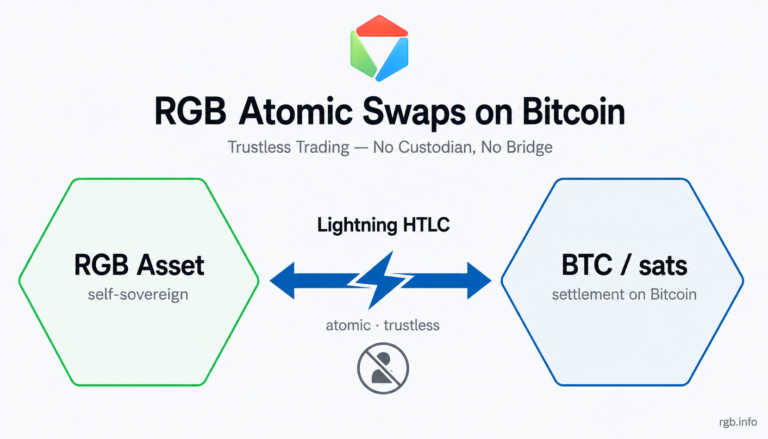
- Liquidity: Bitcoin is ten times larger than any stablecoin by market cap. Everyone wants to trade against Bitcoin. At the moment, this requires using wrapped or bridged Bitcoin, introducing third-party counterparty risks. With RGB Protocol on Bitcoin, USDT and other stablecoins can be traded against real, native Bitcoin, without bridges or wrapped tokens.
As Giacomo confirmed: “This happens without polluting the Bitcoin blockchain.” RGB state transitions require only a very small, occasional OP_RETURN output on-chain. The blockchain footprint is effectively invisible.
How does RGB Protocol on Bitcoin protect user privacy?
RGB Protocol on Bitcoin is private by design. Asset balances and transaction history are not visible on-chain, because verification happens locally between transaction parties, instead of being on a public ledger.
This consequence comes from client-side validation: the defining technical property of RGB Protocol on Bitcoin. See how RGB Protocol on Bitcoin works for a full explanation.
Unlike Ethereum, where anyone can look up a wallet address and see its complete asset holdings, RGB transactions leave no asset-level data on the Bitcoin blockchain. Nobody can identify your RGB asset balances from chain data alone.
Federico noted the growing practical relevance of this: as on-chain transparency on Ethereum has created real physical security risks — people’s home addresses identified through public wallet balances — privacy is no longer an academic concern. RGB’s privacy model addresses this by design.
Is programmable money on Bitcoin a risk for censorship or control?
No — programmable Bitcoin transactions cannot enable CBDC-style control more effectively than existing off-chain mechanisms already can. The real case for programmability is enabling real-world commerce without custodial intermediaries.
The slogan “programmable money, programmable people” raises a legitimate concern: could Bitcoin script programmability be used to restrict spending or enable surveillance? Marco Argentieri addressed this question directly.
Bitcoin was always a scripting language, and Satoshi built an interpreter into the protocol from day one. A standard P2PKH transaction is already a program. The concern about programmability as a vector for control is not new; it surfaced around covenants and will surface again.
Coercive control through programmable money is far more efficiently achieved with custodial multisig and off-chain systems than through on-chain scripting. If a government wanted to restrict Bitcoin spending, it would do so through the institutions holding keys, not through a script.
The constructive argument for programmability is merchant adoption. A merchant accepting Bitcoin often needs to convert to a stable asset at the point of sale, for accounting and volatility reasons. Without programmable flows, this drives merchants back to custodial payment processors, undermining the purpose of Bitcoin payments entirely.
What it means for the Bitcoin ecosystem
The picture that emerges is of a maturing ecosystem where Lightning Network Bitcoin layers each serve distinct roles:
- Lightning Network — the interoperability standard, the common language every sub-network speaks
- Specialized layers (Ark, Spark, Fedimint, Cashu, Liquid) — different UX, security, and programmability trade-offs for different use cases
- Professional swap infrastructure (Boltz and competitors) — routing liquidity across layers efficiently, with open-source backends and negligible switching costs
- RGB Protocol on Bitcoin — the universal asset standard, the only one that moves natively across all Bitcoin layers simultaneously
For developers building on this stack, the starting point is rgb.info and the technical documentation at docs.rgb.info.
To explore wallets and tools that already support RGB Protocol on Bitcoin on Lightning Network, see the RGB ecosystem page.