Betting Stablecoins Future on RGB

This interview was recorded at the Tuscany Lightning Summit 2026 in Viareggio, Italy, where Renat Skitsan talks about the pivot from ThunderStack to Utexo, why blockchains hit a scaling ceiling without client-side validation, and where he sees RGB Protocol on Bitcoin fitting into the future of Bitcoin’s layers. He is a co-founder of Utexo, and previously founded ThunderStack, the RGB and Lightning infrastructure company later folded into Utexo.
In Brief
- ThunderStack pivoted from RGB tooling for builders into Utexo, built on the idea that stable value deserves stable infrastructure.
- Utexo’s three non-negotiables, privacy, predictable fees, instant finality, can only exist together with client-side validation.
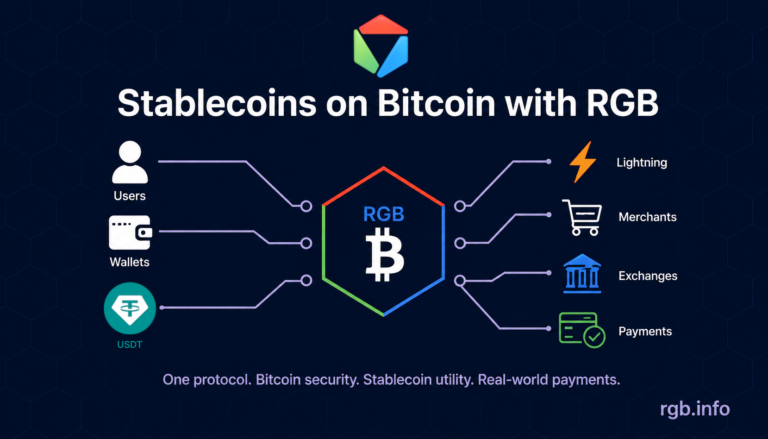
- RGB on Bitcoin fits long-term storage; RGB on Lightning fits everyday payments; the protocol works on either.
- Tether’s history with Omni Layer is why USDT belongs on RGB now: client-side validation rails didn’t exist back then.
- Renat sees RGB as a meta-protocol: one token standard for every Bitcoin layer, no liquidity-hungry swaps required.
How Did ThunderStack Become Utexo?
It’s been an incredible year, and a lot has changed. We pivoted from the initial idea to a much bigger one.
We started ThunderStack with the mission to simplify access to RGB through cloud tooling and SDKs, so developers could actually come and build on RGB. But then we started thinking about how we could push RGB’s growth further: how we could help it grow, how we could make Lightning work better, how we could make it more accessible for end users. That pivot is how Utexo was founded.
Stable value deserves stable infrastructure.
It’s an incredibly simple idea: stable value deserves stable infrastructure, and Bitcoin is the most decentralized and the most stable platform to build on. Lightning is the only solution that lets you transact stable value with stable fees, unlike any other blockchain, where the fee depends on transaction volume.
So we decided to bring USDT on top of those rails, to make it accessible for people to use every day, on the most secure and robust network there is.
What Problem Is Utexo Solving?
Right now, people transact stablecoins over public ledgers, where everyone can see what’s happening. That exposure needs to change, because it’s even worse than the fiat world: blockchain is a revolution when we’re talking about Bitcoin, but for stablecoins on public chains, everyone in the world can see your transaction.
For me, that level of exposure is unacceptable, and I don’t want to live in a world where it keeps happening.
RGB Protocol on Bitcoin and Lightning are designed to solve that privacy problem at scale, while other solutions produce scalability in theory, but not in practice. So the first value we pursue is privacy.
The second is stable infrastructure and stable fees. I don’t want to wake up one morning and find out I can’t pay my bills because fees spiked for no reason, just because a lot of people are transacting that day. Unpredictable fees like that aren’t user-friendly, and money shouldn’t move this way. The outcome ends up worse than the fiat system we already have.
People need predictability when moving funds.
The third important value is finality: how fast you can actually move money. Payment channels like Lightning are the only way to do instant transactions at scale. Blockchains in general cannot scale past a certain point. There’s always a limit, and I think people have already found it, with the fundamental limitations of communication in a network: you need to send a message and get it accepted. We’re already stretching consensus mechanisms and protocols to their limit by sacrificing everything else (privacy, decentralization, censorship resistance) and it still can’t scale. People have given up all of those properties chasing more throughput, and that trade-off still doesn’t get you a system that moves money the way it actually needs to move.
Peer-to-peer, client-side validation is the only proper way to scale to an unlimited number of transactions per second without compromising privacy, while keeping it instant.
What’s the Difference Between RGB On-Chain and RGB on Lightning?
Lightning is a layer 2 on top of Bitcoin, and RGB adds another layer on top of both Bitcoin and Lightning, using them as a settlement layer to inherit Bitcoin’s security.
RGB on Bitcoin makes a lot of sense if you want a neutral, decentralized platform for long-term saving, or for moving large amounts of money, given Bitcoin’s transaction throughput limits and given that it’s still the most secure way to move and store money. But people also need a way to save and move stablecoins day to day, and for everyday payments, small transactions, you need layer 2, which is Lightning.
RGB fits Lightning just as well, because RGB is designed to work on top of any UTXO-centered layer: Lightning, or any other layer that’s built, or will be built, on Bitcoin.
You interact with Lightning the same way you already do with Bitcoin, except now you can move RGB assets, denominated in a stablecoin like USDT, into a Lightning channel and get instant finality, small fees, predictability, and privacy. Lightning already has its own privacy properties, and RGB makes it work even better. The two can fit and reinforce each other when it comes to moving stable value over Bitcoin rails.
Why Did USDT Choose RGB?
Any other system is much more centralized, and if you think long-term, chains appear and disappear all the time. It will keep happening, probably even more, with new layer 1s and layer 2s in the coming years. Users end up having to move from one chain to another, and if you want to prevent people from going through that kind of experience, you need to ask whether a chain will actually be running in the long run.
The only thing specifically designed to answer that question over 10, 20, or 100 years is Bitcoin, as it holds most of the money, and most of the security. This tension is the same thing that happened with Tether, which originally launched on Omni Layer. The technology at the time just wasn’t good enough, so it took time to develop the proper rails through client-side validation, like RGB.
RGB doesn’t depend on anything except the UTXO model itself. In fact, it will keep working on top of Bitcoin no matter which scaling solution wins in ten or twenty years.
That history is why it makes a lot of sense for USDT, for Tether, and for Tether’s users to move away from chains that might disappear in the coming years, where transactions are public and can be censored, toward a foundation where you can be confident your money won’t be lost.
How Does RGB Fit Into the Future of Bitcoin Layer 2s?
Right now we’re in a period where incredible new technologies keep appearing on Bitcoin (Ark, Lightning, channel factories) and we’ll see plenty more in the coming years. The problem is that everyone building one of these layers tries to do their best for their own users, and ends up creating their own token standard on top of their own infrastructure and protocol. That approach produces a bunch of isolated sandboxes, incompatible with each other.
You could argue you can connect them through Lightning, since it acts like a common language across protocols and layers. But that kind of connection requires someone with liquidity in both protocols to swap for you, which takes a lot of unnecessary capital, and users end up paying more than they should, since swaps can be expensive and the price can be unpredictable.
That setup is not ideal. Thus, there needs to be a token standard specifically designed to work on any layer, so people can just use it without needing those swaps: RGB was designed with that exact goal in mind. Layer 2 solutions don’t need to know anything about RGB; the only thing they need is UTXOs. RGB just works on top of any implementation, and brings privacy and compatibility along with it.
That shared foundation makes RGB a kind of meta-protocol that can connect every Bitcoin layer, because all Bitcoin layers share the same UTXO model and inherit their security from Bitcoin.
That compatibility is why RGB is an ideal fit for whatever comes next.
Further Reading
- Client-Side Validation
- RGB on the Lightning Network
- The Business Case for USDT on Bitcoin: Utexo’s Bet on RGB and Lightning
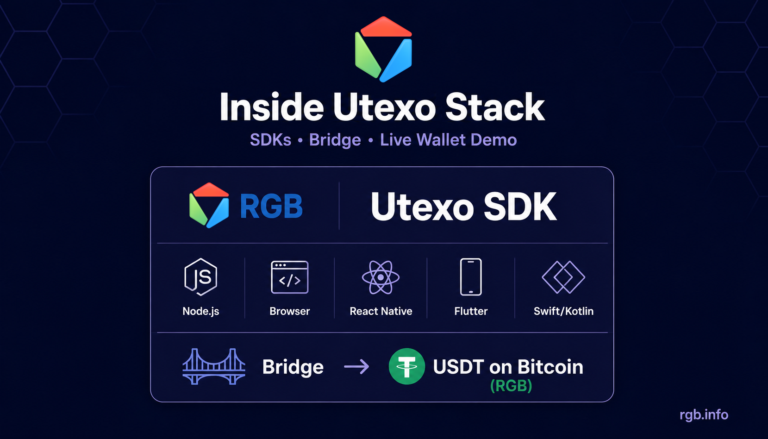
- Inside Utexo’s RGB Stack: SDKs, the Bridge, and a Live Wallet Demo
- RGB Protocol on Bitcoin: Bringing Stablecoins on Bitcoin and Lightning