Pragmatic Maximalism: RGB at Bitcoin Asia Stablecoin Panel
This article is based on the panel “Pragmatic Maximalism: The Market Wants Stablecoins,” held on the Nakamoto Stage at Bitcoin Asia, Hong Kong, on August 27, 2026, with the participation of Birkan Kayadibi, COO of RGB Protocol Association.
In Brief:
- The premise: stablecoins already move far more volume than Bitcoin in daily payments, and the panel asked what Bitcoiners should do about it.
- Regional split: stablecoins dominate in Vietnam and Turkey; Japan has almost none, blocked by exchange regulation.
- Birkan Kayadibi’s argument: USDT launched on Bitcoin in 2014 via the Omni Layer, and RGB’s client-side validation now gives it a privacy edge over Ethereum and Tron.
- The maximalism shift: rejecting stablecoins outright pushes volume to other chains, rather than protecting Bitcoin.
What Was This Panel, and Why Does It Matter for RGB?
“Pragmatic Maximalism: The Market Wants Stablecoins” put four speakers from different markets and companies on stage to inquire about the use of stablecoins and Bitcoin for everyday payments.
The stage welcomed Dominik Weil (BitcoinVN, based in Vietnam), Kishin Kato (Japan Bitcoin Industry, based in Japan), and Birkan Kayadibi (RGB Protocol Association, drawing on his own background in Turkey), moderated by Craig Deutsch of BTC Inc. Three different regions with very different relationships to stablecoins and Bitcoin today.
The panel’s name plays on the phrase “toxic maximalism,” the Bitcoin-culture stance that treated any other cryptocurrency, and often anything built even on top of Bitcoin itself, as suspect by default. Moderator Craig Deutsch framed the discussion around a change of mind already visible at the conference: people seem more willing than before to ask about the utility of stablecoins, instead of dismissing the question outright.
For RGB Protocol on Bitcoin specifically, Birkan Kayadibi, COO of RGB Protocol Association, was the one voice on stage representing a Bitcoin-native answer to stablecoin demand: RGB is the rail where USDT and similar assets can be issued, transferred and settled directly on Bitcoin, instead of relying on centralized chains like Tron or Ethereum.
Why Are Merchants and Emerging Markets Choosing Stablecoins Over Bitcoin?
It’s interesting to see different regions represented on the panel, each one taking a different perspective. Two points were the main focus: volatility and problem solving.
Dominik Weil opened by describing Vietnam’s remittance market: early Bitcoin-based remittance startups around 2013-14 were genuinely cheaper than the alternatives, until stablecoins reached enough market penetration around 2017-18 to take over. As a consequence, he believes that most of the people in the industry of “moving money around” don’t care about ideology, but just focus on finding tools that can solve their problem.
Birkan Kayadibi added a second layer, drawing on his own background in Turkey, where USDT is heavily used in the real economy, while Bitcoin is still widely misunderstood as “just another crypto token.” For a merchant working on a three or four percent margin, he argued, a 30-40% price swing is not a philosophical inconvenience, but a liquidity-management problem most small businesses cannot absorb, especially with goods already in transit overseas.
Kishin Kato offered the outlier case: Japan has almost no stablecoin adoption. Even though demand exists, Japanese exchanges still cannot support tether-style assets under current regulation. That regulatory wall, he suggested, is a genuine opening for Bitcoin and Lightning payments to establish themselves in Japan’s payments space before stablecoins ever can.
Why Does Bitcoin Need Stablecoins, and Why Do Stablecoins Need Bitcoin?
Birkan Kayadibi made a central argument about the relationship between Bitcoin and stablecoins. On the one hand, Bitcoin’s settlement layer and privacy properties make it a better home for stablecoins than the chains hosting most volume today. On the other, stablecoin volume brings attention and liquidity back to the Bitcoin ecosystem.
USDT was actually born on Bitcoin, as it was originally issued on the Omni Layer from 2014, before moving to other chains for practical reasons. In his view, Bitcoin’s technical picture has since changed enough, through Layer 2 work on scalability, so that USDT can now go back to Bitcoin, with two main advantages:
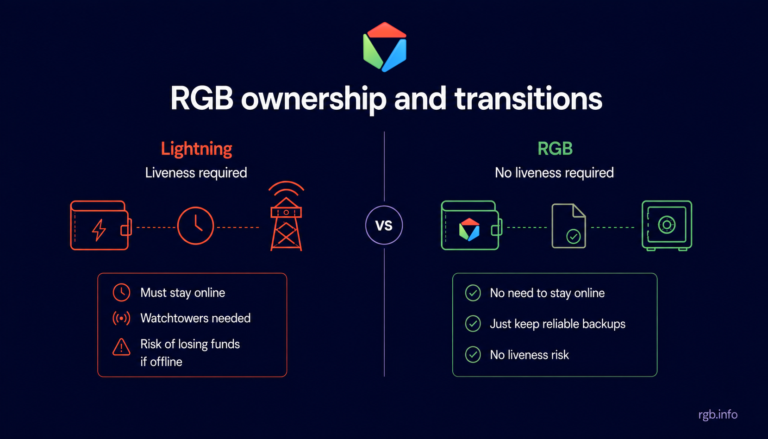
- Privacy. With RGB, client-side validation allows the users to keep data on the client side, which is very different to the global consensus of Bitcoin. A bank, or a company, moving millions of dollars is directly interested in whether that transaction is visible to everyone or only to the parties involved.
- Lightning as a peer-to-peer settlement layer. Because Lightning acts as an interoperability layer across Bitcoin Layer 2s, it enables atomic swaps and peer-to-peer stablecoin movement with better privacy than alternatives, something that, as he said, Tron’s architecture cannot replicate. Every unit of stablecoin volume that moves onto Bitcoin rails instead of elsewhere strengthens Lightning channels and pulls attention back toward the Bitcoin ecosystem rather than feeding a competing chain.
Are Stablecoins Reintroducing Trusted Third Parties to Bitcoin?
Yes, but the panel’s response was that third parties are already unavoidable wherever KYC, exchanges, or wrapped assets are involved, so stablecoins are not uniquely responsible for reintroducing counterparty risks into Bitcoin.
Craig Deutsch raised the tension, invoking Nick Szabo’s line that trusted third parties are security holes, and the Bitcoin white paper’s own critique of the trust banks demand: unlike Bitcoin, a stablecoin is a centralized token that its issuer can freeze at will.
Kayadibi’s answer separated the problem from its cause: exchanges, KYC processes, and wrapped Bitcoin already carry third-party risks today, independently of stablecoins. Anyone who desires full custody and control can already use Bitcoin directly (a problem Satoshi’s design solved in 2008). Stablecoins, in his framing, exist to do something Bitcoin is not yet fast enough to do on its own. They will not introduce a new category of trust risk that wasn’t already present.
Kishin Kato tied the exchange to a cultural point: because scams across the broader crypto space reflect poorly on Bitcoin, regardless of whether Bitcoin itself is involved, calling out bad actors remains necessary. However, people should remember Bitcoin’s positive features: avoiding middlemen and unnecessary regulation.
Is Toxic Maximalism Dead?
An interesting point was raised regarding toxic maximalism. Dominik Weil recalled the shift of the Bitcoin culture that started appearing when Ordinals appeared. Some people supported them, while others remained fixed on the initial idea of Bitcoin, so much so that there was a recent fork in the blockchain. So, how is Bitcoin culture changing?
Dominik Weil distinguished between two different things people call maximalism:
- guarding a community against bad actors extracting value from newcomers, which is an important point for the Bitcoin community in Vietnam;
- a more performative “toxic” style aimed at winning status points online by attacking anyone insufficiently “pure”. The second kind, he argued, does not help Bitcoin adoption, and should embrace more practical questions, like what is actually solving problems for users, and why.
Birkan Kayadibi extended the point into a direct statement about what defending Bitcoin should mean today. If maximalism is defending Bitcoin, we need to consider different narratives at different times: in 2013 it was done one way, in 2017 another, and today it should probably be different as well. Right now, in his opinion, it should be inappropriate to say that stablecoins are wrong, because it means damaging Bitcoin in a way by letting the flow and the attention go somewhere else.
Where the Panel Leaves RGB Protocol on Bitcoin
In a summary, when comparing stablecoins and Bitcoin, every speaker agreed the two are not actually in competition for the same users. What really matters, in practice, is which rails end up carrying that volume.
As Birkan pointed out, through RGB and Lightning, Bitcoin can carry stablecoin volume with privacy and settlement guarantees that other chains cannot match.