Michael Chobanian: RGB and Self-Sovereignty
This interview was recorded at the Tuscany Lightning Summit 2026 in Viareggio, Italy, where Michael Chobanian talks about Bitcoin, RGB, and what sovereign identity means to him. He is the former president of the Blockchain Association of Ukraine, and a co-founder and board member of the RGB Protocol Association.
In Brief
- Michael Chobanian’s stack: Bitcoin for security, Lightning for speed, RGB Protocol on Bitcoin for any asset on top
- For institutions, the main advantage is Bitcoin-level security combined with self-custody of any asset, not just money
- For individuals, RGB Protocol on Bitcoin is a tool for self-sovereignty over assets and identity
- He funds RGB Protocol on Bitcoin development through his own family office and supports the ecosystem as a board member of the RGB Protocol Association
Why did you decide to support RGB?
It’s a good story. It started in 2015 or 2016, at a Bitcoin conference in Odessa, Ukraine, where Giacomo Zucco first talked about RGB. Honestly, I didn’t pay attention. We already had Omni Layer, and Ethereum was coming up.
The second time was from Maxim Orlovsky. I’d met him a few years earlier and helped convert him from banking into crypto, long before I knew what he was building. The third time was at the Honeybadger conference in Riga, where I saw it wasn’t just theory anymore, it was starting to work. Then, last year, Viktor Ihnatiuk of Utexo told me they were launching it, and a few weeks later, they actually did.
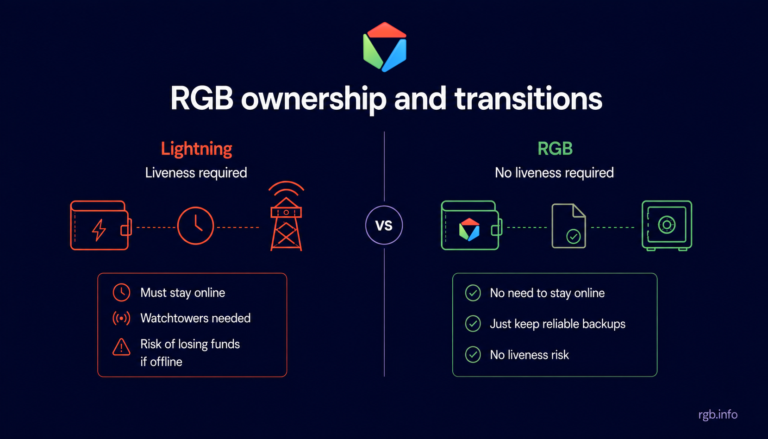
That same year, at the Lugano Summer School, I met the people building RGB and decided to dig in properly. I’m a Bitcoin guy, always have been, so RGB was a logical fit: Bitcoin for security, Lightning for speed, and RGB Protocol on Bitcoin on top for any asset.
Running RGB directly on Bitcoin only makes sense for very large amounts. For anything else, RGB on Lightning is the stack I believe in, that’s why I’m here.
Which advantages do you think RGB can bring to the institutional level?
I think we’re still a bit too far from the institutional level today. The main advantage is obviously security. Bitcoin is by far the largest network on every measure: value, volume, money invested in infrastructure, mining, branding, and wallet support. Take any wallet, and Bitcoin will be there, unless it’s a single-asset wallet. So it’s the most secure base there is. I don’t trust networks that work today and could just break tomorrow because it’s technically “a blockchain” that supposedly can’t stop. I don’t believe in that. For me, Bitcoin is the security layer.
On top of it, you have Lightning, which makes it fast; that’s the main advantage Lightning brings. And on top of that stack, you can put any asset: a stablecoin, a wrapped real-world asset, identity (which is one of the things I’m exploring), pretty much anything that has value to you personally.
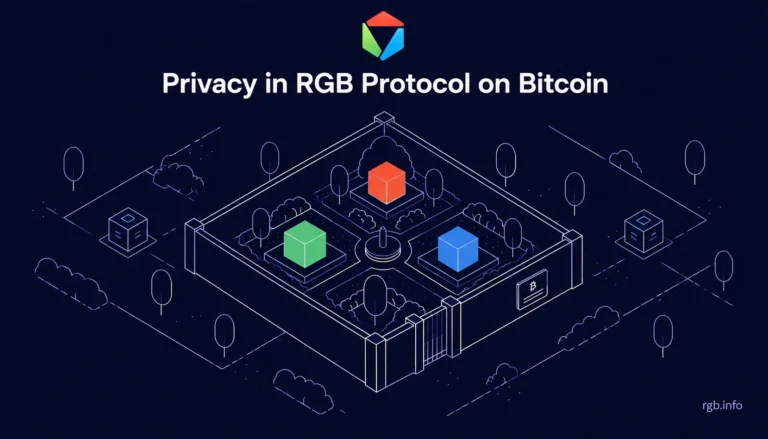
Because RGB Protocol on Bitcoin isn’t only about the blockchain layer. RGB is about taking control of your own belongings and understanding that you are the only person responsible for that asset, whatever kind of asset it is: your identity, your phone, anything you created. It’s self-hosted. You take control of your device, and you understand that the device holds the cryptographic keys to your assets. No other person, no other company is responsible for it.
Regarding the enterprise usage, I don’t think RGB is mainly built for enterprise. In my opinion, enterprises can use it too, obviously, but RGB is here to give people self-sovereignty.
I’m self-sovereign because I don’t rely on anyone. I can send a transaction through a centralized messaging app or I can use keys directly. I send a message, and the transaction gets anchored to Lightning or to Bitcoin. Either way, I don’t depend on anyone, and that’s crucial to me.
Coming from Ukraine, where life showed me that depending on the state can harm you, I had to build resilience away from the state. I’m alive, I’m here in the beautiful city of Viareggio, Italy, eating fantastic food, meeting fantastic people. Other people who stayed in Ukraine aren’t self-sovereign, and they live a completely different life. They don’t have the Italian “Dolce Far Niente” (note: an idiomatic expression for a way of living life slowly, enjoying leisure and relaxation).
RGB Protocol on Bitcoin is about “Dolce Far Niente”.

What does sovereign identity mean to you, and how can RGB help?
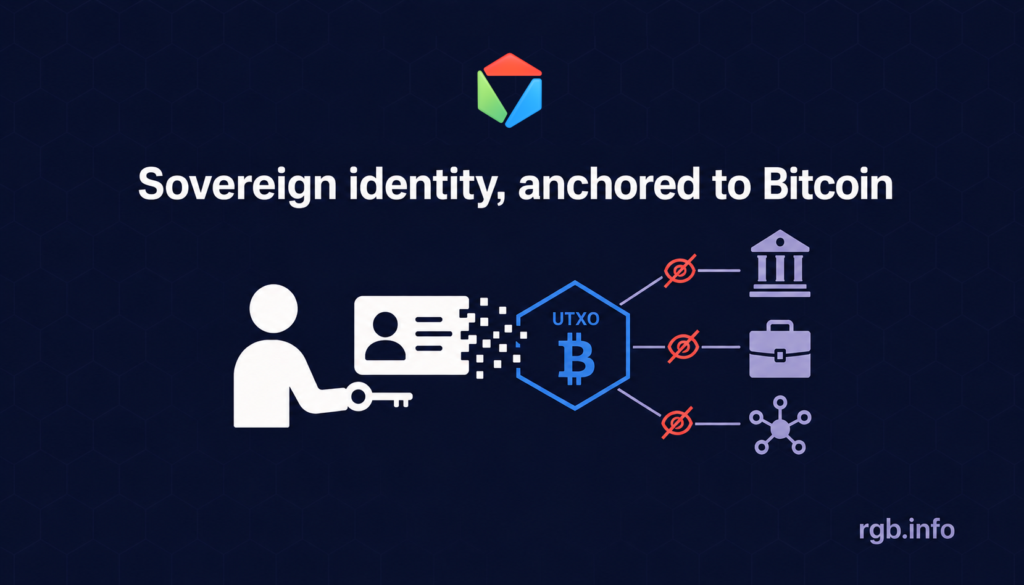
Here we’re talking about identity, not as a digital passport. Identity, in this sense, means identifying yourself as a sovereign individual. We can explore what tools we can use to be self-sovereign. RGB Protocol on Bitcoin is obviously one of those tools.
It’s not the only one, and it’s not a magic technology that solves every problem. It can solve some of the problems, but we’re exploring how we can use RGB to be self-sovereign.
We need to explore what kind of world we live in right now, where we’re heading, and what risks we might encounter in the future.
We could end up in total dictatorship fueled by AI. If you read the manifesto published by Palantir, they describe one of the worlds they want to build: a pure dictatorship where you have no choice. In a world like that, if you rely on centralized services controlled by companies like Palantir, BlackRock, State Street, and Vanguard, you’re in trouble: you’d have no choice, and you’d end up living in a world where writing something critical of the main political party on social media can get you disconnected from everything, and, if you’re unlucky, jailed, or made to simply disappear.
There are already so many examples in the world of things going badly. So we need to raise self-sovereignty among people.
It’s a nice word, but what does it actually mean? How can I be self-sovereign? It means giving people the right tools. We’re here like Prometheus: he brought us fire, and the people developing these tools are bringing technologies that can take your phone (which today isn’t self-sovereign because it’s controlled by Apple or Google) and make it self-sovereign.
Our role is to take something incredibly interesting and useful for humanity and wrap it in a more or less user-friendly tool, and give it to people so they can be self-sovereign. That’s basically what I do.
Tell us about your fund, and about your role on the board of the RGB Protocol Association
The fund you’re mentioning is basically a family office structure. My main project, the passion of my life, is called Layer2State, which is about a future where people live in total abundance: we don’t kill each other, we live in harmony with mother nature, mother earth, and in harmony with AI technologies that don’t enslave us, or aren’t used to enslave us.
I’m financing it myself to figure out what the future looks like, since right now everything is foggy and changes every single day. Trying to predict that future is exactly why my interest in RGB Protocol on Bitcoin comes in: I want to fund, in any way possible, the development of tools that bring self-sovereignty to people. RGB is one of these projects.
How about the Association?
I’ve done this before in Ukraine. I was president of the Blockchain Association of Ukraine, so I understand how to build a market. If you look around, you’ll see a lot of Ukrainians in crypto; part of that is because of the work we did with the Association in Ukraine, and then people moved around the world.
My role is to help the RGB Protocol Association and the people developing RGB find product-market fit, so the market pays for what they build, and they have the funds to keep developing: hiring new people, new technology, AI, or whatever they need.
If we don’t do it, someone else will build tools for a dictatorship instead, and I don’t want to live in that world, nor do the people I’ve met here at the conference, especially not a digital dictatorship where you have no choice and can be switched off just like that.
No money, no digital identity, you’re no one.

Michael Chobanian
Co-founder and board member of the RGB Protocol Association.