RGB Hackathon 2026 in Turin: Recap and Winners
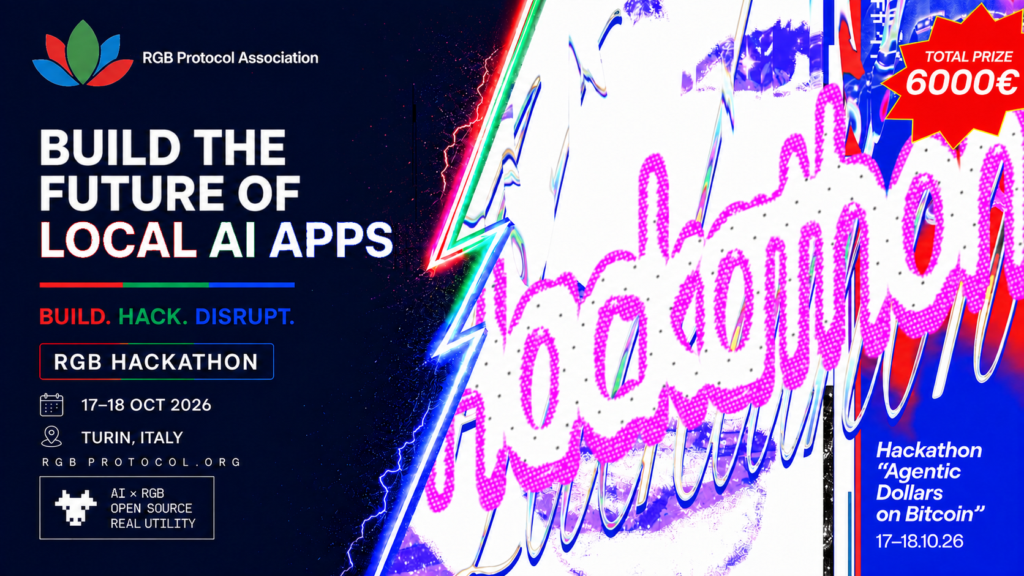
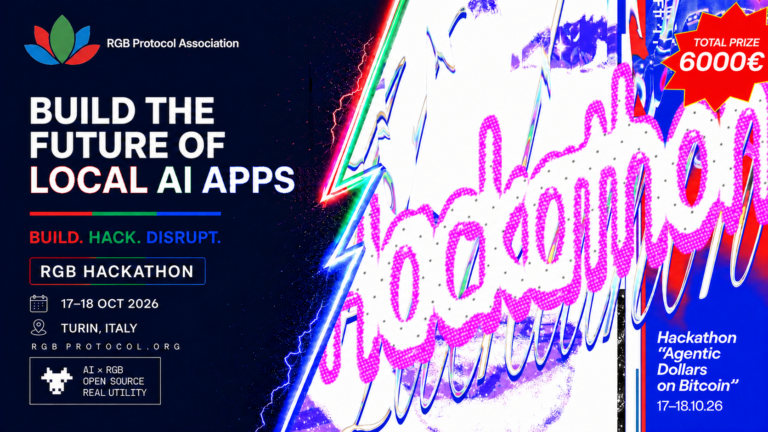
On October 17 and 18, 2026, 24 teams met at BLOX in Turin for Agentic Dollars on Bitcoin, the RGB hackathon 2026 of RGB Protocol Association with Tether as main sponsor. Over the weekend, between Saturday morning and Sunday at 13:00, every team built an application for digital dollars on RGB Protocol on Bitcoin, with AI models running locally on the device. Below, the recap covers the format of the weekend, the ten finalists and the three projects on the podium.
In brief:
- More than 400 applications, from candidates of at least 29 nationalities, and about 70 builders in 24 teams on site at BLOX, Turin, on October 17-18, 2026.
- Every project used RGB and QVAC, Tether’s stack for local AI. Tether’s WDK was optional and worth bonus points.
- Five judges from KaleidoSwap, Utexo, RGB Protocol and Tether selected ten finalists after a round of live demos.
- The podium: Kit+ty in first place, AIR-GB-LIGHTNING in second and Yolki-Palki in third.
What Was Agentic Dollars on Bitcoin?
Agentic Dollars on Bitcoin asked teams for “dollar apps”: self-custodial applications for digital dollars, driven by AI agents on the user’s own device. As a result, the financial logic and the AI inference both stay private and can work offline, with Bitcoin as the settlement layer.
To reach the goal, every project worked with three stacks:
- RGB Protocol on Bitcoin (required): issuance and transfer of assets such as USDT, with client-side validation and support for the Lightning Network.
- QVAC (required): Tether’s stack for AI models on local hardware, with no data sent to a cloud service.
- WDK (optional): Tether’s Wallet Development Kit for self-custodial wallets, worth up to one bonus point.
RGB Protocol Association organized the event with Tether as main sponsor and Utexo as co-sponsor. BitPolito, the Bitcoin student association of Politecnico di Torino, and BLOX, the venue, joined as partners. Politecnico di Torino, for its part, supported the initiative and invited its students to the hackathon.
Who Took Part in the Hackathon?
In total, the call for applications collected more than 400 applications, including those gathered through Politecnico di Torino, from candidates of at least 29 nationalities. In the end, about 70 builders in 24 teams of two to four people reached Turin, with university students, in particular from Politecnico di Torino, next to software engineers and professionals from the payments industry.
Besides Italy, the teams on site came from Türkiye, Croatia, Kazakhstan, Russia, Guatemala and the United States.
What Happened over the Two Days in Turin?
First, on Saturday at 08:30, the kickoff introduced the logistics, the three stacks and the mentors. After that, mentors from the RGB, KaleidoSwap and Utexo teams remained available at BLOX for both days, for questions on code, tools and design choices.
Meanwhile, each team worked in a public GitHub repository. In fact, by Friday evening, every team shared the first version of the repository, with a README listing any code, prototype or design already in existence. The judges then compared the first version with the final commit of Sunday at 13:00, so the score reflected the work of the weekend.
On Sunday, after the submission deadline, the teams showed a short live demo of the main flow to the judges. Later in the afternoon, the judges announced ten finalists, each with a five-minute pitch and two minutes of questions. Finally, the awards ceremony closed the event in the evening.
How Did the Judges Score the Projects?
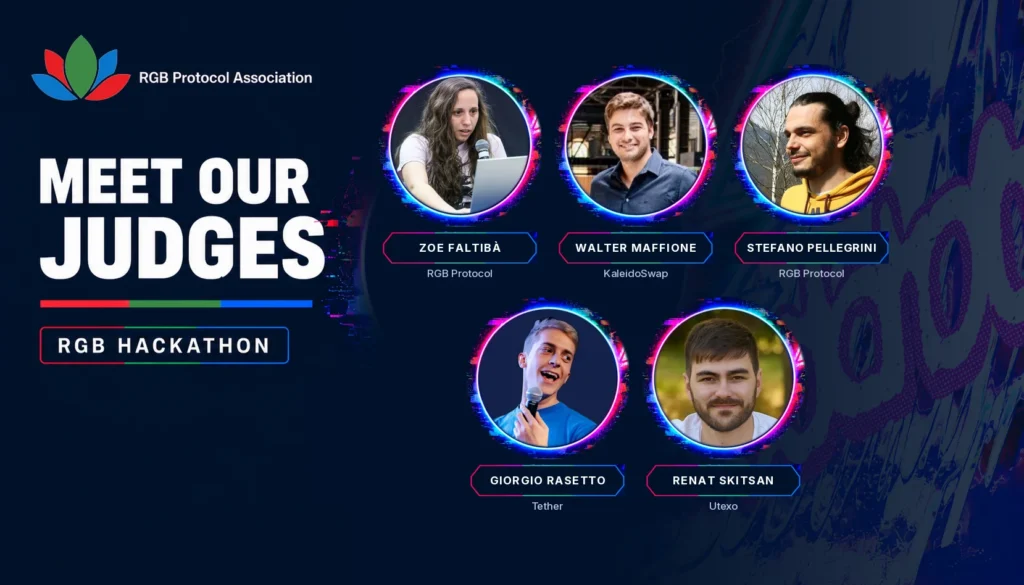
Five judges evaluated the projects:
- Walter Maffione, KaleidoSwap
- Renat Skitsan, Utexo
- Zoe Faltibà, RGB Protocol Team from Bitfinex
- Stefano Pellegrini, RGB Protocol Team from Bitfinex
- Giorgio Rasetto, Tether
The score mostly depended on whether RGB played a real part in the product, and whether the local AI did useful work. Besides, the judges looked at how much of each project worked live, how easy the app was for someone with no technical background, the originality of the idea and the chances of a life after Sunday. In addition, a solid WDK integration brought a few bonus points.
In practice, the judges rewarded live demos, transparency about prior work and simulated parts, and products with a real need for both RGB and local AI.
Who Were the Ten Finalists?
In alphabetical order:
- AIR-GB-LIGHTNING: multi-path routing for RGB assets on the Lightning Network, with a local AI model for the choice of the route.
- AVL: HubWallet, a small device for shops with self-service machines, such as laundromats and coworking spaces, for payments in dollars on RGB via QR code; a local AI helps the owner configure devices and rules in plain language.
- BOUNTY HUNTERS: Goal Digger, a challenge app with a stake in USDT on a personal goal, bets from friends against the outcome, a local AI as judge of the proof and an RGB payment to the winner.
- Coin³: WiseLedger, a local AI for invoices, with detection of fraudulent ones and payment of valid ones in RGB assets from a self-custodial wallet.
- fork2checkbook: a digital checkbook on ESP32 devices for offline handoffs of RGB value, with no internet connection and no app between the two holders, and redemption in a wallet at a later time.
- Inglorious Engineers: Freelancer Escrow Agent, an escrow service in USDT on RGB, with a local AI for the conversion of a plain-language agreement into checks on the delivered work.
- Kit+ty: a shared kitty for group trips, with a personal budget for each traveler in an RGB channel on the Lightning Network.
- QVACche: a team of students from BitPolito that created the betting platform Bether.
- Satstride: PassBook, an Android wallet with a marketplace for Bitcoin-backed loans, settlement in test USDT on RGB and local AI models for the analysis of financial data.
- Yolki-Palki: pálka, a non-custodial exchange for bitcoin and RGB assets, with multi-party trades in a single Bitcoin transaction.
Which Projects Won the Hackathon?
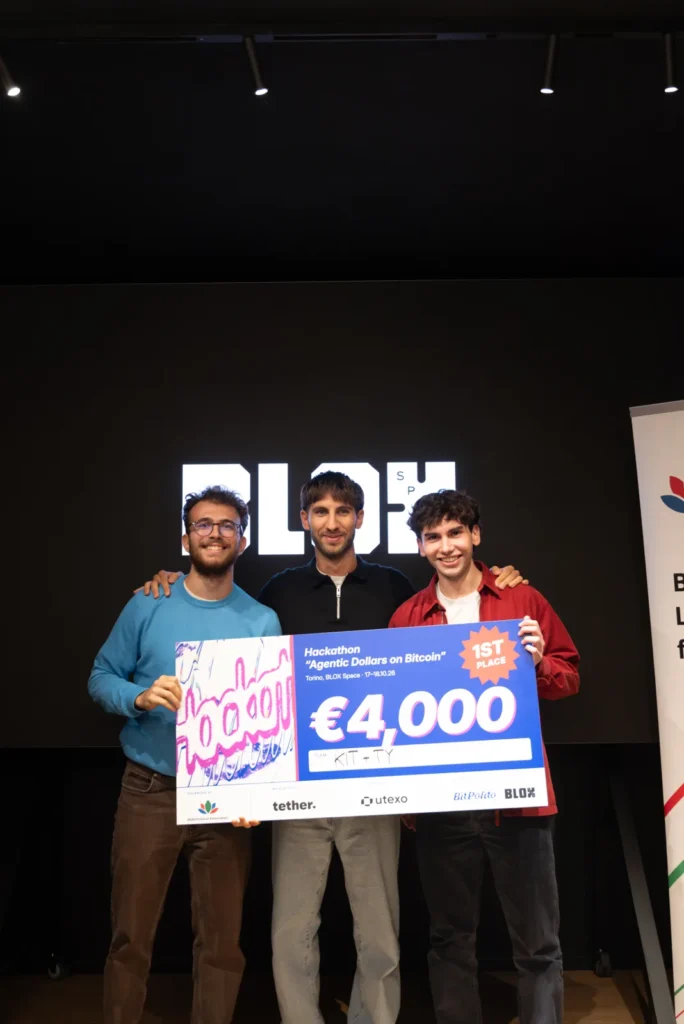
First Place: Kit+ty, a Shared Kitty for Group Trips
Prize: €4,000 and a guaranteed spot at the CypherTank · Repository: github.com/marco-pedron/kit-ty
On organized group trips, shared costs usually end up in the coordinator’s cash envelope, or one traveler pays in advance and spends the rest of the trip in pursuit of refunds. To solve the problem, Kit+ty, by Paolo, Federico and Marco, offers tour operators an alternative, as a service for their customers.
To start, each traveler opens an RGB channel on the Lightning Network with the node of the tour operator and funds the channel with their own digital dollars. In this way, the channel works as the traveler’s budget for the trip: nobody else, the operator included, can spend the balance.
Then, when a member pays for the group, QVAC reads a photo of the receipt on the device, and a sentence such as “Bob and I had the pho, Charlie only beers” becomes a split per person. However, the AI only proposes the split, while deterministic code computes every cent. Afterwards, the agent of each traveler checks the expense and refunds the payer over Lightning within seconds, as long as the amount stays within limits chosen by the traveler; above the limits, the traveler approves or contests each line.
Under the hood, every member runs an instance of rgb-lightning-node, and the digital dollar is an RGB asset with the NIA schema, as a stand-in for USD₮. In addition, the operator’s on-chain treasury relies on WDK, and the demo runs on Bitcoin regtest.
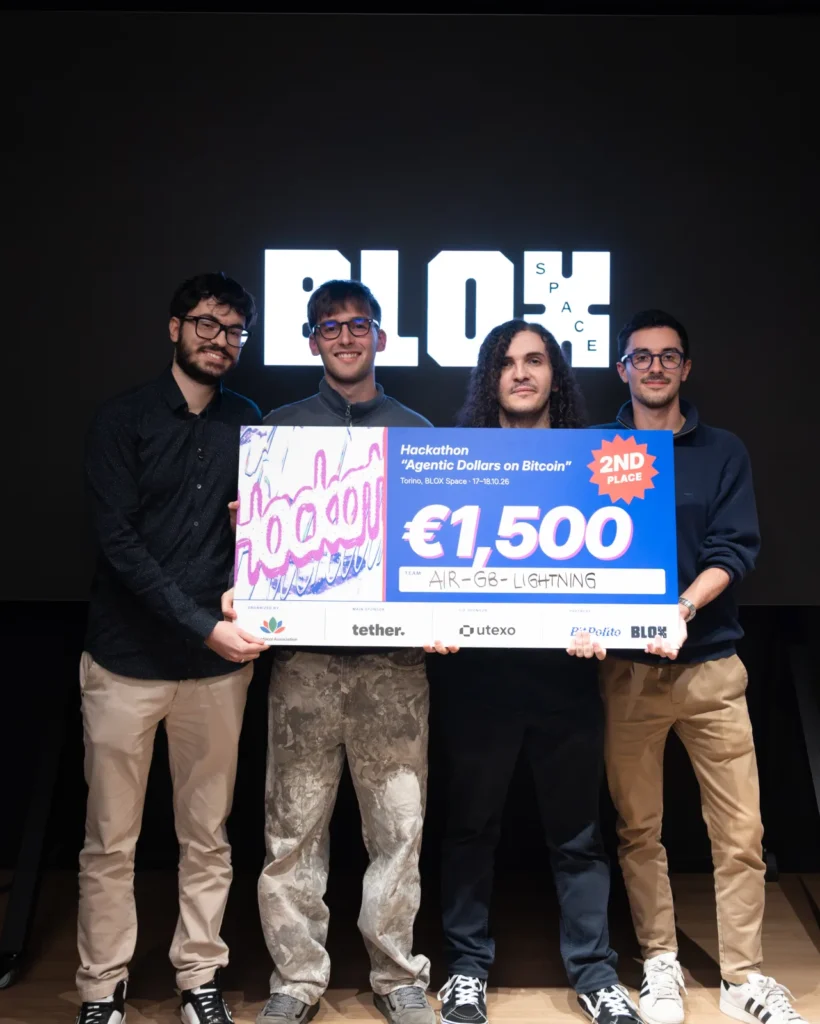
Second Place: AIR-GB-LIGHTNING, Multi-Path Payments for RGB Assets
Prize: €1,500 · Repository: github.com/ObvAstral/air-gb-lightning
AIR-GB-LIGHTNING focuses on liquidity in RGB payments on the Lightning Network. According to the team, an RGB payment larger than the capacity of every single channel fails today, even with enough funds spread across several channels of the sender.
To address the issue, the project splits an RGB payment across multiple paths, with a technique known as multi-path payments (MPP), through modified versions of rgb-lightning-node and rust-lightning. At the same time, a local QVAC model reads the node’s own payment history, rates each channel and selects the routing strategy, while deterministic checks on the real balances limit the room for errors by the model. Moreover, users can set preferences in plain language, such as a maximum fee or the exclusion of a specific node.
To measure the effect, the team ran a benchmark on a regtest network of 20 nodes: 13 payments out of 20 reached the destination, against 7 out of 20 with the standard single-path node.
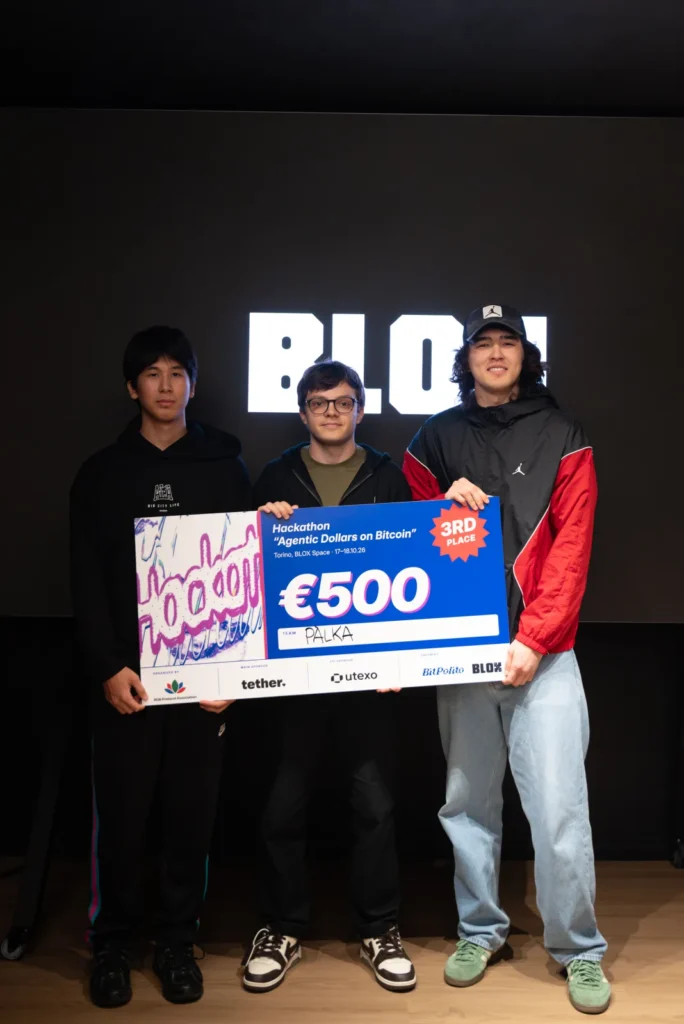
Third Place: Yolki-Palki, Multi-Party Exchanges in One Bitcoin Transaction
Prize: €500 · Repository: github.com/yolki-palki-team/rgb-hackaton
Pálka, the project of team Yolki-Palki, connects traders without a direct counterparty. For example, Alice offers asset X in exchange for dollars, Bob offers dollars in exchange for bitcoin, and Carol offers bitcoin in exchange for asset X: no pair matches, but the three orders together form a ring.
In such cases, pálka finds the ring and settles all the transfers in a single Bitcoin transaction, with bitcoin inputs and RGB state transitions side by side, so the exchange completes for every participant or for none.
First, traders describe their orders in plain language to a local QVAC model, which drafts the terms for review. However, the AI sets no prices and has no say on the validity of a transaction. On the technical side, the project relies on rgb-lib for the RGB wallet, on KaleidoMind, the agent toolkit of KaleidoSwap, on top of QVAC, and on WDK for the top-up of the RGB wallet with bitcoin. Currently, the demo runs on Bitcoin regtest, with a public website at owlpeer.com.
What Comes Next for the Projects?
As winner of the first place, Kit+ty will take part in the semifinals of CypherTank, a Bitcoin-focused pitch and funding program. Meanwhile, the repositories of the projects remain public on GitHub, for anyone interested in the code.
In the coming weeks, the RGB channels will publish interviews with participants, mentors and sponsors, recorded in Turin during the weekend.
Finally, we want to sincerely thank all 24 teams for two days of work with digital dollars on RGB Protocol on Bitcoin and local AI, to the judges and the mentors for their time and feedback, to Tether and Utexo for their support, and to BitPolito and BLOX for the hospitality.