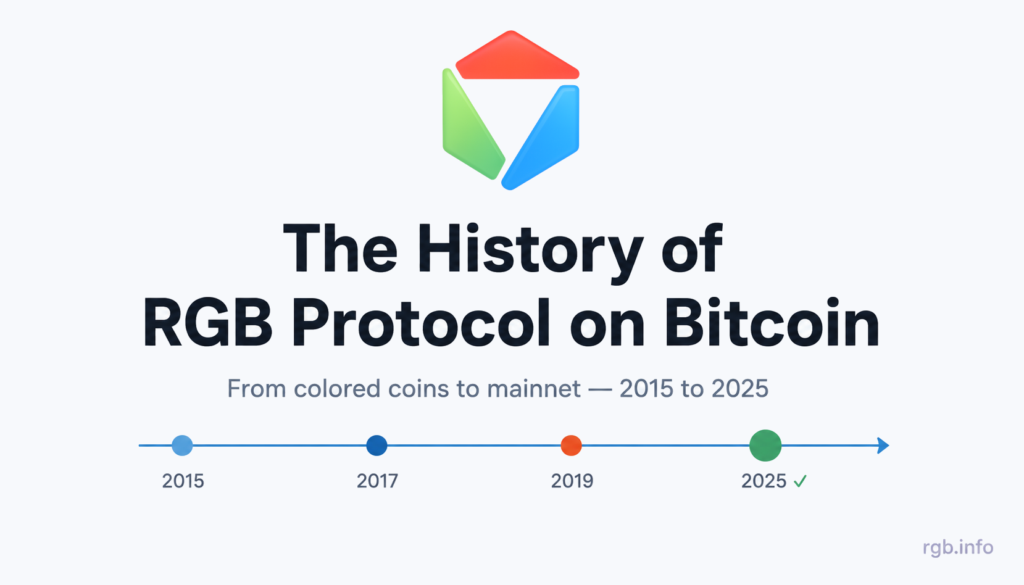
The History of RGB Protocol on Bitcoin
The idea: Bitcoin as more than money
Bitcoin was designed to do one thing extremely well: transfer value between parties without trusting a third party. But from the early days of the ecosystem, developers began asking a broader question: could Bitcoin’s security and decentralization be used to represent any kind of digital asset, not just bitcoin itself?
The first attempts, like Colored Coins and Mastercoin, tried to layer asset functionality on top of Bitcoin by embedding metadata in transactions. They worked, but came with significant tradeoffs: all asset data was visible on-chain, the blockchain grew with every transfer, and privacy was essentially nonexistent.
A more fundamental approach was needed.
Phase 0 — 2015: the mapping and the name
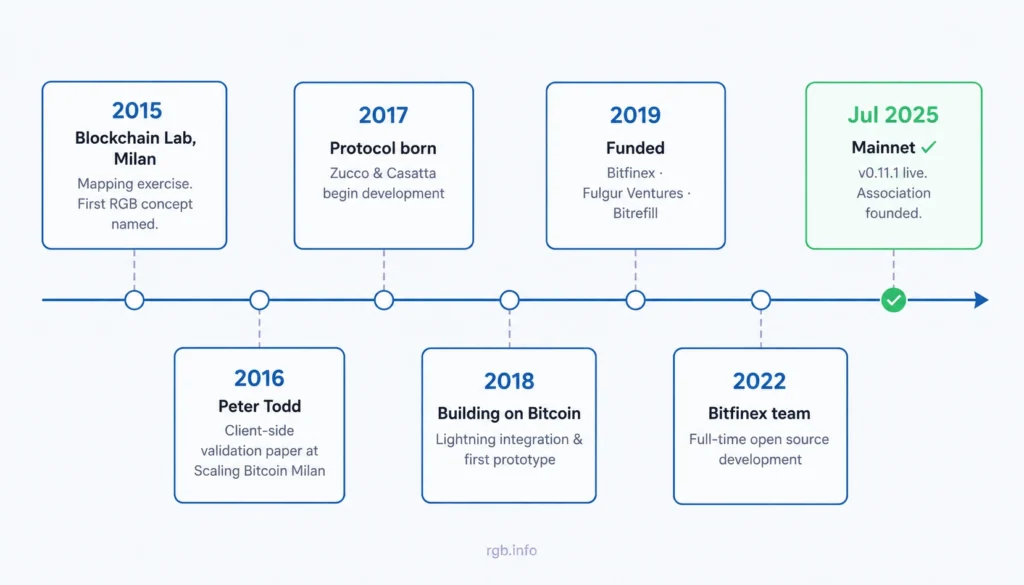
The story of RGB begins in 2015 at Blockchain Lab, a Bitcoin research and consultancy center in Milan founded by Giacomo Zucco. The lab brought together a group of researchers and practitioners — including Riccardo Casatta, Marco Amadori, and others — and regularly hosted prominent international guests from the Bitcoin ecosystem.
At that time, Blockchain Lab was commissioned by a client to map and assess all existing approaches to issuing digital assets on Bitcoin: a category then known as “colored coins.” The team reviewed every major protocol of the era: Colu, CoinPrism, CoinSpark, CounterParty, MasterCoin (later Omni), and others. They invited the creators of each protocol to Milan to present their work and explain their approach.
The conclusion of this mapping exercise was a design document describing the ideal architecture for a colored coin scheme on Bitcoin — one that addressed all the known shortcomings of existing approaches: UTXO set bloat, limited supply caps, on-chain data burden, distorted miner incentives, and reduced fungibility and privacy.
Mir Serena Liponi, a key figure in the early Bitcoin community in Italy and a central presence in the Blockchain Lab ecosystem, suggested naming this ideal design RGB — a reference to the additive color model, a nod to Colored Coins, and an acronym that quietly encoded the names of the people behind it. At this stage, RGB was not a protocol — it was the name of a proof of concept describing what an ideal colored coin scheme could look like, produced for a client.
Phase 1 — 2016: the theoretical foundation
In 2016, Peter Todd, one of the most respected cryptographers and protocol designers in the Bitcoin ecosystem, presented a paper at Scaling Bitcoin Milan on client-side validation. The core idea was radical: validation does not need to happen on-chain. Bitcoin only needs to serve as a proof-of-publication system, a way to anchor commitments to a shared, immutable ledger. The actual validation of transactions could be done off-chain, by the parties involved in a transfer, using only the data relevant to them.
The privacy and scalability implications were profound: no one outside a transaction needs to know it happened, and the blockchain carries only a minimal cryptographic commitment, not the full asset history.
Peter Todd had been a resident at Blockchain Lab in Milan, and Giacomo Zucco was on the programme committee for Scaling Bitcoin. After the conference, Zucco invited Todd to return to Milan for a residency to explore whether client-side validation — while too radical a change for Bitcoin itself — could be applied specifically to asset issuance. The connection between the ideal colored coin design from the 2015 report and Todd’s client-side validation model was immediately apparent.
Phase 2 — 2017: RGB becomes a protocol
In 2017, building on Peter Todd’s client-side validation model and the earlier colored coin design work, Giacomo Zucco and Riccardo Casatta began developing RGB into a concrete protocol proposal. The name from the 2015 report was carried forward — now it was no longer just a design concept, but the name of a real protocol under development.
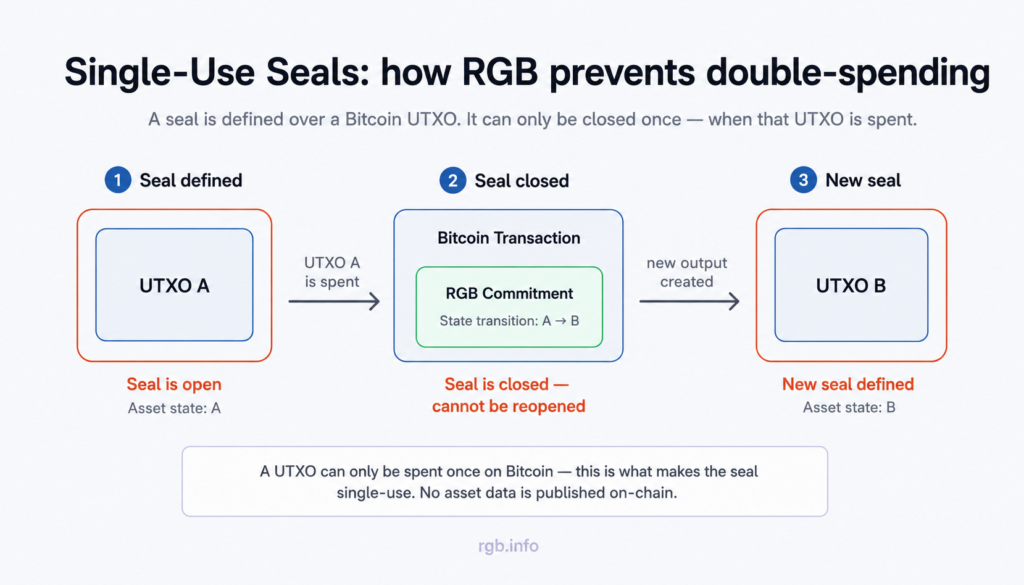
Working at Blockchain Lab, alongside the Poseidon Group who had originally commissioned the colored coin mapping, the team outlined a system for issuing and transferring digital assets on Bitcoin using client-side validation — inheriting Bitcoin’s double-spend protection through single-use seals without publishing anything to the blockchain beyond a minimal cryptographic commitment.
Due to some organizational complications around the initial sponsorship, the project was temporarily frozen after this phase. In summer 2018, interest was rekindled.
2018: Lightning integration and the first prototype
In 2018, Giacomo Zucco presented RGB at the Building on Bitcoin conference in Lisbon, this time with a new dimension: the idea of merging RGB with the Lightning Network. Zucco observed that the UX tradeoffs of client-side validation — an online receiver, additional backups — were closely parallel to those already accepted by the Bitcoin community for Lightning. Since Lightning already required online presence and careful state backups, RGB could leverage Lightning’s infrastructure to address these limitations, passing consignments through Lightning messages and storing backups alongside channel states.
Following the presentation, Alekos Filini, a talented young Bitcoin developer who had been following the RGB concept since its early days, began building the first working prototype of RGB, turning the theoretical model into code. The Poseidon Group continued financing this effort, with Giacomo Zucco’s company also contributing to the initial development phase.
2019–2022: building the foundations
In spring 2019, during the Understanding Bitcoin conference in Malta, Giacomo Zucco was approached by three people: John Carvalho of Bitrefill, Oleg Mikhalsky representing Fulgur Ventures, and Paolo Ardoino, CTO of Bitfinex. They expressed interest in funding RGB development and putting it on a path to production. Together with the Poseidon Group, Bitfinex, Bitrefill, and Fulgur Ventures committed resources to RGB development.
When Alekos Filini moved to Blockstream to work on what would become the Bitcoin Development Kit, Maxim Orlovsky, a Ukrainian software engineer and protocol designer, took on the role of lead developer, bringing deep technical expertise to the protocol’s architecture. A coordination group formed, bringing together all key stakeholders: John Carvalho of Bitrefill as project coordinator, Giacomo Zucco as ideator and promoter, Paolo Ardoino representing Bitfinex as primary funder, and Marco Amadori of inbitcoin as one of the first prospective clients. In particular, inbitcoin had a concrete need for colored coin tokens on Lightning, making RGB a directly applicable solution.
Peter Todd, consulted during this period, described RGB as “the best thing to build on currently”: it was a significant endorsement from the person whose theoretical work had made it possible.
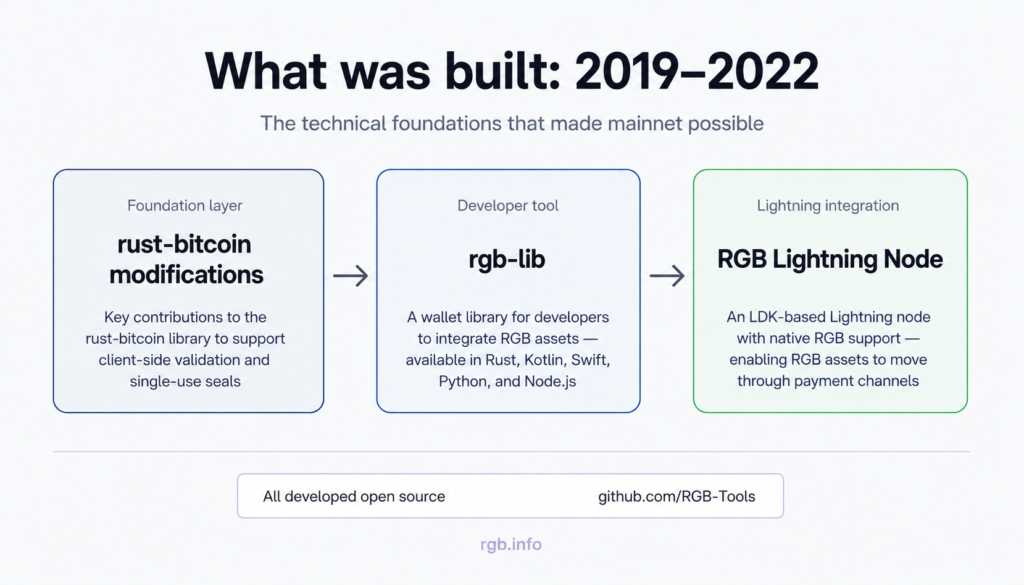
By the end of 2020, Bitfinex and Fulgur Ventures stopped funding development, as the project under Orlovsky’s leadership was growing in complexity without getting closer to delivery, leaving RGB self-funded by Orlovsky and his company Pandora Core. This period is central to the history of RGB Protocol on Bitcoin. Although quieter publicly, produced important technical work: key modifications were pushed to the rust-bitcoin library to support client-side validation and single-use seals, laying the groundwork for the broader ecosystem.
In 2022, Bitfinex and Fulgur Ventures renewed their interest in RGB. This time, instead of just supporting financially, they opted to create a dedicated team that could boost RGB development. Federico Tenga, nowadays R&D strategist at Bitfinex and a long-standing contributor to the project, formed a dedicated team at Bitfinex, working full-time on open source RGB development, with the goal of bringing the protocol to mainnet. The team made several contributions to the protocol and developed rgb-lib, a widely adopted wallet library to integrate RGB, and RGB Lightning Node, an LDK-based Lightning node with native RGB support.
2024–2025: two paths forward
By 2025, the development community faced a fork in the road.
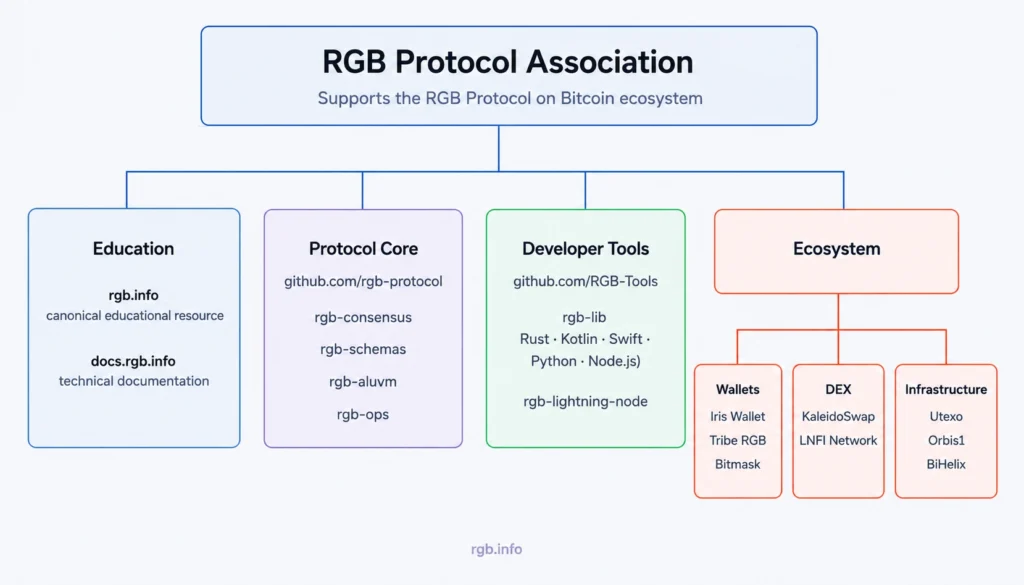
RGB Protocol on Bitcoin had evolved through a continuous series of versions: v0.9, v0.10, v0.11, each building on the previous. Version 0.11.1 represented the natural continuation of this path: fix existing issues, remove unused parts, increase test coverage, and deliver a working mainnet release. A significant number of projects, including Iris Wallet, Kaleidoswap, LNFI, Bitmask, Thunderstack, UTEXO, Orbis1, and Bitcoin Tribe, had already built on this version and were ready for mainnet.
In parallel, a proposal to take a radically different direction emerged with version 0.12, which was a substantial rewrite of the codebase, introduced with limited prior discussion with the companies building on RGB. The builders and investors who had been working toward mainnet rejected this proposal, as it was still incomplete, untested, and brought significant changes to the main codebase. Instead, they chose to continue on the established path with v0.11.1.
In July 2025, a new GitHub organization called rgb-protocol was created to provide a dedicated home for the completed work on v0.11.1, continuing development with a clear focus on stability, solid testing, and clear documentation.
Since then, the former RGB-WG organization owned by Maxim Orlovsky, has seen no meaningful updates or public activity.
July 2025: mainnet
In July 2025, RGB Protocol on Bitcoin v0.11.1 reached mainnet, a landmark moment for the protocol after years of development.
On the same day, the companies building on RGB announced that their products were live and integrated with the mainnet release: LNFI Network, Thunderstack (*now Utexo), Bitmask, Bitcoin Tribe, and Iris Wallet all went live simultaneously, demonstrating that the ecosystem was ready.
The same month, the RGB Protocol Association was founded, bringing together the key companies developing and investing in RGB: Bitfinex, Tether, Fulgur Ventures, Boosty Labs, Kaleidoswap, LNFI, Bitmask, Thunderstack, Bitcoin Tribe, Terricon Capital, and Layer 2 State Foundation.
Giacomo Zucco, representing Plan B Network, and Birkan Kayadibi, already active in the RGB ecosystem, were tasked with managing the Association.
Among the founders, other key people included:
- Federico Tenga (Bitfinex),
- Oleg Mikhalsky (Fulgur Ventures),
- Viktor Ihnatiuk (Utexo),
- Walter Maffione (Kaleidoswap),
- Michael Chobanian (Layer 2 State).
In August 2025, Tether officially announced plans to launch USDT on RGB Protocol on Bitcoin, one of the most significant endorsements in the protocol’s history. Paolo Ardoino, CEO of Tether and a long-standing supporter of RGB both through Bitfinex’s internal development team and in numerous public statements over the years, described the vision: “Bitcoin deserves a stablecoin that feels truly native, lightweight, private, and scalable. With RGB, USD₮ gains a powerful new pathway on Bitcoin.”
Today: an active ecosystem
As of 2026, RGB Protocol on Bitcoin v0.11.1 is the only actively developed version of the protocol. The rgb-protocol organization maintains the codebase at github.com/rgb-protocol, with regular contributions and a clear roadmap focused on Lightning Network optimization, USDT issuance readiness, and new protocol integrations including Ark. Besides, the related ecosystem is alive and growing.
The canonical educational resource is rgb.info.
The complete technical documentation is at docs.rgb.info.
The RGB Protocol Association can be found at rgbprotocol.org.
RGB Protocol on Bitcoin is not a new idea. It is the result of nearly a decade of research, development, and collaboration by a broad community of Bitcoin developers. What is new is that it works, it is live on mainnet, and it is ready to build on.
A note on naming
Three things share similar names and are frequently confused:
- RGB color model — Red, Green, Blue. The color system used in displays and imaging. Completely unrelated.
- RGB++ — a separate protocol on the Nervos/CKB blockchain, developed by a different team. Different architecture, different blockchain, no relation to RGB Protocol on Bitcoin.
- RGB v0.12 — a separate development branch maintained by the former RGB-WG organization, owned by Maxim Orlovsky. As of early 2026, no meaningful updates or public activity have been recorded on this codebase.
Sources & Resources
Primary sources
- RGB Community Telegram chat: public discussions and announcements from the RGB developer and builder community.
External references
- Peter Todd, “Disentangling Crypto-Coin Mining: Timestamping, Proof-of-Publication, and Validation” (2013) — petertodd.org
- Tether announcement: USDT on RGB Protocol on Bitcoin — tether.io
- rgb-protocol motivations document — github.com/rgb-protocol
- v0.11.1 vs v0.12 technical comparison — github.com/rgb-protocol