BiHelix: Building RGB Protocol’s Application Layer
This interview was recorded on an X Space on August 12, 2026, the second Chinese-language community call hosted by RGB Hub. Bibo (@Bibo_Brooks) is co-founder of BiHelix, an application framework layer for Bitcoin built on RGB Protocol on Bitcoin and Lightning Network. He is also one of the founding members of the RGB Protocol Association.
In Brief
- Bibo discovered Bitcoin in 2011 and co-founded BiHelix in 2023, right after RGB Protocol’s first stable release
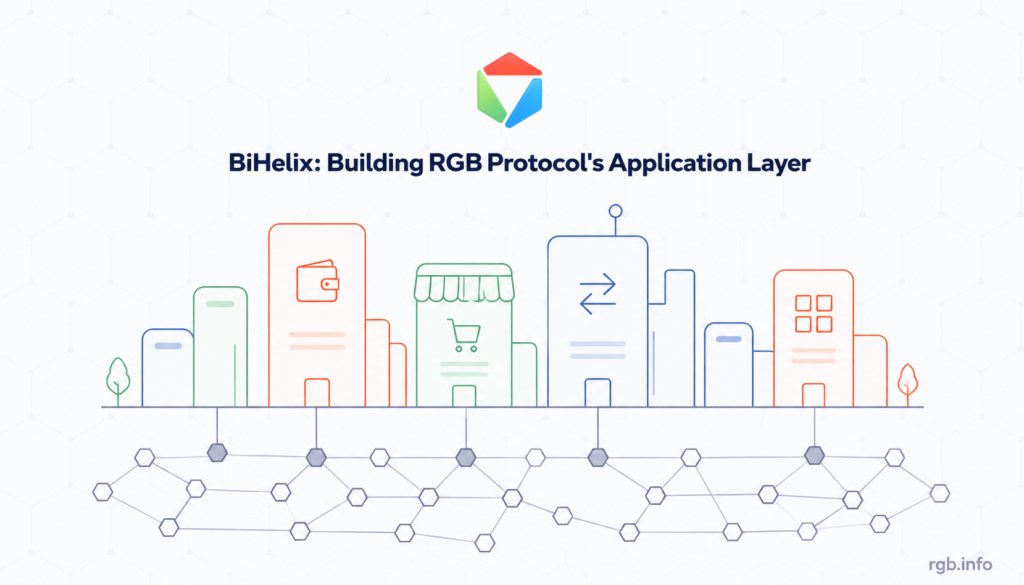
- BiHelix positions itself as an application framework layer for Bitcoin, the same relationship the internet has between TCP/IP and everything built above it
- Its core products are BiHelix Node and the open-source Wallet Service; the team is targeting Q3/Q4 2026 for a retail-facing DEX
- Super Bazaar, a trading marketplace the community built on BiHelix’s application layer, already clears more than 1 BTC in daily volume
- He names three advantages of Bitcoin-native infrastructure: real BTC, near-unlimited scalability, and privacy by default
How Did You First Get Into Bitcoin?
I came to Bitcoin fairly early. In 2011, I was developing new business at a US consulting firm, and Bitcoin already came up occasionally in the news. But I didn’t understand it in any real depth back then. Systematic study only started in 2016. Even then, I mostly saw Bitcoin as a way to make money, not a career to build. I joined the industry properly, what people here call “the circle,” in 2021.
Looking back, my path ran through three stages. Around 2011 or 2012, I left FICO to start my first company, an internet finance venture. Bitcoin was still just a name I’d noticed in passing. By 2016, that internet finance work naturally pulled me toward Bitcoin. Even so, I mostly saw a volatile asset worth trading, not an industry worth joining.
2021 changed that, though not straight into BiHelix. I moved into the space properly, first working on a handful of DeFi projects during DeFi Summer. Founding BiHelix came only in 2023, once RGB Protocol’s first stable version shipped and the timing finally felt right.
How Do You See the Bitcoin Market Today?
Bitcoin has moved through distinct phases. In its earliest years, the identity that stuck was digital gold and a store of value. That framing made sense: Bitcoin’s core achievement was building a trustless digital asset system with no third party involved. That story shaped most people’s mental model of Bitcoin for over a decade.
Standing in 2026, I’d argue the picture has shifted. AI agents are maturing quickly, and Bitcoin’s infrastructure is maturing right alongside them. That list now includes Lightning Network, RGB Protocol on Bitcoin, Taproot Assets, several Bitcoin layer-2 projects, and newer BIPs under active discussion.
Individually, these pieces solve small parts of Bitcoin’s application layer. But RGB is what unifies them into something coherent. Once the technical bar drops low enough for ordinary people, not just developers, Bitcoin is set up for what I’d call a mass-adoption breakout. That reading is where I’d place Bitcoin right now.
When Did You First Encounter RGB Protocol on Bitcoin?
Fairly early, actually, back in 2021, right as I started my own venture. A Bitcoin OG told us Bitcoin’s ecosystem had an unusually powerful protocol that, once mature, could reshape Web3’s entire landscape. So my co-founder, Hong Shuning, started digging into the codebase not long after, and translated some of the earliest introductory material on RGB. By 2023, once RGB’s first stable version shipped, we moved fast and founded BiHelix.
What Is BiHelix’s Positioning?
BiHelix sits as an application framework layer for Bitcoin, and that positioning has stayed fixed since day one. Lightning Network and RGB Protocol on Bitcoin remain protocols, and a protocol by itself sits far from anything commercially usable. The internet worked the same way with TCP/IP. Nobody builds directly on a transport protocol; every product sits on the application layer above it. We treat RGB the same way: we engineer it into something simple enough for ordinary developers and users to build and transact on.
That positioning defines who we build for. Not the deeply technical developers already fluent in RGB, but ordinary programmers, including people now shipping software through AI-assisted “vibe coding.” They need Bitcoin’s application layer to feel as approachable as any other stack. Skip that step, and the ecosystem stays out of reach for most people. As a result, adoption never really takes off.
What Does BiHelix Actually Build?
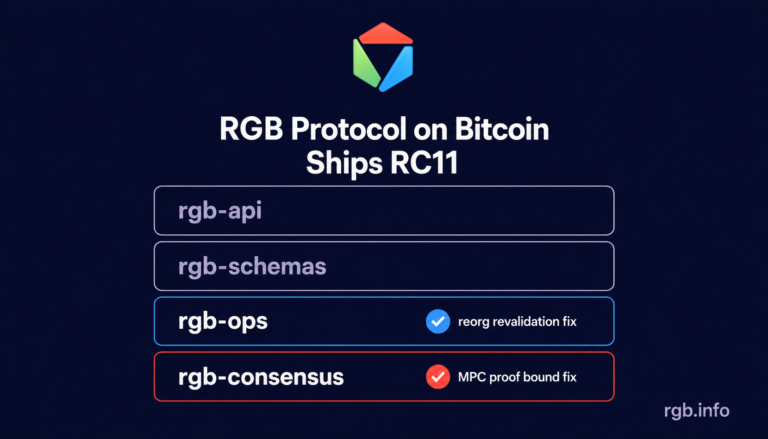
The product itself is simple to describe. We took RGB Protocol on Bitcoin (currently at version 0.11.1 RC11) and integrated it directly into a Lightning Network node. We actually finished that work back in 2023. Since then, every protocol update has rolled straight into what we call BiHelix Node.
BiHelix Node runs two ways. One route is fully custodial, our Wallet Service product. The other lets someone run the node directly and manage RGB Protocol assets themselves.
We split the product that way for a reason. From my time running product teams, most people never engage with the technical layer at all. Right now, nearly everyone paying attention to RGB is a fairly serious developer, thinking natively: run a full node, full stop. Real need exists for that group, but it isn’t representative.
Most people don’t understand the technology and wouldn’t know how to run a node. What they actually want is a secure custodial service where they can trade, issue assets, and build applications directly. The Wallet Service covers that segment, while we also support self-custody for the technical crowd.
Finally, large traders get their own dedicated path next: atomic-swap DEX infrastructure we’re targeting for Q3/Q4 2026.
Custody through BiHelix Node works differently than it sounds. RGB’s defining property is that only the private key holder can decode an asset. As a result, BiHelix never gains real custody the way a centralized platform would. People steer away from custodial products less because assets sit somewhere unsafe. More often, they’d rather not manage the underlying technical complexity themselves. Closing exactly that gap is what Wallet Service does.
How Does BiHelix’s Planned DEX Compare to Kaleidoswap?
We’re building a native, atomic-swap DEX, aimed at a different user than Kaleidoswap serves. Kaleidoswap targets technically sophisticated users who already understand RGB deeply. By contrast, our target sits closer to retail: people who just want to deposit an asset, trade it, and withdraw, without needing to understand the mechanics underneath.
Collaborating with Kaleidoswap genuinely appeals to us: their work goes deeper on the non-custodial side, and our overall philosophy tracks closely with theirs. Rather than build a competing non-custodial layer from scratch, we’d rather plug into what Kaleidoswap has already built. That way, we can focus our own effort on the custodial, mass-market side over Lightning Network.
What Is Super Bazaar in BiHelix’s Ecosystem?
Super Bazaar is one of the live products already running in our ecosystem, a trading product the community built independently on top of BiHelix’s application layer, positioned as a trading marketplace rather than strictly a DEX. Still early days, only recently launched, and it’s already clearing more than 1 BTC in daily trading volume. Growth to tens of BTC a day feels likely before long. Once daily volume reaches 50 BTC, a product at that scale becomes genuinely significant by any measure. The same logic scales to 100x or 1000x that volume, since what’s trading remains a single asset category. Once stablecoins enter the picture, the wider market genuinely takes off.
As the infrastructure provider, BiHelix supports every project building in the ecosystem rather than singling one out to promote. Ethereum and Uniswap sit in a comparable relationship. Ethereum doesn’t formally endorse Uniswap specifically. Similarly, backing one ecosystem project over another wouldn’t sit right for BiHelix either.
Why Do Stablecoins Matter for RGB Protocol on Bitcoin’s Growth?
Large, traditional capital sits mostly in stablecoins today. When that capital enters Bitcoin’s ecosystem matters enormously for the whole ecosystem’s breakout. Stablecoins alone, arriving before there’s anywhere real to use them, won’t get the job done, though. What has to exist first is a genuinely smooth RGB Protocol on Bitcoin DEX. Ordinary users need to already swap Bitcoin-native assets with ease. Only once that groundwork sits in place does a stablecoin’s arrival trigger the wider ecosystem’s breakout.
A stablecoin isn’t a bank walking through the door, to be precise. Underneath, it remains just another RGB asset, centralized in the sense that a single issuer backs it rather than the protocol itself. Scale is what makes stablecoins different: they already represent the largest pool of capital anywhere in crypto. So once that capital moves onto Bitcoin, it pulls every other RGB Protocol on Bitcoin asset up alongside it.
How Do You See AI and Bitcoin Converging?
AI’s development speed and Bitcoin’s ecosystem development speed move together. I’d argue AI is actually core to why Bitcoin carries real value at all. Bitcoin wasn’t really built for humans to hold; it exists for future AI agents, or what people here sometimes call “non-carbon life,” to use directly. The logic is simple: an AI agent can’t establish ownership over gold sitting in a vault, but it can establish ownership over BTC living on-chain. Bitcoin-native assets are on track to become AI’s base-layer asset.
People sometimes assume EVM-based assets could fill that role just as well. Technically, they could, but efficiency becomes the real constraint. Lightning Network is where the answer lives. Far more than a payment channel, it’s closer to a future settlement system, the way SWIFT handles clearing between banks in traditional finance today. Clearing between AI agents, or across whatever financial system comes after today’s, runs through Lightning Network, since nothing else clears at comparable efficiency. So our team calls Lightning Network “SWIFT 2.0.”
AI’s growth and Bitcoin’s growth reinforce each other precisely along those lines. AI makes the technical side simpler to build on. Bitcoin-native assets give AI something real to transact with.
Later in the call, an audience member asked whether Lightning Network’s future points more directly toward AI. High-frequency, small-value payments suit AI use cases well, after all. Bibo agreed, pointing to L402, Lightning Network’s own AI-payments protocol, while noting the protocol itself remains fairly immature. Even so, he expects a lot more AI-driven payment activity to run through Lightning Network going forward.
What Sets RGB Protocol on Bitcoin Apart From Other Scaling Paths?
Bitcoin’s ecosystem has followed three broad directions historically. Sidechains came first, the category most early projects fell into, names like Merlin and BEVM among them. Bitcoin itself isn’t Turing-complete, so spinning up a separate chain looked like the obvious workaround.
Colored coins marked a second direction, essentially dead today. It’s an old technique that, lacking both Turing-completeness and decentralization, created problems severe enough to push the space past it, congestion and blockage on the network among them.
Bitcoin-native infrastructure, Lightning Network paired with RGB Protocol on Bitcoin, forms the third direction. It carries three advantages neither of the earlier two can match.
Real BTC comes first. Sidechains require bridging: actual BTC crosses onto another chain, and a wrapped, synthetic stand-in replaces it there. Bridges are exactly where failures happen. Bitcoin-native assets never leave the base layer to begin with.
Scalability through client-side validation ranks second. Lightning Network’s efficiency runs high enough, in theory, to route the entire internet’s transaction volume through Bitcoin. No other chain can match that feat, and client-side validation is the mechanism that makes it possible.
Privacy completes the set. Every other chain ecosystem today runs fully exposed: knowing someone’s wallet address hands over their entire transaction history. RGB Protocol on Bitcoin breaks from that pattern. Counterparties stay private by default unless a project actively chooses to disclose its own transaction data. Combined, these three advantages put any developer building on Bitcoin-native infrastructure a full generation ahead of the alternatives.
On top of that, RGB Protocol itself is Turing-complete.
From the Audience
Listeners pressed Bibo on a few practical points.
On accessing BiHelix’s infrastructure, he confirmed BiHelix Node isn’t open source yet. Wallet Service already is, though, and developers can start using it directly today. Anyone after deeper collaboration can reach the team through Telegram. Super Bazaar itself already runs on that same infrastructure and Wallet Service.
On ecosystem size, Bibo put BiHelix’s ecosystem at around 30 developers, with a user base past 60,000. The company operated out of Shanghai, Nanjing, Hong Kong, and Singapore, and is now consolidating its headquarters in Hong Kong or Singapore.
Interview conducted on an X Space, August 12, 2026, hosted by the RGB Protocol Association’s Chinese community. Bibo (@Bibo_Brooks) is co-founder of BiHelix, an application framework layer for Bitcoin built on RGB Protocol on Bitcoin and Lightning Network.